
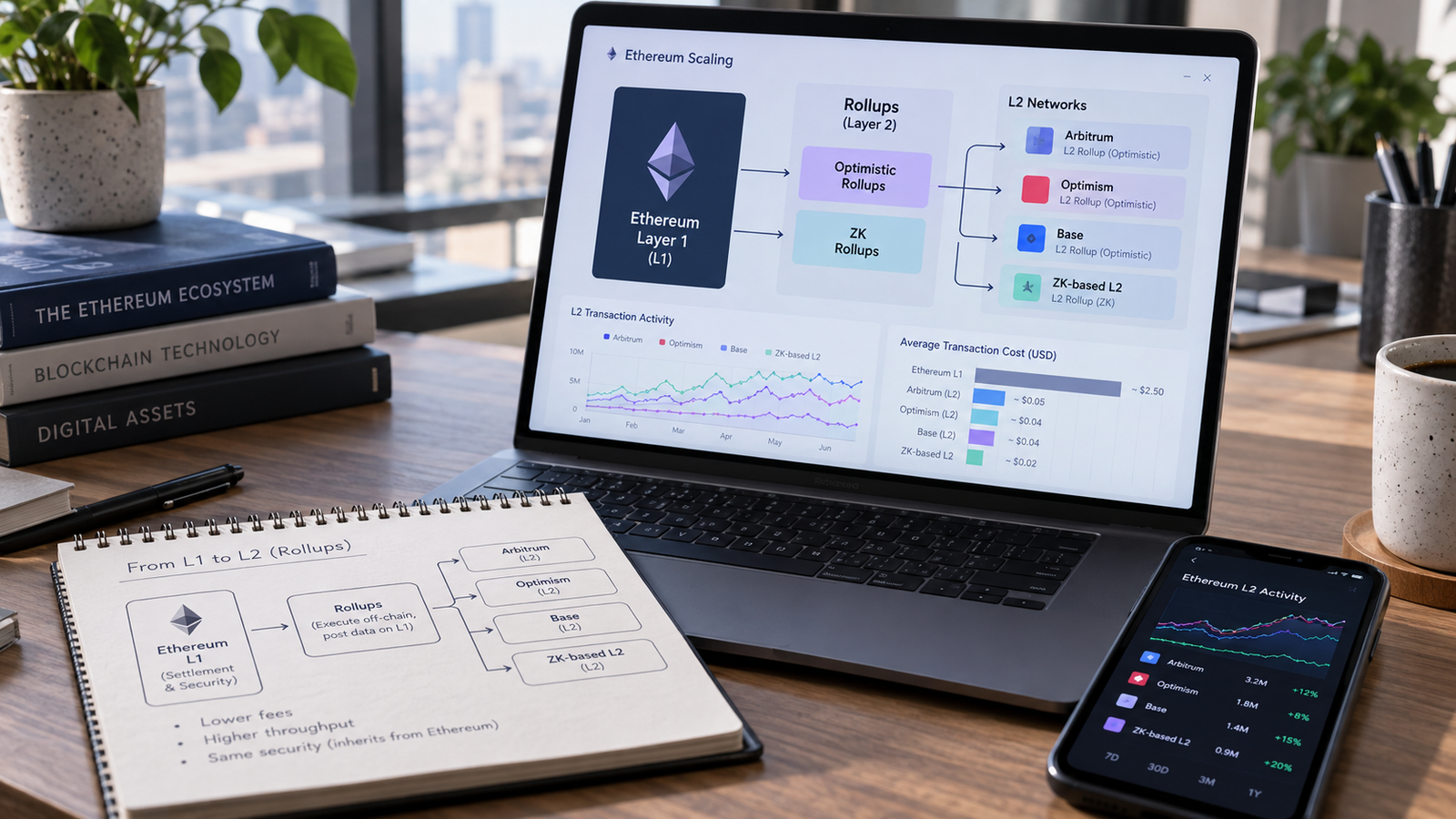
Ethereum powers decentralized finance, stablecoin payments, NFT marketplaces, and thousands of blockchain applications. But processing every transaction directly on Ethereum comes with a trade-off: limited block space and potentially expensive gas fees.
Ethereum Layer 2 networks address this problem by executing transactions outside the main blockchain while using Ethereum for settlement and security.
Networks such as Arbitrum, Base, and Optimism make everyday blockchain interactions faster and typically cheaper. Behind them is a technology called a rollup, which groups transactions together and submits their data and results to Ethereum.
Understanding how these systems work is increasingly important as Ethereum evolves toward a rollup-centric scaling model.
What Is Ethereum Layer 2?
Ethereum Layer 2 (L2) refers to scaling systems that process transactions outside Ethereum Mainnet, also known as Layer 1 (L1), while relying on Ethereum for important security guarantees.
Ethereum L1 provides the underlying consensus, settlement infrastructure, and data availability needed by rollups.
Layer 2 handles much of the transaction execution.
Instead of requiring Ethereum validators to execute every individual L2 transaction, rollups execute them separately and submit compressed transaction data and state commitments to Ethereum.
This design increases transaction capacity without requiring every Ethereum node to perform all the L2 computation.
Ethereum’s official documentation describes this approach as a central part of its scaling strategy.
Layer 1 vs Layer 2 Ethereum: Understanding the Architecture
The main difference between Ethereum L1 and L2 is where transaction execution happens and how the results are verified.
| Feature | Ethereum Layer 1 | Ethereum Layer 2 Rollups |
|---|---|---|
| Execution | Ethereum Mainnet | Separate L2 environment |
| Consensus | Ethereum validators | L2 ordering, with L1 settlement |
| Transaction costs | Often higher | Generally lower |
| Transaction processing | Limited by L1 capacity | Higher throughput |
| Security | Ethereum consensus | Ethereum plus rollup-specific mechanisms |
| Data availability | Ethereum | Ethereum for standard rollups |
| Examples | Ethereum Mainnet | Arbitrum, Base, OP Mainnet |
Ethereum L2 networks are not simply independent blockchains connected by a bridge.
A genuine rollup uses Ethereum contracts and proof mechanisms to enforce rules about its state. This provides a stronger connection to Ethereum’s security model than a conventional sidechain operating under its own independent validator set.
However, not all networks marketed as L2 offer identical security guarantees.
How Does Layer 2 Work? The Rollup Transaction Lifecycle
Ethereum Layer 2 networks process transactions outside the Ethereum mainnet while using Layer 1 for settlement, data availability, and verification.
Although implementation details vary between networks, most Ethereum rollups follow a similar transaction lifecycle.
Five Steps of an Ethereum Layer 2 Transaction
| Step | Process | What Happens |
|---|---|---|
| 1 | Transaction submission | A user signs and sends a transaction to an L2 network through a compatible wallet. |
| 2 | Sequencing and execution | The L2 sequencer orders transactions and executes them, updating the rollup’s state. |
| 3 | Transaction batching | Multiple transactions are grouped and compressed to reduce the cost of publishing data to Ethereum. |
| 4 | Ethereum data publication | The rollup publishes required transaction data and state commitments to Ethereum L1. |
| 5 | Verification and settlement | Fault-proof or validity-proof mechanisms allow Ethereum to enforce correct state transitions. |
Ethereum Rollups Explained: Optimistic vs ZK Rollups
The two major rollup categories differ primarily in how they establish transaction validity.
Optimistic Rollups
Optimistic rollups assume submitted state transitions are valid unless challenged.
After transactions are processed, the rollup posts commitments and transaction data to Ethereum.
A dispute mechanism allows incorrect state transitions to be challenged using fault proofs.
This is the model used by prominent Ethereum scaling solutions such as Arbitrum One, Base, and OP Mainnet.
A major advantage is compatibility with existing Ethereum development tools and smart contracts.
The principal limitation is withdrawal finality. Canonical withdrawals to Ethereum commonly require a challenge period of approximately seven days, although specific implementations and alternative bridge services differ.
Zero-Knowledge Rollups
Zero-knowledge rollups use cryptographic validity proofs to demonstrate that submitted state transitions follow the rollup’s rules.
Instead of relying on a dispute window to catch incorrect computation, Ethereum verifies a proof associated with the state transition.
This allows faster finality after the necessary proof submission and L1 verification, without the optimistic-rollup challenge delay.
Examples of ZK-based Ethereum scaling systems include zkSync Era and Scroll.
Despite their name, ZK rollups do not automatically make transactions private. The proofs establish computational correctness; transaction privacy requires additional design features.
Optimistic Rollups vs ZK Rollups
| Comparison | Optimistic Rollups | ZK Rollups |
|---|---|---|
| Verification | Fault proofs and challenges | Cryptographic validity proofs |
| Initial assumption | State accepted unless challenged | State must be proven valid |
| Canonical L1 withdrawal | Often around 7 days | No fraud-challenge waiting period |
| Computational requirements | Lower proving overhead | Proof generation can be intensive |
| EVM compatibility | Generally mature | Varies by implementation |
| Main challenge | Dispute systems and withdrawal delays | Proving costs and technical complexity |
Neither design is universally superior. Its practical security depends on proof-system implementation, contract permissions, upgrades, data availability, and operational decentralization.
How Much Does Ethereum Layer 2 Improve Scalability?
Layer 2 adoption can be measured using transaction activity, transaction costs, and the economic value secured by rollup systems.
L2BEAT publishes ecosystem-wide metrics, including user operations per second (UOPS), which measure user activity rather than simply counting blockchain transactions.
Ethereum vs L2 Rollups: Transaction Activity
One way to understand Ethereum Layer 2 scalability is to compare how much transaction-related activity occurs on Ethereum Mainnet versus rollup networks.
L2BEAT tracks user operations per second (UOPS), a metric designed to measure blockchain activity, including operations that may be bundled within a single transaction.
Ethereum L1 vs L2 Activity Comparison
| Metric | Ethereum L1 | L2 Rollups Combined |
|---|---|---|
| User operations per second (UOPS) | 21.85 | Approximately 2,080 |
| Execution environment | Ethereum Mainnet | Multiple L2 networks |
| Transaction processing | Directly on L1 | Primarily off-chain execution |
| Settlement | Ethereum | Ethereum-based settlement mechanisms |
| Typical transaction fees | Higher | Lower |
Source: L2BEAT Activity, October 21, 2026. Figures represent a reported activity snapshot rather than theoretical maximum throughput.
The figures indicate that Ethereum rollups collectively process substantially more user operations than Ethereum Mainnet alone.
Based on these illustrative snapshot values, combined L2 activity was approximately 95 times Ethereum L1 activity.
However, this does not mean an individual L2 network is 95 times faster than Ethereum. The comparison includes activity aggregated across multiple rollups.
UOPS is also different from traditional transactions per second (TPS), as a single blockchain transaction may contain multiple user operations.
What These Numbers Tell Us
Ethereum’s scaling strategy is designed to distribute transaction execution across multiple networks rather than increase the workload performed directly by every Ethereum validator.
As rollup adoption grows, more user activity can occur on L2 while Ethereum continues to provide the underlying settlement and security infrastructure.
The result is greater combined ecosystem capacity without requiring every transaction to execute on Ethereum Mainnet.
Why Are Layer 2 Transaction Fees Lower?
Rollups reduce costs by executing transactions outside Ethereum and sharing the cost of L1 data publication across many users.
However, Ethereum still charges for data availability and settlement.
A simplified L2 fee consists of:
\[ \text{L2 fee}\approx\text{Execution cost}+\text{L1 data cost}+\text{Overhead} \]
One of Ethereum’s most important improvements was EIP-4844, introduced through the Dencun upgrade in March 2024.
It created a separate data-storage mechanism called blobs, allowing rollups to publish compressed information more cheaply than traditional calldata in many conditions.
Unlike permanent transaction history, blob data has a limited protocol availability window, initially approximately 18 days. This reduces long-term storage requirements.
Actual fees depend on network demand, transaction complexity, sequencing policies, and Ethereum blob pricing.
Consequently, L2 transactions are usually cheaper than equivalent L1 operations, but not guaranteed to cost a particular amount.
Arbitrum, Base and Optimism: How They Differ
Arbitrum, Base, and Optimism are among the most recognizable Ethereum Layer 2 networks.
All three use optimistic rollup technology, but they differ in their technical stacks, governance structures, ecosystems, and approaches to scaling.
Understanding these differences helps explain how Ethereum L2 infrastructure can support different applications while relying on similar underlying principles.
Comparison of Major Ethereum Layer 2 Networks
| Feature | Arbitrum One | Base | OP Mainnet (Optimism) |
|---|---|---|---|
| Rollup type | Optimistic | Optimistic | Optimistic |
| Technology stack | Arbitrum Nitro | OP Stack | OP Stack |
| Main ecosystem focus | DeFi and smart contracts | Consumer applications and payments | DeFi and Superchain infrastructure |
| EVM compatibility | High | High | High |
| Mainnet settlement | Ethereum | Ethereum | Ethereum |
| Native transaction fee asset | ETH | ETH | ETH |
| Notable characteristic | BoLD dispute protocol | OP Stack-based ecosystem | Core network of the Superchain ecosystem |
Arbitrum One
Arbitrum One is an Ethereum Layer 2 network built on Arbitrum Nitro technology.
It supports Ethereum-compatible smart contracts and is widely used for decentralized exchanges, lending protocols, and other DeFi applications.
One of its important technical features is BoLD (Bounded Liquidity Delay), a dispute protocol designed to improve the process of challenging incorrect rollup assertions.
Arbitrum’s architecture focuses on scaling execution while preserving Ethereum-based settlement and dispute resolution.
Base
Base is an Ethereum Layer 2 network developed by Coinbase using the open-source OP Stack.
Its ecosystem focuses on making on-chain applications more accessible, including payments, consumer services, decentralized finance, and applications requiring frequent low-cost transactions.
Base shares important technical foundations with other OP Stack networks.
However, its operational infrastructure, governance arrangements, and decentralization progress must still be assessed individually.
OP Mainnet (Optimism)
OP Mainnet is an Ethereum optimistic rollup built using the OP Stack.
It plays a central role in the Superchain ecosystem, an initiative intended to support interoperable networks using shared infrastructure and standards.
Optimism emphasizes modular scaling infrastructure, allowing developers to build additional chains using components from the OP Stack.
Which Ethereum Layer 2 Is Better?
There is no universally best Ethereum Layer 2 network.
Arbitrum, Base, and OP Mainnet each provide lower-cost Ethereum-compatible execution, but their practical differences depend on application availability, liquidity, transaction costs, and security configurations.
From a technical perspective, the most important factors are the maturity of the proof system, upgrade controls, sequencer decentralization, data availability, and the ability of users to withdraw funds under adverse conditions.
How Secure Are Ethereum Layer 2 Networks?
Ethereum settlement provides important security benefits, but an L2 is not automatically as decentralized or censorship-resistant as Ethereum itself.
Several risks deserve attention.
Sequencer centralization: Many L2 networks still rely on centralized sequencing infrastructure. A sequencer can potentially delay transactions or influence ordering.
Smart contract vulnerabilities: Bugs in rollup contracts, proofs, or bridges can endanger funds.
Upgrade and governance risks: Administrators or security councils may retain powers to modify critical infrastructure.
Data availability: Users and independent validators need access to sufficient transaction data to reconstruct state and verify activity.
Cross-chain bridges: Moving funds between networks introduces additional contract and messaging risks.
Independent research platform L2BEAT evaluates rollups using maturity stages and detailed risk assessments.
Its Stage 0, Stage 1, and Stage 2 framework examines decentralization and the ability of users to exit under adverse conditions. These stages indicate maturity criteria, not an absolute measure of safety.
Practical Uses of Ethereum Layer 2
Layer 2 infrastructure supports applications where Ethereum Mainnet fees would make frequent interactions impractical.
Common use cases include:
- DeFi trading, lending, and liquidity management.
- Stablecoin transfers and low-value payments.
- Blockchain gaming and NFT applications.
- Social platforms with frequent on-chain interactions.
- Smart contract deployment and testing.
- Business applications requiring repeated transactions.
Using an L2 generally requires a compatible wallet, funds on the intended network, and ETH or another supported fee asset.
Moving assets between Ethereum and an L2 may involve a canonical bridge or a third-party liquidity bridge.
Before transferring funds, verify the destination network, token contract, bridge security, and withdrawal conditions.
Limitations of Ethereum Scaling Solutions
Ethereum L2s improve scalability but introduce additional technical complexity.
Liquidity and applications may be fragmented across different rollups. Users can face bridge fees, switching costs, and delays when moving assets between networks.
A centralized sequencer can also create service interruptions or censorship concerns.
For developers, multiple L2 environments introduce infrastructure challenges involving interoperability, state synchronization, and cross-chain messaging.
For users, low transaction fees should never be interpreted as proof that a network has minimal risk.
Ethereum’s long-term roadmap aims to improve data availability, rollup interoperability, and decentralization while preserving the security properties of the base layer.
Frequently Asked Questions
What is the difference between Ethereum Layer 1 and Layer 2?
Layer 1 is Ethereum’s base blockchain, responsible for consensus and settlement. Layer 2 processes transactions separately while using Ethereum contracts and security mechanisms to anchor and verify results.
Are Ethereum Layer 2 networks safe?
Security varies by network. Rollups can inherit important Ethereum security guarantees, but centralized sequencers, governance controls, smart contract bugs, and bridge design introduce additional risks.
Is Base an Ethereum Layer 2?
Yes. Base is an Ethereum optimistic rollup built using the OP Stack.
Are optimistic rollups or ZK rollups faster?
Both can provide fast user-facing transaction execution. ZK rollups can achieve L1-verified finality without waiting through an optimistic fraud-challenge period, but proof generation and settlement introduce their own latency.
Do Ethereum L2 networks use ETH?
Many Ethereum L2 networks use ETH for transaction fees, although fee-token support varies by network and application.
Can Layer 2 replace Ethereum Mainnet?
Rollups are designed to complement Ethereum rather than replace its role in settlement, security, and data availability.
Final Thoughts
Ethereum Layer 2 is a central component of the network’s approach to blockchain scalability.
By moving transaction execution away from Mainnet and using Ethereum for settlement and verification, rollups increase transaction capacity while reducing costs for users.
Optimistic rollups rely on challenge mechanisms, while ZK rollups use cryptographic validity proofs. Both approaches involve trade-offs involving complexity, finality, and operational security.
Networks such as Arbitrum, Base, and Optimism demonstrate how this technology can support real-world applications, but their long-term value depends on more than speed or low fees.
The key to understanding Ethereum scaling is recognizing the division of responsibilities: Layer 2 handles execution at scale, while Ethereum Layer 1 provides the settlement and security foundation.