

Ethereum staking is one of the most popular ways to earn passive crypto income while helping secure the network. But if you are new to staking, the choices can feel confusing. Should you run your own validator? Join a staking pool? Or use an exchange?
The short answer is this: the best way to stake Ethereum depends on how much ETH you own, how comfortable you are with self-custody, and how much risk you are willing to take.
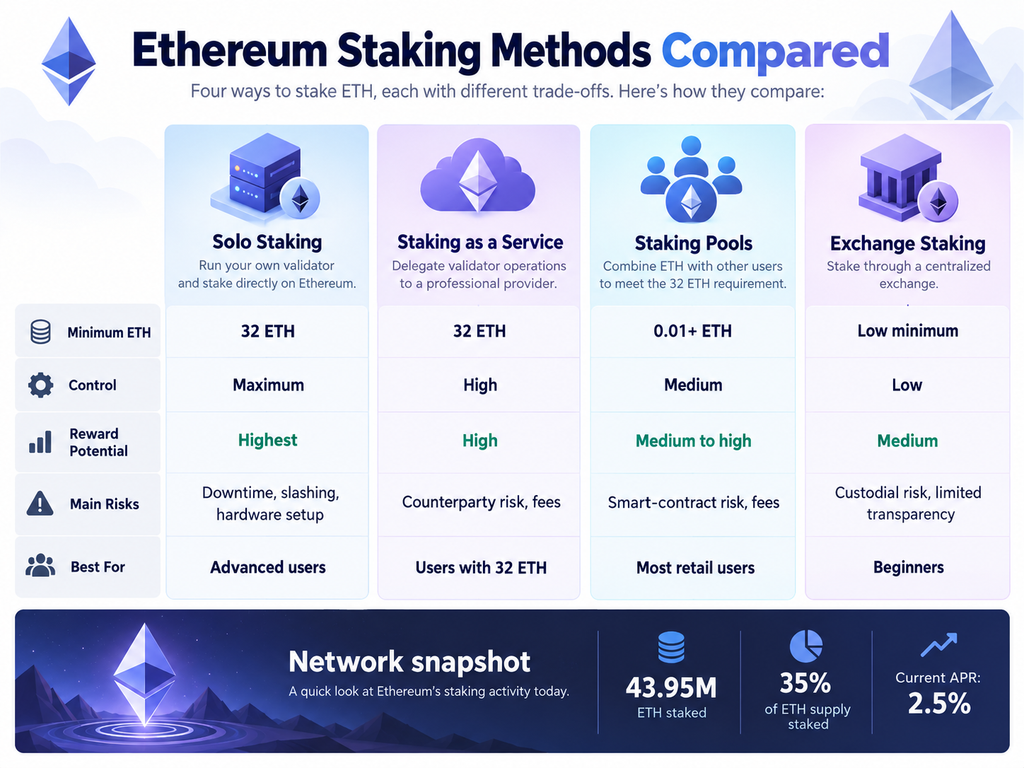
According to Ethereum’s official staking dashboard, approximately 43.95 million ETH is staked, representing about 35% of the total ETH supply, with a reported annual percentage rate (APR) of around 2.5%. These figures change over time, and individual returns depend on validator performance, provider fees, and network conditions.
What Is Ethereum Staking?
Ethereum uses a proof-of-stake consensus mechanism. Instead of miners, the network relies on validators that deposit ETH and help confirm transactions, propose blocks, and maintain network security.
In return, validators earn ETH rewards for participating honestly in the network.
If you want to stake directly on Ethereum, you need at least 32 ETH to activate your own validator. However, Ethereum also supports participation through staking pools, where users can stake much smaller amounts.
According to Ethereum.org, some pooled staking services accept deposits starting from 0.01 ETH.
How Much Ethereum Do You Need to Stake?
One of the most common questions beginners ask is how much Ethereum to stake.
The answer depends on your preferred staking method, available capital, and willingness to manage technical infrastructure.
| Staking Method | Minimum ETH | Best For |
|---|---|---|
| Solo staking | 32 ETH | Advanced users seeking maximum control |
| Staking as a service | 32 ETH | Investors who prefer managed validators |
| Ethereum staking pools | As low as 0.01 ETH with some providers | Users with smaller ETH holdings |
| Exchange staking | Varies by exchange | Beginners prioritizing convenience |
If you want to stake ETH without 32 ETH, pooled staking and exchange staking are the most accessible options.
Although these services reduce the minimum investment, they introduce additional risks associated with smart contracts, third-party operators, or centralized custody.
Main Ways to Stake Ethereum
1. Solo Staking Ethereum
Solo staking involves operating your own Ethereum validator.
You provide the necessary ETH deposit, maintain the required hardware, and participate directly in Ethereum’s consensus mechanism.
This method offers the greatest independence because you retain control over your validator infrastructure and withdrawal credentials.
Advantages:
- Receive protocol rewards without paying a staking provider.
- Maintain direct control over validator operations.
- Contribute to Ethereum’s decentralization.
- Avoid custodial and staking-pool smart-contract risks.
Disadvantages:
- Requires at least 32 ETH.
- Demands technical knowledge and ongoing maintenance.
- Requires reliable hardware and internet connectivity.
- Exposes validators to inactivity penalties and potential slashing.
Solo staking is generally suitable for experienced Ethereum holders who are comfortable managing blockchain infrastructure.
2. Staking as a Service
Staking as a service allows investors to operate a dedicated validator without maintaining the technical infrastructure themselves.
Users typically deposit 32 ETH, while a specialized provider manages validator operations.
Depending on the service, users may retain control of their withdrawal credentials while delegating validator signing operations.
Advantages:
- No need to maintain your own hardware.
- Access to dedicated validator rewards.
- Less technical responsibility than solo staking.
- Potentially greater transparency than custodial exchange staking.
Disadvantages:
- Requires 32 ETH.
- Operator fees reduce earnings.
- Validator performance depends on the service provider.
- Additional counterparty and operational risks.
This option can appeal to investors who hold enough ETH for a validator but prefer professional infrastructure management.
3. Ethereum Staking Pools
Ethereum staking pools combine deposits from multiple participants to fund validator operations.
They are particularly useful for investors who want to participate in staking without committing 32 ETH.
Some decentralized staking protocols issue liquid staking tokens representing a user’s staked position.
These tokens can sometimes be transferred, traded, or used within decentralized finance applications.
Advantages:
- Accessible with relatively small amounts of ETH.
- No requirement to operate validator hardware.
- Convenient for long-term ETH holders.
- Some solutions provide additional liquidity through staking tokens.
Disadvantages:
- Smart-contract vulnerabilities may expose deposited assets.
- Pool operators charge fees.
- Liquid staking tokens may trade below their underlying ETH value.
- Additional dependencies can complicate withdrawals.
Ethereum staking pools are often a practical option for retail investors, provided they understand the protocol’s risks and fee structure.
4. Exchange Staking
Exchange staking allows users to earn staking rewards through centralized cryptocurrency platforms.
The process is usually straightforward: deposit ETH, activate the staking product, and monitor accumulated rewards.
The exchange handles validator operations and distributes rewards according to its terms.
Advantages:
- Simple setup.
- Low technical requirements.
- Often supports relatively small deposits.
- Rewards can usually be monitored through an account dashboard.
Disadvantages:
- The exchange may control custody of your ETH.
- Fees can significantly reduce net rewards.
- Withdrawals may depend on platform policies.
- Exchange insolvency, hacking, or account restrictions can create additional risks.
Exchange staking is convenient, but investors should carefully evaluate the provider’s reputation, custody arrangements, and withdrawal conditions.
Ethereum Staking Rewards: How Much Can You Earn?
Ethereum staking rewards depend on several factors, including the total amount of ETH staked across the network, validator performance, transaction priority fees, and potential MEV-related rewards.
The official Ethereum staking page reports an APR of approximately 2.5% as a reference benchmark.
This rate is variable and should not be interpreted as a guaranteed return.
Estimated Annual Ethereum Staking Rewards
The following calculations assume a constant 2.5% annual return without compounding, operating expenses, or provider fees.
| ETH Staked | Estimated Annual Reward | Estimated Total After One Year |
|---|---|---|
| 0.5 ETH | 0.0125 ETH | 0.5125 ETH |
| 1 ETH | 0.025 ETH | 1.025 ETH |
| 5 ETH | 0.125 ETH | 5.125 ETH |
| 10 ETH | 0.25 ETH | 10.25 ETH |
| 32 ETH | 0.80 ETH | 32.80 ETH |
These examples illustrate potential ETH-denominated rewards rather than guaranteed investment profits.
For instance, an investor staking 10 ETH at a hypothetical 2.5% annual rate would earn approximately 0.25 ETH before fees.
However, the value of those rewards in US dollars depends on Ethereum’s market price.
How Staking Fees Affect Returns
Different staking methods introduce different expenses.
| Method | Main Costs | Impact on Returns |
|---|---|---|
| Solo staking | Hardware, electricity, maintenance | Operating costs reduce net profit |
| Staking as a service | Validator management fees | Provider deducts a portion of rewards |
| Staking pools | Protocol and operator fees | Net APR depends on fee structure |
| Exchange staking | Platform commissions or reward spreads | Published yields may be lower than protocol rewards |
Investors should compare net returns rather than advertised APR alone.
Ethereum Staking Risks Explained
Although Ethereum staking can generate additional ETH, it is not a risk-free investment.
Understanding Ethereum staking risks is essential before choosing a provider or operating a validator.
Slashing Risk
Slashing is a penalty applied when validators violate Ethereum’s consensus rules.
For example, signing conflicting messages can result in part of a validator’s stake being destroyed.
Proper validator configuration and secure key management help reduce this risk.
Validator Downtime
Validators that remain offline can miss rewards and receive inactivity penalties.
Solo stakers should maintain reliable internet connectivity, monitor validator performance, and keep their software updated.
Ordinary downtime does not automatically cause slashing, but it can reduce overall profitability.
Smart-Contract Risk
Decentralized staking pools often rely on smart contracts to manage deposits and issue staking tokens.
Software vulnerabilities, incorrect configurations, or protocol exploits can threaten deposited assets.
Investors should review security audits, protocol documentation, and operational history before participating.
Custodial Risk
Centralized staking services may require users to surrender control of their ETH.
If an exchange experiences financial difficulties, suspends withdrawals, or suffers a security breach, users may struggle to recover their funds.
Market Volatility
Staking rewards are generally denominated in ETH, not fiat currency.
Even if your ETH balance increases, a significant decline in Ethereum’s market price may outweigh the value of staking rewards.
For example, earning 2.5% more ETH does not protect an investor against a 20% decline in ETH’s dollar price.
Ethereum Staking Withdrawal: How Does Unstaking Work?
Ethereum staking withdrawals allow participants to retrieve accumulated rewards or exit their staking positions.
Following Ethereum’s Shanghai/Capella upgrade in April 2023, validators gained the ability to withdraw staked ETH.
Subsequent protocol developments, including Pectra, expanded withdrawal functionality.
However, withdrawal procedures depend on the staking method.
Solo Staking Withdrawals
Solo validators can request an exit and withdraw their remaining balance after completing the necessary protocol procedures.
Processing times depend on Ethereum’s validator exit queue and withdrawal mechanisms.
Staking Pool Withdrawals
Pooled staking withdrawals follow the rules of the selected protocol.
Some providers offer direct withdrawal requests, while liquid staking tokens may also be tradable on secondary markets.
Selling a liquid staking token may provide faster liquidity, but its market price can differ from its underlying ETH value.
Exchange Staking Withdrawals
Centralized exchanges establish their own unstaking procedures and processing schedules.
Some platforms may require additional waiting periods or impose restrictions beyond Ethereum’s underlying protocol requirements.
Before depositing ETH, investors should review withdrawal conditions and possible fees.
Which Ethereum Staking Method Should You Choose?
Choosing the right approach involves balancing capital requirements, technical experience, control, and liquidity needs.
| Investor Profile | Suitable Staking Method |
|---|---|
| Experienced investor with 32 ETH | Solo staking |
| ETH holder seeking managed validator operations | Staking as a service |
| Investor with less than 32 ETH | Staking pools |
| Beginner seeking a simple interface | Exchange staking |
| Investor prioritizing self-custody | Solo staking or carefully evaluated non-custodial pooled staking |
There is no universally superior staking method.
Solo staking provides the most direct participation in Ethereum’s consensus system, while pooled staking makes rewards accessible to smaller investors.
Exchange staking offers convenience but introduces greater dependence on centralized intermediaries.
Final Thoughts
Learning how to stake Ethereum involves more than selecting a platform with an attractive annual yield.
Investors should evaluate minimum deposits, potential rewards, provider fees, custody arrangements, validator performance, and withdrawal flexibility.
Solo staking offers maximum independence but requires substantial capital and technical responsibility.
Ethereum staking pools provide an accessible alternative for smaller ETH holders, while managed validators and centralized exchanges simplify participation at the cost of additional dependencies.
Ultimately, the most suitable staking strategy depends on your investment goals, technical capabilities, and tolerance for risk.
Ethereum staking can help long-term holders accumulate additional ETH while supporting network security, but rewards are variable and capital remains exposed to cryptocurrency market volatility.