Not all Ethereum tokens work the same way. A stablecoin such as USDC, a unique NFT artwork, and a collection of blockchain gaming items may exist on the same network, but they follow different technical rules.
Those rules are defined by Ethereum token standards.
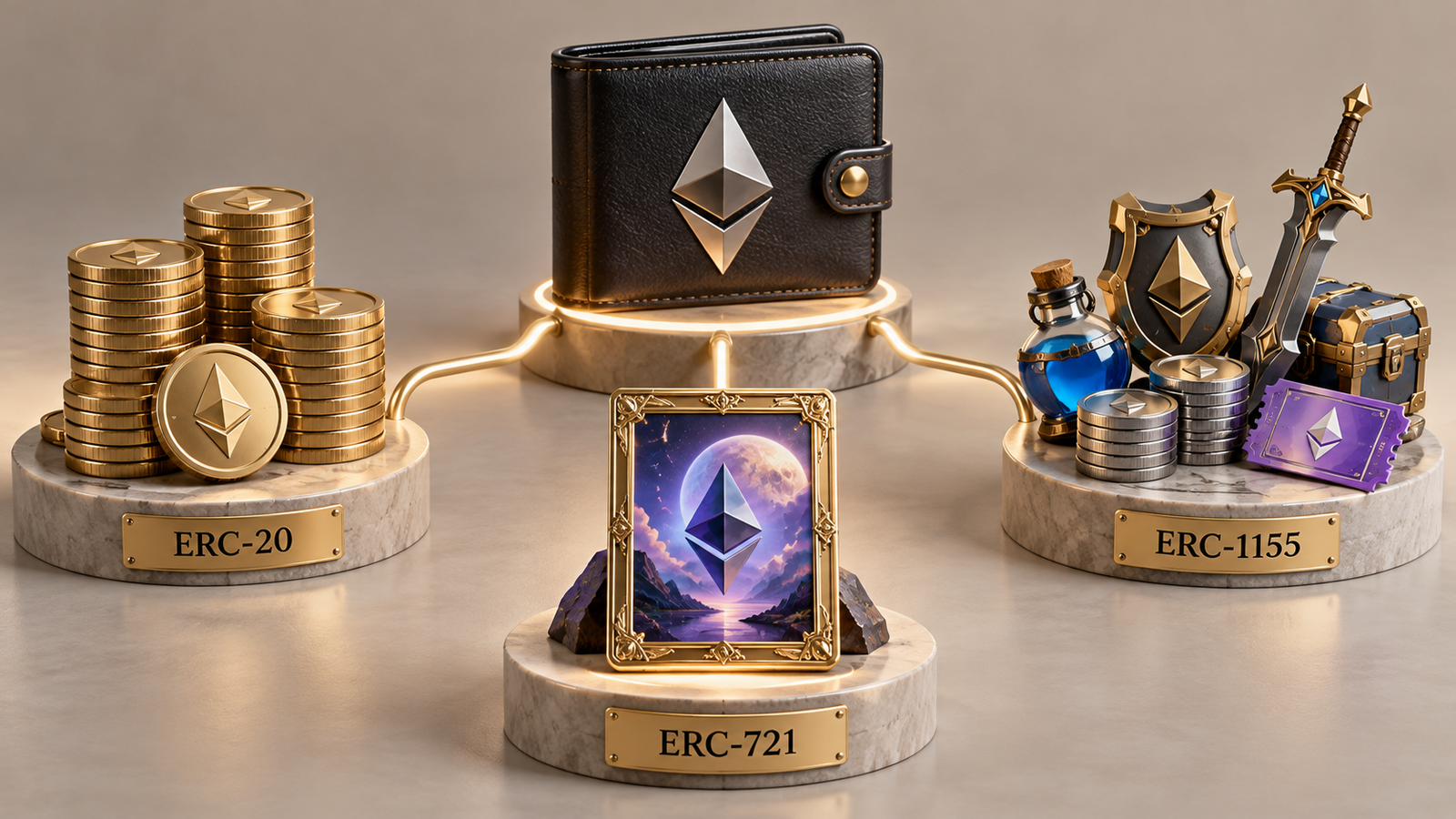
ERC-20, ERC-721, and ERC-1155 are three important standards used to create and manage digital assets on Ethereum. Each determines how tokens are represented, transferred, tracked, and integrated with wallets or decentralized applications.
The fundamental difference comes down to whether assets are interchangeable, individually unique, or managed as multiple token types within one contract.
Understanding these ethereum token standards helps investors recognize what they actually own and allows developers to select the appropriate architecture for their applications.
What Are Ethereum Token Standards?
Ethereum token standards are technical specifications that define how smart contracts should interact with wallets, exchanges, marketplaces, and other blockchain applications.
ERC stands for Ethereum Request for Comments. An ERC defines an interface or set of rules that developers can implement when building Ethereum-based systems.
Standardization allows applications to work with tokens without needing custom integration logic for every new asset.
For example, a decentralized exchange can support many ERC-20 tokens because they expose common functions for transferring assets and checking balances.
Similarly, NFT marketplaces can interact with ERC-721 collections through standardized ownership and transfer methods.
Three widely used standards serve different purposes:
- ERC-20 represents interchangeable, or fungible, tokens.
- ERC-721 represents individually identifiable non-fungible tokens.
- ERC-1155 supports multiple token types, including fungible and non-fungible assets, within a single smart contract.
These standards are implemented through smart contracts. They do not create separate Ethereum blockchains.
ERC-20 vs ERC-721 vs ERC-1155: Comparison Table
The following comparison highlights the differences in token structure, ownership, efficiency, and common applications.
| Feature | ERC-20 | ERC-721 | ERC-1155 |
|---|---|---|---|
| Token type | Fungible | Non-fungible | Fungible and non-fungible |
| Interchangeability | Fully interchangeable units | Unique token IDs | Depends on token ID and design |
| Balance representation | Amount per address | Ownership of individual token IDs | Amount per address and token ID |
| Multiple asset types per contract | Typically one fungible asset | One NFT collection with many unique tokens | Multiple distinct token types |
| Batch transfers | Not part of the base standard | Not part of the base standard | Native batch transfers |
| Common applications | Stablecoins, DeFi, governance | NFTs, collectibles, certificates | Gaming, digital items, mixed asset collections |
| Standard approval model | Amount-based allowance | Individual token or collection operator | Operator approval |
| Main advantage | Broad compatibility | Individual asset ownership | Flexible multi-token management |
The choice between erc20 erc721 erc1155 depends on the asset model rather than which standard is newest.
ERC-20: The Standard for Fungible Tokens
ERC-20 is used for fungible assets, meaning each unit is interchangeable with another unit of the same token.
One USDC is equivalent to another USDC of the same token contract. The individual units don’t need separate identities.
This makes ERC-20 suitable for cryptocurrencies, stablecoins, governance tokens, reward systems, and tokenized financial assets.
How ERC-20 Works
An ERC-20 smart contract maintains token balances associated with Ethereum addresses.
It also implements standardized functions, including:
| Function | Purpose |
|---|---|
balanceOf() | Returns the token balance of an address |
transfer() | Transfers tokens to another address |
approve() | Authorizes a spender to use tokens |
transferFrom() | Transfers tokens using an existing allowance |
allowance() | Shows the remaining authorized amount |
totalSupply() | Returns the total token supply |
For example, when someone sends 100 ERC-20 tokens to another wallet, the smart contract updates the relevant balances.
There is no need to identify which particular token units moved.
Real-World ERC-20 Use Cases
ERC-20 tokens are fundamental to decentralized finance.
Applications include stablecoin payments, decentralized trading, liquidity pools, lending protocols, DAO governance, and tokenized financial products.
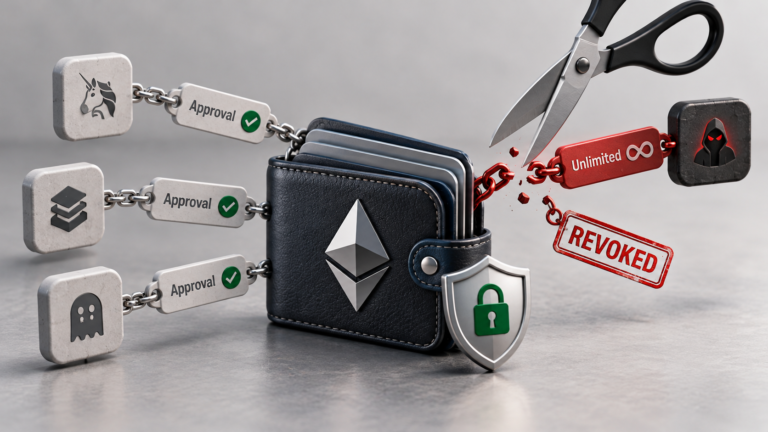
However, ERC-20 tokens also introduce approval-related risks. Granting unlimited allowances to malicious or compromised smart contracts can expose a wallet’s current and future token balances.
ERC-721: The Standard for Non-Fungible Tokens
ERC-721 is designed for non-fungible assets.
Unlike ERC-20 tokens, each ERC-721 token has a distinct identifier within its smart contract.
For example, NFT #125 and NFT #126 may belong to the same collection but represent different digital assets.
They cannot simply be substituted for one another as identical units.
How ERC-721 Works
Each NFT is identified by a token ID and an associated owner.
The combination of the smart contract address and token ID uniquely identifies the NFT on its blockchain.
Common ERC-721 functions include:
| Function | Purpose |
|---|---|
ownerOf() | Identifies the owner of an NFT |
balanceOf() | Returns the number of NFTs held by an address |
safeTransferFrom() | Transfers an NFT with receiver compatibility checks |
approve() | Authorizes another address to manage one NFT |
setApprovalForAll() | Authorizes an operator to manage all NFTs in a collection |
ERC-721 is commonly associated with digital collectibles, but its potential applications extend beyond artwork.
Examples include game characters, event tickets, digital certificates, membership credentials, and representations of unique assets.
Importantly, owning an NFT does not automatically grant copyright or legal ownership of the underlying physical or digital item. Those rights depend on the asset’s terms and legal structure.
What Is ERC-1155?
ERC-1155 is a multi-token standard designed to manage different asset types within one smart contract.
It can support fungible tokens, non-fungible tokens, and semi-fungible items.
This makes ERC-1155 particularly useful for gaming ecosystems and applications containing many categories of digital assets.
Imagine a blockchain game with 10,000 identical healing potions, 500 identical swords, and one unique legendary weapon.
Instead of deploying a separate ERC-20 or ERC-721 contract for each asset category, developers can represent those assets using different token IDs within one ERC-1155 contract.
How ERC-1155 Works
ERC-1155 tracks balances using both an owner address and a token ID.
For example:
| Token ID | Asset | Supply in Example |
|---|---|---|
| 101 | Healing Potion | 10,000 |
| 102 | Iron Sword | 500 |
| 103 | Legendary Crown | 1 |
| 104 | Arena Ticket | 2,000 |
The legendary crown could function as a unique NFT, while potions and tickets could represent interchangeable units within their respective token IDs.
ERC-1155 also supports batch operations through functions such as safeBatchTransferFrom().
This allows multiple token types to be transferred in one transaction rather than requiring a separate transaction for every asset type.
The result can be more efficient smart contract interactions, especially in applications managing large inventories.
ERC-721 vs ERC-1155: Which Is Better for NFTs?
Both ERC-721 and ERC-1155 can represent NFTs, but their architectures differ.
ERC-721 is centered on individually unique tokens. Each token ID identifies one NFT.
ERC-1155 is centered on token types and balances. A particular ID can represent a supply of one unique item or multiple interchangeable copies.
NFT Architecture Comparison
| Scenario | ERC-721 | ERC-1155 |
|---|---|---|
| Collection of 1,000 unique artworks | Suitable | Suitable with appropriate design |
| 10,000 identical game items | Inefficient for interchangeable units | Well suited |
| One unique digital certificate | Suitable | Possible |
| Mixed gaming inventory | Requires multiple asset arrangements | Designed for this scenario |
| Transfer multiple token types together | Additional logic required | Built-in batch functionality |
| One unique owner per token ID | Standard ownership model | Requires supply and design constraints |
For traditional one-of-one NFT collections, ERC-721 offers a straightforward ownership model.
ERC-1155 becomes particularly attractive when applications combine unique assets with interchangeable items or need batch operations.
Neither standard automatically guarantees that NFT metadata is permanent or that the underlying media cannot change.
ERC-20 vs ERC-1155: Key Differences
The difference between ERC-20 and ERC-1155 becomes especially clear when an application manages multiple kinds of fungible assets.
ERC-20 typically represents one fungible token within a contract.
ERC-1155 can represent numerous fungible asset types using different token IDs.
For example, a gaming platform could create five distinct in-game currencies or resources.
Using a conventional ERC-20 approach, each currency would generally require its own token contract.
With ERC-1155, all five could be managed by one multi-token contract.
However, ERC-20 generally has broader native support across exchanges, DeFi protocols, and token-specific infrastructure.
ERC-1155 fungible assets are not automatically compatible with interfaces expecting ERC-20 tokens.
This distinction matters when deciding whether the assets must integrate with existing liquidity markets.
Batch Transfers: A Practical Efficiency Example
One of ERC-1155’s important advantages is reducing the number of transactions required for multi-asset transfers.
Consider a game where one user sends 10 different item types to another player.
| Metric | ERC-721 Approach | ERC-1155 Approach |
|---|---|---|
| Distinct item types transferred | 10 | 10 |
| Standard individual transfer operations | 10 | Not required |
| Transactions using basic transfer interfaces | 10 | 1 batch transaction |
| Native multi-token batching | No | Yes |
| Potential gas savings from batching | Not inherent | Yes |
This example assumes the ERC-721 assets are transferred separately through their standard interfaces and the ERC-1155 assets are managed by a compatible single contract.
ERC-721 assets can also be batched using additional smart contract infrastructure, so the table is not a universal gas-cost comparison.
The ERC-1155 approach reduces the number of independently submitted transactions from 10 to 1 in this simplified scenario.
That represents a 90% reduction in transaction count, not necessarily a 90% reduction in gas fees.
Actual gas consumption depends on contract implementation, storage operations, calldata, and network conditions.
Fungible vs Non-Fungible Tokens: Why It Matters
Understanding fungible vs non fungible tokens is essential for interpreting blockchain asset ownership.
Fungible assets are interchangeable units of the same type. They work well as payment instruments, accounting balances, and financial tokens.
Non-fungible assets have individual identities. Their value may depend on rarity, provenance, attributes, or contractual rights.
Semi-fungible assets combine characteristics of both models.
For example, 1,000 general admission tickets for the same event may be interchangeable before use. After redemption, an individual ticket can represent a distinct participation record.
ERC-1155 can support such application designs, although the smart contract must implement the relevant lifecycle and redemption rules.
The standard itself does not automatically change an asset’s economic properties over time.
Wallet Compatibility and Ethereum Token Security
Ethereum wallets typically interact with ERC-20, ERC-721, and ERC-1155 assets through standardized smart contract interfaces.
However, compatibility is not guaranteed for every wallet, exchange, or application.
Some platforms only support ERC-20 deposits. Sending an ERC-1155 asset to an unsupported deposit address may result in funds becoming inaccessible through that service.
Before transferring assets, verify the blockchain network, contract address, token standard, and receiving platform’s supported asset types.
Security also differs between the standards.
ERC-20 relies heavily on allowance-based permissions for delegated transfers, while ERC-721 and ERC-1155 use token-specific or operator approvals.
An unlimited ERC-20 allowance may expose an entire token balance, while an NFT operator approval may authorize transfers of multiple NFTs.
Token standards establish interfaces, but they do not guarantee that a smart contract is secure, audited, or economically trustworthy.
Which Ethereum Token Standard Should Developers Choose?
Selecting a token standard depends on the product’s functional requirements.
| Project Requirement | Common Choice | Reason |
|---|---|---|
| Stablecoin or utility token | ERC-20 | Fungible balances and broad integration |
| DAO governance asset | ERC-20 | Interchangeable voting units |
| Unique NFT artwork | ERC-721 | Clear individual token ownership |
| NFT membership collection | ERC-721 | Individually identified credentials |
| Blockchain gaming inventory | ERC-1155 | Multiple token categories |
| Gaming consumables and collectibles | ERC-1155 | Fungible and unique assets together |
| Marketplace requiring batch item transfers | ERC-1155 | Native batch transfer functionality |
For developers, architecture should be determined before deployment. Migrating an established token ecosystem to a different standard can require additional contracts, asset migration procedures, and integration updates.
Final Thoughts
Ethereum token standards define how digital assets are represented and transferred across smart contracts, wallets, and decentralized applications.
ERC-20 provides a widely supported foundation for fungible currencies and financial tokens. ERC-721 enables individual ownership of unique digital assets, while ERC-1155 offers a flexible architecture for collections containing multiple token types.
For investors, understanding these differences helps clarify what a token represents and which platforms can support it.
For developers, the decision affects smart contract architecture, transaction efficiency, application compatibility, and long-term integration costs.
The key is not choosing the newest standard. It is choosing the standard that matches the economic characteristics and technical requirements of the asset.