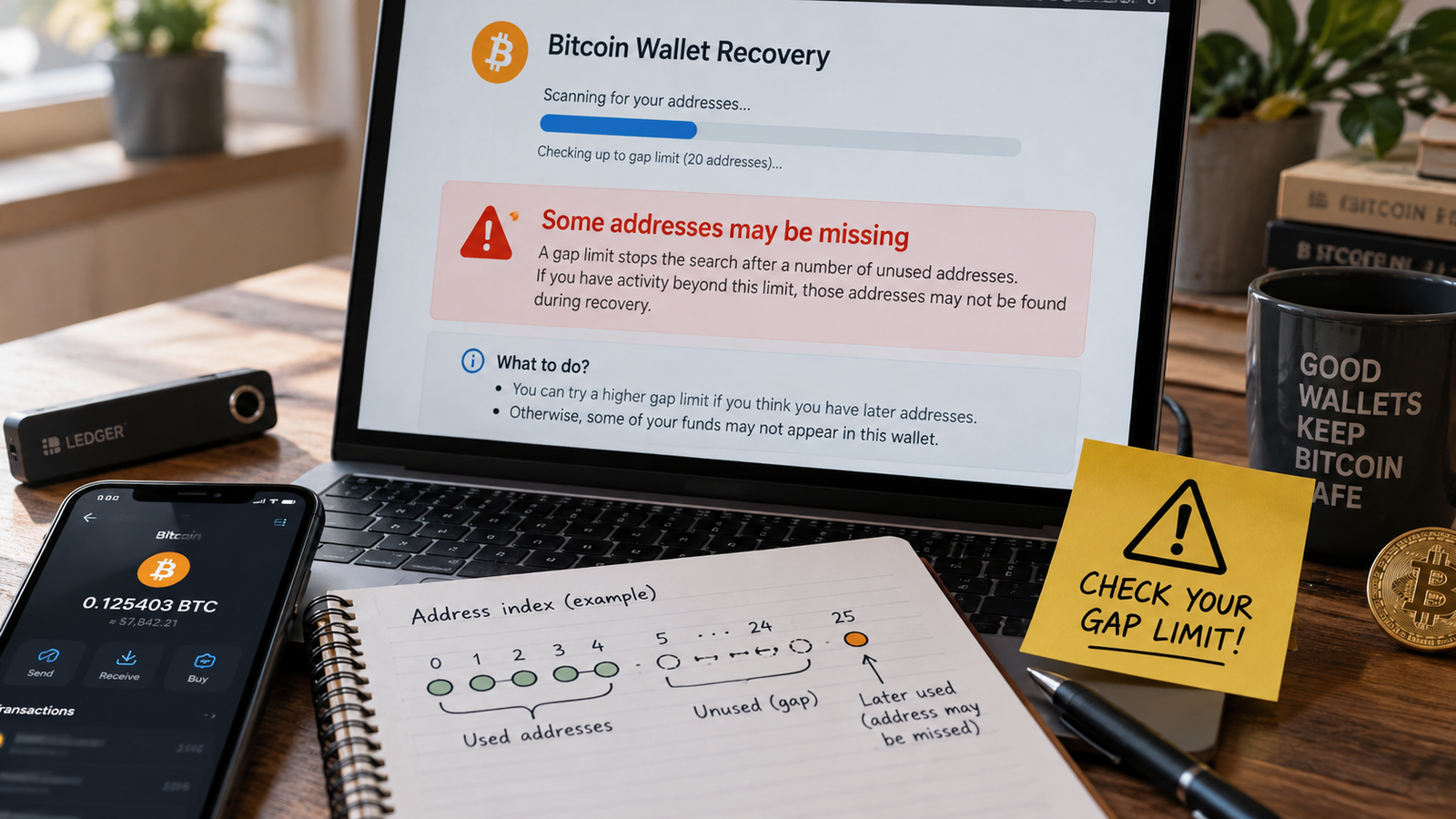
You restore your Bitcoin wallet using the correct recovery phrase, but something looks wrong. Your balance is lower than expected, some transactions are missing, or previously used receiving addresses don’t appear.
The Bitcoin may still be there. The problem could be how your wallet searches for addresses during recovery.
Many hierarchical deterministic (HD) wallets use a mechanism called the gap limit to decide how many unused addresses to check before stopping the recovery scan.
Under the BIP44 standard, the default bitcoin address gap limit is 20 consecutive unused receiving addresses. If funds exist beyond that gap, a wallet following this discovery rule might not find them automatically.
Understanding this behavior is especially useful when restoring an older wallet, switching wallet software, or investigating a missing balance.
What Is a Bitcoin Wallet Gap Limit?
A Bitcoin wallet gap limit is the maximum number of consecutive unused addresses a wallet will scan before assuming there are no more active addresses further along that address sequence.
Most modern Bitcoin wallets use HD technology, which allows them to generate many different addresses from the same underlying wallet keys.
Rather than storing a separate recovery secret for every address, compatible HD wallets can deterministically recreate their address sequences.
However, recovery software still needs to discover which addresses have transaction history.
Checking an unlimited number of addresses would be inefficient, so wallet software uses a stopping rule.
BIP44 specifies a gap limit of 20 for its standard external-address discovery process. After finding 20 consecutive unused addresses, scanning stops.
This is a wallet discovery rule, not a Bitcoin blockchain limit.
It doesn’t mean a wallet can hold only 20 addresses, nor does it prevent funds from being received at later addresses.
How the 20-Address Gap Limit Works
Consider an HD wallet that has generated multiple Bitcoin receiving addresses.
Each address has an index, beginning at zero.
During recovery, the wallet checks these addresses sequentially, looking for transaction history.
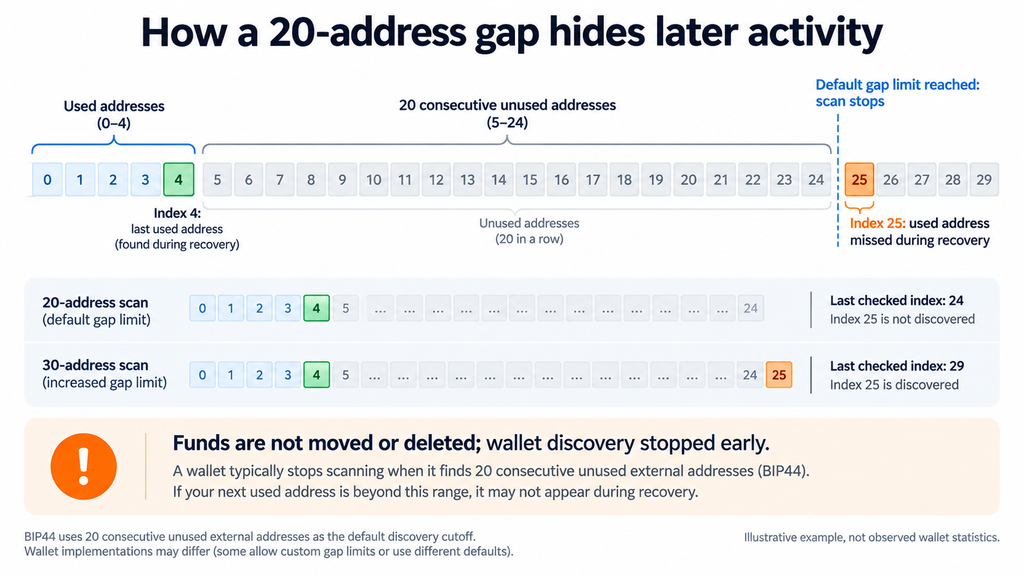
Suppose the wallet previously used address index 4, followed by 20 unused addresses at indexes 5 through 24.
The next used address is index 25.
Under the default BIP44 discovery rule, scanning stops at index 24, meaning the activity at index 25 may remain undiscovered.

Illustrative address-discovery scenario: after 20 consecutive unused addresses, a wallet using the default gap limit stops before reaching a later used address.
The example demonstrates why wallet recovery can show an incomplete transaction history even when the underlying keys are correct.
Address Discovery: Numerical Example
| Metric | Default Scan | Extended Scan |
|---|---|---|
| Configured gap limit | 20 | 30 |
| Last initially discovered used index | 4 | 4 |
| Consecutive unused addresses | 20 (indexes 5–24) | 20 (indexes 5–24) |
| Address index 25 examined | No | Yes |
| Activity at index 25 discovered | No | Yes |
The extended scan finds additional activity because it continues beyond the original stopping point.
Once a used address is discovered, the consecutive-unused-address counter resets.
These are illustrative values, not observed recovery success rates.
Why Do Bitcoin Wallets Use Gap Limits?
Gap limits balance address discovery against resource usage.
An HD wallet can derive an enormous number of potential addresses, but checking all of them against blockchain history would be impractical.
The gap limit allows wallet software to assume that long sequences of unused addresses probably indicate the end of meaningful activity.
This provides several advantages.
Faster Wallet Recovery
A wallet can stop scanning once it reaches the defined threshold instead of searching through potentially millions of unused addresses.
This can reduce recovery time, especially when working with a remote blockchain server.
Lower Resource Usage
Address discovery requires wallet software to derive addresses and check their transaction history.
Extending the scan unnecessarily can increase network requests, computation, and loading times.
Predictable Address Management
Using a consistent discovery rule makes address recovery more manageable across compatible implementations.
However, the gap limit is a convention rather than a universal requirement.
Wallets can implement different discovery methods, larger search windows, or configurable gap limits.
For example, Sparrow Wallet documents a default gap limit of 20 for normal wallets and 40 for its Postmix wallets.
Why Addresses May Be Missing After Wallet Recovery
A gap limit problem is one possible explanation for missing Bitcoin addresses, but it isn’t the only one.
1. Too Many Unused Addresses Were Generated
If a wallet generates many receiving addresses without using them, it may create a long unused sequence.
For example, someone might repeatedly generate fresh deposit addresses while skipping most of them.
If a later address eventually receives Bitcoin, the wallet may not discover it during restoration if the preceding unused gap exceeds its scan threshold.
This is particularly relevant for advanced users, automated systems, and some unusual wallet workflows.
2. The New Wallet Uses a Different Derivation Path
Bitcoin HD wallets organize addresses using derivation paths.
Different wallet standards can use different paths and address formats.
Common examples include:
| Standard | Common Bitcoin Account Path | Typical Address Type |
|---|---|---|
| BIP44 | m/44'/0'/0' | Legacy P2PKH |
| BIP49 | m/49'/0'/0' | Nested SegWit |
| BIP84 | m/84'/0'/0' | Native SegWit |
| BIP86 | m/86'/0'/0' | Taproot |
These are standard first-account examples, not universal paths for every wallet.
Restoring the correct seed into software configured for a different derivation path can produce a different set of addresses.
In that situation, increasing the gap limit alone will not solve the problem.
3. The Wrong Account Was Selected
Some HD wallets support multiple accounts under one recovery seed.
A restored wallet may initially display only the first account.
If the funds were held under another account index, the balance may appear incomplete until the appropriate account is discovered or selected.
4. The Wallet Has Not Finished Synchronizing
An incomplete blockchain scan can temporarily produce missing balances or transaction history.
Before changing advanced settings, confirm that the wallet is connected and fully synchronized.
If the problem persists after synchronization, follow our guide to troubleshooting Bitcoin transactions not showing in your wallet.
5. The Wallet Uses a Different Passphrase
Some wallets support an optional BIP39 passphrase in addition to the recovery phrase.
A different passphrase generates a different wallet.
Even with the correct recovery words, an incorrect or omitted passphrase can result in entirely different addresses.
Never assume a gap limit problem until you have verified the wallet configuration.
How to Safely Recover Missing Bitcoin Addresses
If you suspect a gap limit issue, begin with low-risk checks.
Step 1: Confirm Your Original Wallet Configuration
Identify which wallet application or hardware wallet originally managed the funds.
Check its documentation for the address type, account structure, derivation path, and any known gap limit settings.
This is especially important when switching between wallet applications.
Step 2: Verify Addresses on the Blockchain
If you have a previously used Bitcoin receiving address, search for it using a reputable block explorer such as Mempool.space.
Check whether the address has transaction history or unspent outputs.
This can establish whether the expected activity exists on-chain, although a public explorer cannot verify that your wallet controls the address.
Step 3: Check the Wallet’s Discovery Settings
Some wallet applications allow users to adjust the address gap limit.
For example, Sparrow Wallet documents an advanced gap-limit setting that can help discover transactions beyond the normal scanning range.
Its documentation also cautions that increasing the value too much can slow wallet loading.
If your wallet supports a larger discovery range, follow its official documentation.
Avoid arbitrary configuration changes or experimental recovery tools.
Electrum also uses a default gap limit of 20 addresses. According to the official Electrum documentation, recovering addresses beyond this limit may require increasing the gap limit or generating additional addresses until the previously used ones are discovered.
Step 4: Verify the Account and Derivation Path
If an extended scan doesn’t find the missing addresses, examine whether the correct account and address standard are selected.
Do not assume that every wallet application automatically discovers all possible derivation paths.
Receiving and change addresses may follow separate derivation branches. Understanding how Bitcoin change addresses work can help explain why some funds are missing after wallet restoration.
Step 5: Use Official Wallet Support Resources
For complex recovery cases, consult the original wallet developer’s documentation or an established technical support channel.
You can describe the wallet model, software version, address type, and general issue without revealing secrets.
Never provide your seed phrase, private keys, or wallet passphrase to someone offering recovery assistance.
Does Increasing the Gap Limit Put Your Bitcoin at Risk?
Increasing an address discovery limit through a trusted wallet’s official settings does not, by itself, move your Bitcoin or create blockchain transactions.
It simply instructs the wallet to search further along an address sequence.
The main practical tradeoff is performance: larger scans can require more time and resources.
However, using unfamiliar recovery applications or entering your seed into websites introduces serious security risks.
A legitimate support representative does not need your recovery phrase to explain a gap limit setting.
If your wallet contains significant funds, prioritize preserving existing backups and following the manufacturer’s documented recovery procedures.
Final Thoughts
Bitcoin’s gap limit is a practical mechanism that helps HD wallets discover transaction history without scanning an unlimited number of addresses.
The standard 20-address discovery threshold works well for conventional wallet usage, but unusual address-generation patterns can create gaps large enough to hide later activity during recovery.
If a restored wallet displays missing addresses or an incomplete balance, the underlying Bitcoin may still be accessible.
Start by verifying the original wallet configuration, address type, account, and synchronization status. Then investigate gap-limit settings using official wallet documentation.
Most importantly, keep recovery credentials private throughout the process.
Understanding how HD wallet discovery works can help distinguish a recoverable display problem from a more serious wallet configuration issue.
Sources and References
- BIP-32 – Hierarchical Deterministic Wallets
- BIP-39 – Mnemonic Code for Generating Deterministic Keys
- BIP-44 – Multi-Account Hierarchy for Deterministic Wallets
- BIP-49 – Derivation Scheme for Nested SegWit Accounts
- BIP-84 – Derivation Scheme for Native SegWit Accounts
- BIP-86 – Key Derivation for Single Key Taproot Outputs
- Sparrow Wallet – Official Documentation and FAQ
- Electrum – Wallet Gap Limit Documentation