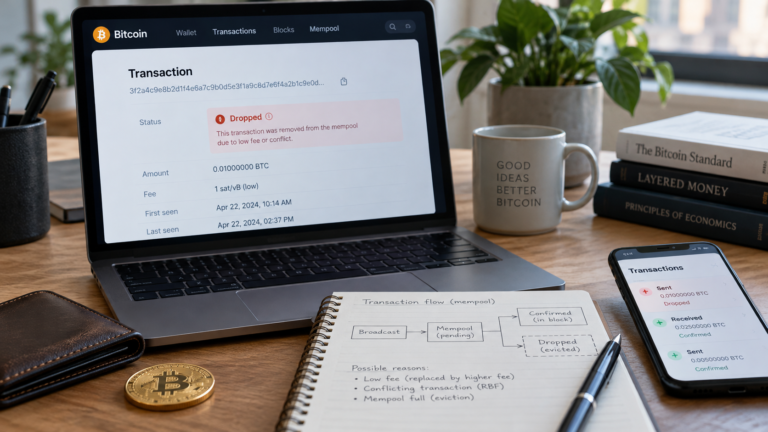

A Bitcoin transaction can remain unconfirmed for hours or even days when its fee is too low relative to competing transactions. The funds haven’t necessarily disappeared. More often, the transaction is waiting in the mempool because miners have more profitable transactions to include in blocks.
Two established methods can help: Replace-by-Fee (RBF) and Child-Pays-for-Parent (CPFP).
Both increase the economic incentive for miners to confirm a payment, but they work differently. RBF replaces an unconfirmed transaction with a higher-fee version. CPFP creates a second transaction that pays enough to make confirming both worthwhile.
The right choice depends on who controls the funds, the wallet’s capabilities, and the total fee required.
Why Do Bitcoin Transactions Get Stuck?
Bitcoin blocks have limited capacity, and miners generally prioritize transactions that offer higher fees relative to their virtual size.
Fees are measured in satoshis per virtual byte (sat/vB), not as a percentage of the amount transferred.
Bitcoin targets an average block interval of approximately 10 minutes, but that doesn’t guarantee a transaction will confirm within 10 minutes.
During periods of network congestion, a payment offering 2 sat/vB might remain unconfirmed while transactions paying 15 sat/vB are included first.
Bitcoin Transaction Fee Example
| Transaction Size | Fee Rate | Total Fee |
|---|---|---|
| 200 vB | 2 sat/vB | 400 sats |
| 200 vB | 5 sat/vB | 1,000 sats |
| 200 vB | 10 sat/vB | 2,000 sats |
| 200 vB | 15 sat/vB | 3,000 sats |
| 200 vB | 25 sat/vB | 5,000 sats |
Illustrative calculations, not live Bitcoin network fee recommendations.
A 200-vB transaction paying 400 satoshis may have difficulty confirming if the current fee market is substantially higher.
Before increasing the fee, check the transaction ID using a Bitcoin block explorer such as mempool.space.
What Is Bitcoin Replace-by-Fee (RBF)?
Replace-by-Fee allows an unconfirmed Bitcoin transaction to be replaced with another version that spends at least one of the same inputs and pays a sufficient additional fee.
Typically, the sender creates a replacement transaction with the same intended payment but a higher miner fee.
The extra fee often comes from reducing the change returned to the sender.
For example, consider a transaction paying 400 sats at 2 sat/vB.
If the replacement remains 200 vB and targets 15 sat/vB, its new total fee would be:
200 × 15 = 3,000 satoshis.
The incremental fee compared with the original transaction is 2,600 satoshis.
This doesn’t mean both transaction fees are ultimately paid. If the replacement confirms, the original conflicting transaction cannot also confirm.
How RBF Works
- A sender broadcasts a Bitcoin transaction with an insufficient fee.
- The transaction remains unconfirmed.
- The sender selects a fee-bumping option in a compatible wallet.
- The wallet creates and signs a replacement transaction.
- The replacement is broadcast with a higher fee.
- If accepted and mined, the replacement confirms instead of the original.
The replacement generally receives a different transaction ID (TXID).
An important detail: modern Bitcoin Core implementations support full-RBF, meaning replacement doesn’t always require the original transaction to explicitly signal RBF.
However, wallet support and network relay policies still matter. A replacement must satisfy applicable policy rules, and acceptance isn’t guaranteed.
What Is Child-Pays-for-Parent (CPFP)?
Child-Pays-for-Parent takes a different approach.
Instead of replacing the original transaction, someone creates a new transaction spending one of its unconfirmed outputs.
This new transaction is called the child. The original is the parent.
The child pays a sufficiently high fee to raise the combined effective fee rate of the two transactions.
Miners can then earn the fees from both by confirming them together in the correct order.
CPFP is particularly useful when the recipient wants to accelerate an incoming payment but cannot modify the sender’s original transaction.
How CPFP Works
Suppose a parent transaction is 200 vB and pays 400 sats.
The recipient creates a 150-vB child transaction spending an output from that parent.
To make the combined package attractive at 15 sat/vB:
Combined size = 200 + 150 = 350 vB.
Required combined fee = 350 × 15 = 5,250 sats.
Parent fee = 400 sats.
Required child fee = 5,250 − 400 = 4,850 sats.
The child must therefore pay approximately 32.33 sat/vB to raise the combined package to 15 sat/vB.
Although the child’s individual fee rate is high, miners evaluate the combined economics of the dependent transactions.
Bitcoin RBF vs CPFP: Key Differences
| Feature | RBF | CPFP |
|---|---|---|
| Mechanism | Replaces original transaction | Adds a child transaction |
| Who can initiate? | Party able to authorize replacement inputs | Owner of a spendable unconfirmed output |
| Original TXID | Usually changes | Remains unchanged |
| Additional transaction | Replacement instead of original | Yes |
| Fee calculation | Replacement transaction | Parent and child combined |
| Typical use | Accelerate an outgoing payment | Accelerate an incoming payment |
| Wallet requirements | Replacement construction and signing | Spending unconfirmed outputs |
| Generally cheaper? | Often | Usually more expensive |
| Guaranteed confirmation? | No | No |
RBF is usually more fee-efficient because it doesn’t require the extra block space occupied by a child transaction.
CPFP is valuable when replacing the original payment isn’t practical.
RBF vs CPFP: Which Costs Less?
Consider the same unconfirmed payment under both methods.
Original transaction:
- Size: 200 vB
- Fee rate: 2 sat/vB
- Total fee: 400 sats
Assume the desired effective fee rate is 15 sat/vB.
Fee-Bumping Cost Comparison
| Metric | RBF | CPFP |
|---|---|---|
| Original transaction size | 200 vB | 200 vB |
| Added child size | None | 150 vB |
| Target effective rate | 15 sat/vB | 15 sat/vB |
| Required replacement/child fee | 3,000 sats | 4,850 sats |
| Original fee | Replaced | 400 sats |
| Incremental fee expenditure | 2,600 sats | 4,850 sats |
| Final confirmed fee total | 3,000 sats | 5,250 sats |
In this simplified example, RBF requires 2,600 additional satoshis, while CPFP requires a new 4,850-satoshi fee.
The difference in incremental expenditure is 2,250 sats.
Real transactions may have different sizes, additional unconfirmed ancestors or replacement-policy requirements. These can change the calculation.
The key financial principle remains: CPFP must compensate miners for the combined block space, while RBF usually pays for a replacement of roughly the same size.
How to Speed Up a Stuck Bitcoin Transaction With RBF
If you sent the transaction, start by checking whether your wallet supports fee bumping.
Step 1: Locate the Transaction
Open your Bitcoin wallet and find the pending payment.
Copy the transaction ID and inspect it using a block explorer.
Confirm that the transaction has zero confirmations.
Step 2: Check Current Network Fees
Compare the transaction’s current fee rate with recent blocks and estimated confirmation rates.
Avoid selecting an arbitrary high fee without examining network conditions.
Step 3: Select the RBF Option
Depending on the wallet, the feature may be called:
- Increase Fee
- Bump Fee
- Replace Transaction
- Speed Up
Not every wallet offers these controls.
Step 4: Set a Competitive Fee
Choose a fee rate that reflects the desired confirmation urgency and current network conditions.
The replacement may need to satisfy minimum additional-fee and mempool-policy requirements beyond simply paying a slightly higher rate.
Step 5: Review and Broadcast
Verify the recipient, amount and change output before approving the replacement.
After broadcasting, track the new transaction ID.
If the wallet doesn’t support RBF, using a separate tool may require access to the relevant signing keys or wallet data. Never disclose a seed phrase to a website offering transaction acceleration.
How to Use CPFP for an Unconfirmed Bitcoin Payment
CPFP is more dependent on wallet functionality.
The wallet must allow spending an eligible output from an unconfirmed transaction.
Step 1: Identify an Unconfirmed Output
Check whether the stuck payment has an output controlled by your wallet.
Recipients may be able to spend their incoming funds, while senders may be able to spend their unconfirmed change.
Step 2: Create a Child Transaction
Use a compatible wallet to spend the unconfirmed output, commonly by sending it to another address you control.
Step 3: Calculate the Required Fee
Estimate the combined size of the parent and child.
Use the formula:
Required child fee = Target fee rate × (Parent vB + Child vB) − Parent fee.
This formula assumes a simple two-transaction package. Additional unconfirmed ancestors or descendants complicate the calculation.
Step 4: Broadcast and Monitor
Sign and broadcast the child transaction.
A miner must confirm the parent before the child, although both may be included in the same block.
Some wallets automate CPFP under a fee-bump or accelerate function.
When RBF or CPFP Won’t Work
Neither method guarantees immediate confirmation.
Several limitations can prevent successful acceleration.
| Situation | What It Means |
|---|---|
| Transaction already confirmed | RBF and CPFP are no longer needed |
| Wallet lacks RBF support | Replacement may require different wallet software |
| No spendable unconfirmed output | CPFP isn’t available to that user |
| Insufficient funds for extra fee | Fee bump may be impossible |
| Complex unconfirmed transaction chain | Relay restrictions may apply |
| Transaction absent from mempools | Rebroadcasting or package relay may be needed |
| Transaction sent by an exchange | Exchange controls the outgoing transaction |
Modern Bitcoin Core package-relay improvements can help some low-fee parent transactions propagate together with higher-fee children.
However, support varies by software and transaction structure.
A transaction disappearing from one explorer’s mempool also doesn’t guarantee it has been permanently canceled. Other nodes may still retain or rebroadcast it.
Should You Use a Bitcoin Transaction Accelerator?
Third-party accelerators are another option, particularly when wallet-based fee bumping isn’t available.
Some services work with mining pools to prioritize eligible transactions through separate payment arrangements.
Others merely rebroadcast transactions and may provide little benefit.
Before paying for an accelerator, check its actual service model, fees and refund conditions.
Be cautious of websites asking for private keys or recovery phrases. Legitimate transaction acceleration doesn’t require revealing your wallet seed.
How to Avoid Stuck Bitcoin Transactions
The simplest way to manage confirmation delays is to select appropriate fees before sending.
Check current network congestion, use a wallet with fee-bumping functionality, and avoid relying on minimum fees for time-sensitive payments.
For larger transfers, verify the destination address and transaction settings carefully.
Also remember that Bitcoin transaction fees depend on transaction size, not the BTC amount transferred.
Sending 0.001 BTC can require a higher fee than sending 1 BTC if the smaller payment uses more inputs and occupies more block space.
Frequently Asked Questions
Is RBF better than CPFP?
RBF is generally cheaper and more straightforward for senders using compatible wallets. CPFP is often more useful for recipients or users controlling unconfirmed outputs.
Can a Bitcoin receiver use RBF?
Usually, the receiver cannot replace a transaction signed by someone else. The receiver may instead use CPFP if the incoming output is spendable.
Can I use CPFP without RBF enabled?
Yes. CPFP doesn’t require the original transaction to signal RBF. It requires a suitable unconfirmed output and compatible transaction-relay conditions.
Does RBF cancel the original Bitcoin transaction?
A successfully confirmed replacement conflicts with the original transaction, preventing the original from confirming. Merely broadcasting a replacement doesn’t guarantee it will be accepted or mined.
How long does RBF take to confirm?
There is no fixed time. Confirmation depends on the replacement fee rate, mempool conditions and miner selection.
Does CPFP require two transaction fees?
Yes. The parent and child each pay a fee, and miners assess their combined economic value.
Can a stuck Bitcoin transaction stay pending forever?
It may remain unconfirmed for an extended period, but nodes can eventually evict it from their mempools. Eviction from one node doesn’t necessarily remove it from the entire network.