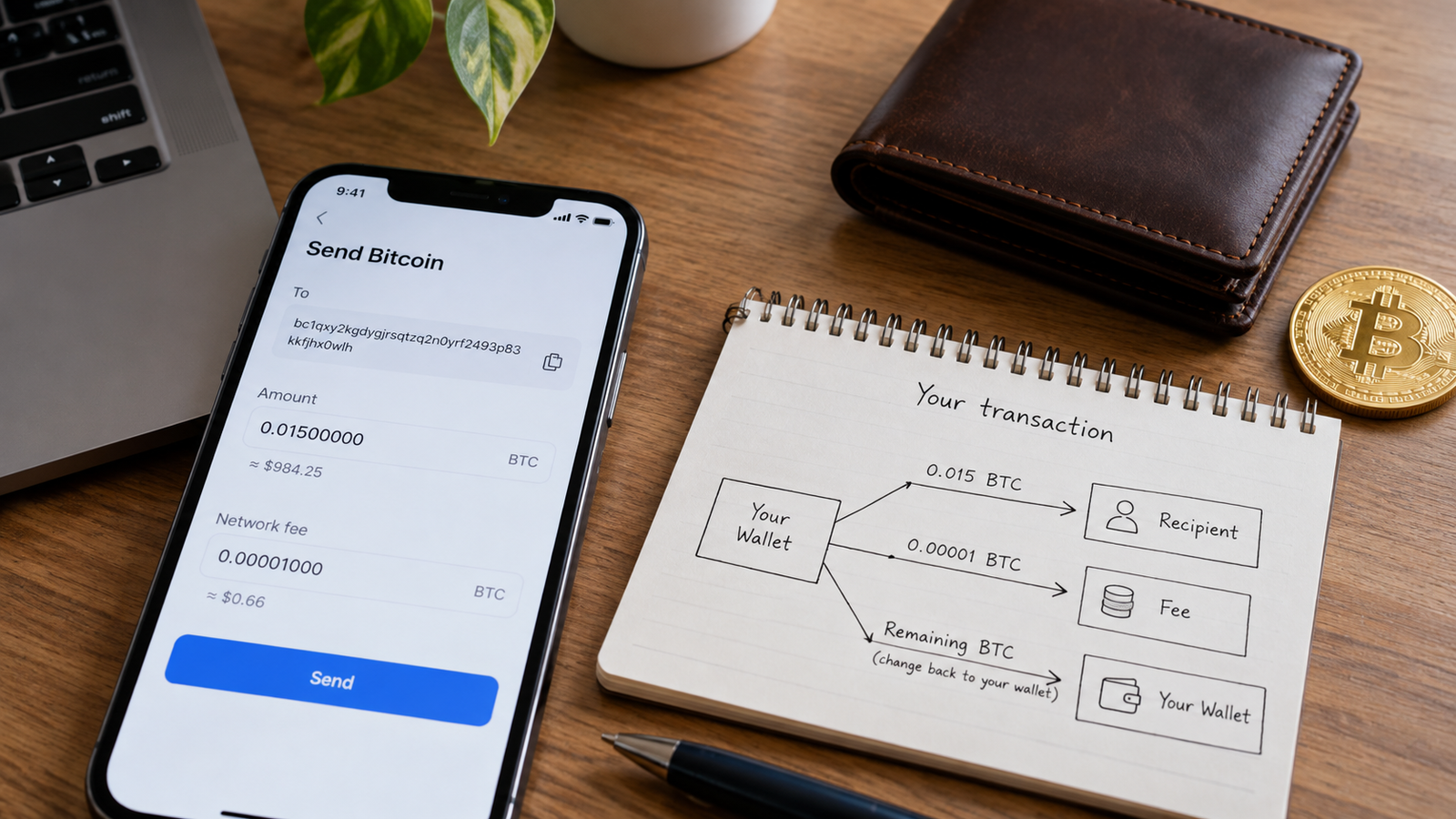
You send 0.3 BTC to someone, but a blockchain explorer shows that your transaction moved 0.8 BTC. Where did the remaining Bitcoin go?
This is one of the most confusing aspects of Bitcoin transactions for beginners. Unlike a traditional bank account, Bitcoin doesn’t simply subtract the payment amount from a single account balance. Instead, it uses unspent transaction outputs (UTXOs), which often need to be split into a payment and change.
A Bitcoin change address is where your wallet sends the leftover BTC after completing a transaction. The address typically belongs to your own wallet, so the remaining funds are still yours.
Understanding how change addresses work can help you interpret blockchain transactions, avoid balance confusion, and recognize potential wallet security issues.
What Is a Bitcoin Change Address?
A Bitcoin change address is an address controlled by your wallet that receives leftover Bitcoin from a transaction.
Think of it like paying for a $30 purchase with a $50 bill. The merchant receives $30, and you receive $20 in change.
Bitcoin works similarly, except that the network handles digital transaction outputs rather than physical cash.
When you spend Bitcoin, your wallet selects one or more existing UTXOs. If their combined value exceeds the amount you want to send plus the transaction fee, the wallet will typically create a change output.
That change is sent back to an address controlled by your wallet.
For example:
- Your wallet selects a 0.8 BTC UTXO.
- You want to send 0.3 BTC.
- The transaction fee is 0.0001 BTC.
- Your wallet sends 0.4999 BTC to a change address.
The original 0.8 BTC UTXO is fully spent, but the leftover value remains yours through the newly created output.
How Bitcoin Change Addresses Work: A Simple Example
Bitcoin uses the UTXO model, meaning your wallet’s balance consists of separate unspent outputs from previous transactions.
Each UTXO must be spent in its entirety. Any value not assigned to a new output becomes part of the transaction fee.
That is why Bitcoin wallets commonly create two outputs: one for the recipient and another for the sender’s change.
Bitcoin transaction flow
How Bitcoin Change Addresses Work
Infographic

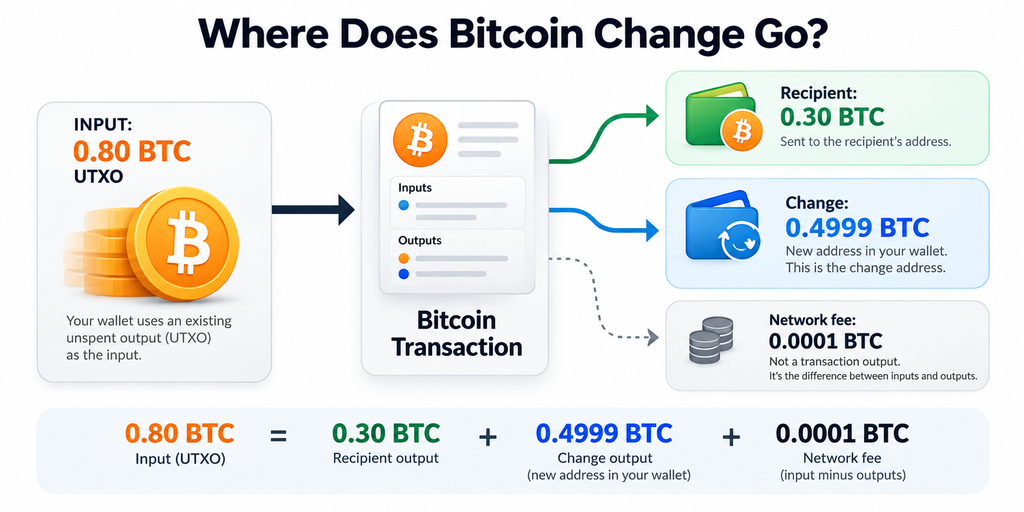
Illustrative transaction: 0.80 BTC input is divided into a 0.30 BTC recipient payment, 0.4999 BTC returned as change, and a 0.0001 BTC transaction fee.
Here is the transaction breakdown:
| Transaction Component | Amount | Destination |
|---|---|---|
| Input UTXO | 0.8000 BTC | Existing wallet funds |
| Payment output | 0.3000 BTC | Recipient’s address |
| Change output | 0.4999 BTC | Sender’s change address |
| Transaction fee | 0.0001 BTC | Paid to the miner |
| Total accounted for | 0.8000 BTC | Complete transaction |
The calculation is:
\[ 0.8000=0.3000+0.4999+0.0001 \]
After confirmation, the recipient controls a new 0.3 BTC output, and your wallet controls the 0.4999 BTC change output.
The fee is not a normal transaction output. It is the difference between the total input value and the total output value.
Why Does Bitcoin Need Change Addresses?
Bitcoin doesn’t maintain balances in the same way as conventional banking systems.
Your displayed wallet balance is calculated from UTXOs associated with keys or scripts your wallet controls.
For example, your wallet might contain:
| UTXO | Value |
|---|---|
| UTXO A | 0.15 BTC |
| UTXO B | 0.25 BTC |
| UTXO C | 0.40 BTC |
| Total balance | 0.80 BTC |
If you want to send 0.3 BTC, your wallet may select UTXOs B and C, totaling 0.65 BTC.
It then creates a recipient output of 0.3 BTC and, after deducting the transaction fee, a change output returning the remaining value.
The unselected 0.15 BTC UTXO remains untouched.
This process is called coin selection.
Wallets use different coin-selection strategies to balance transaction fees, efficiency, UTXO management, and privacy.
Is a Bitcoin Change Address Part of Your Wallet?
Yes. In a properly functioning wallet, the automatically generated change address is controlled by the same wallet that created the transaction.
Most modern hierarchical deterministic (HD) wallets derive multiple addresses from their wallet seed.
These addresses can serve different purposes, including receiving payments and collecting change.
Your wallet tracks them automatically and includes their unspent outputs when calculating your available balance.
This means you don’t normally need to:
- Manually create a change address.
- Import the address after every transaction.
- Transfer change back to your main receiving address.
- Keep using the same public Bitcoin address.
Bitcoin Core, for example, supports automatic change address selection and allows advanced users to specify a change address when constructing transactions.
The important requirement is that the wallet must retain access to the keys needed to spend its change outputs.
Why Does My Bitcoin Wallet Generate a New Change Address?
Generating a fresh change address is standard practice for many Bitcoin wallets.
One reason is privacy.
Bitcoin’s blockchain is public. Anyone can inspect transaction inputs, outputs, and amounts using a block explorer.
If your wallet repeatedly uses the same address, external observers may find it easier to connect transactions and analyze your financial activity.
Using new change addresses helps reduce straightforward address reuse.
However, change addresses do not make Bitcoin transactions completely anonymous. Blockchain analysis may still identify probable change outputs through transaction patterns and other heuristics.
The Bitcoin developer documentation recommends using fresh addresses for change rather than unnecessarily reusing existing addresses.
How to Identify a Bitcoin Change Output on a Block Explorer
When viewing a transaction on Mempool.space or Blockstream Explorer, you may notice multiple outputs even though you sent Bitcoin to just one person.
For example, a transaction might display:
| Output | Address | Amount |
|---|---|---|
| Output 0 | bc1q…recipient | 0.3000 BTC |
| Output 1 | bc1q…change | 0.4999 BTC |
The first output could represent your intended payment, while the second could be your change.
However, a block explorer cannot always determine which output belongs to the recipient and which represents change.
Some explorers provide change-detection estimates, but these are not definitive proof of address ownership.
Output order also does not reliably identify change.
To verify the change output, use your own wallet’s transaction details or advanced coin-control features, if available.
Bitcoin Core users can verify whether an address is recognized by their wallet using the getaddressinfo RPC command. The ismine field indicates whether the address belongs to the wallet, while ischange indicates whether it was used for change. This is more reliable than guessing from transaction output amounts or their position in a block explorer.
Can Bitcoin Change Get Lost?
Normally, no. Change sent to an address controlled by your wallet remains spendable through that wallet.
However, there are situations where users may lose access to it.
Incomplete Wallet Backup
Some older or nonstandard wallets may require backups that include newly generated private keys.
If a backup does not contain the keys needed to spend a change output, restoring that backup may not recover the funds.
Modern HD wallets generally derive change addresses from their recovery seed, although restoring the correct wallet structure, derivation paths, and any required passphrase is still important.
Incorrect Custom Change Address
Advanced wallets may allow users to specify a custom change address.
If that address belongs to someone else or is not controlled by the sender, the change could become inaccessible to the intended owner.
Never manually specify a change address unless you fully understand its ownership.
Wallet Restoration Issues
After restoring a wallet, some change outputs might not appear immediately due to synchronization problems, account discovery limitations, or incorrect derivation settings.
Check the transaction on a block explorer and verify the wallet configuration before assuming the funds are missing.
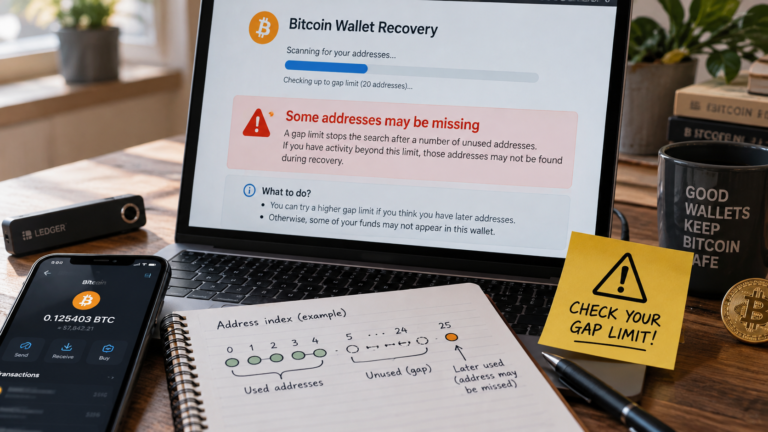
If some addresses or balances are missing after restoring your wallet, check whether the Bitcoin wallet gap limit is affecting address discovery.
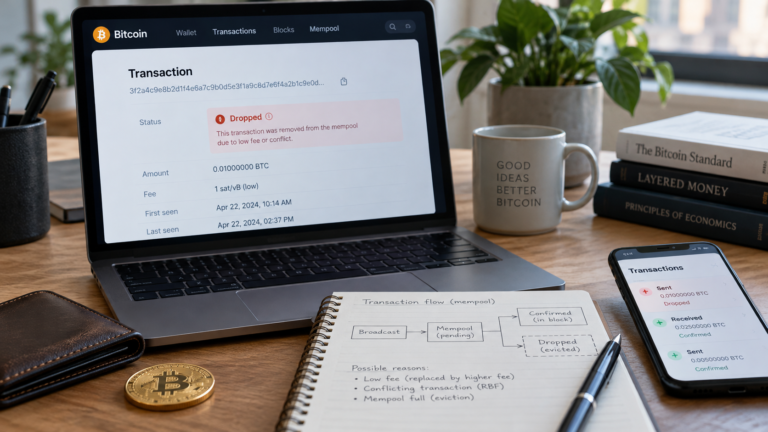
If the transaction is visible on the blockchain but the balance remains incorrect, follow our troubleshooting guide for Bitcoin transactions not showing in your wallet.
Does a Bitcoin Change Output Increase Transaction Fees?
It can.
Bitcoin transaction fees depend primarily on transaction size or weight and the selected fee rate, rather than the amount of BTC being transferred.
Adding a change output increases the size of the transaction and therefore may increase its fee.
However, creating change is usually preferable to paying a large unused amount as a miner fee.
Sometimes, a wallet deliberately creates no change output.
This can happen when selected inputs closely match the payment plus fee, or when the remaining amount is too small to create an economical output under the wallet’s dust and fee policies.
In such cases, the leftover value may be added to the transaction fee instead.
Bitcoin Change Address vs. Receiving Address
Although both are valid Bitcoin destinations, they serve different purposes within the wallet.
| Feature | Receiving Address | Change Address |
|---|---|---|
| Main purpose | Receive payments | Receive leftover BTC |
| Typical creation | Generated when requesting payment | Generated during transaction construction |
| Controlled by wallet | Yes | Yes |
| Can hold spendable BTC | Yes | Yes |
| Usually managed automatically | Yes | Yes |
| Visible on the blockchain | Yes | Yes |
At the protocol level, a change output is a normal Bitcoin transaction output.
The distinction is primarily how the wallet intends to use it.
Final Thoughts
Bitcoin change addresses are a normal part of how Bitcoin transactions work.
When your wallet uses a UTXO larger than the intended payment, it typically creates a bitcoin change output that returns the remaining BTC to an address under your control.
Your Bitcoin hasn’t disappeared, and you haven’t accidentally sent more money to the recipient. The wallet has simply divided the selected inputs into new outputs while accounting for the network fee.
Understanding this process makes it easier to read blockchain explorer data, recognize how Bitcoin balances are calculated, and manage your transactions with greater confidence.