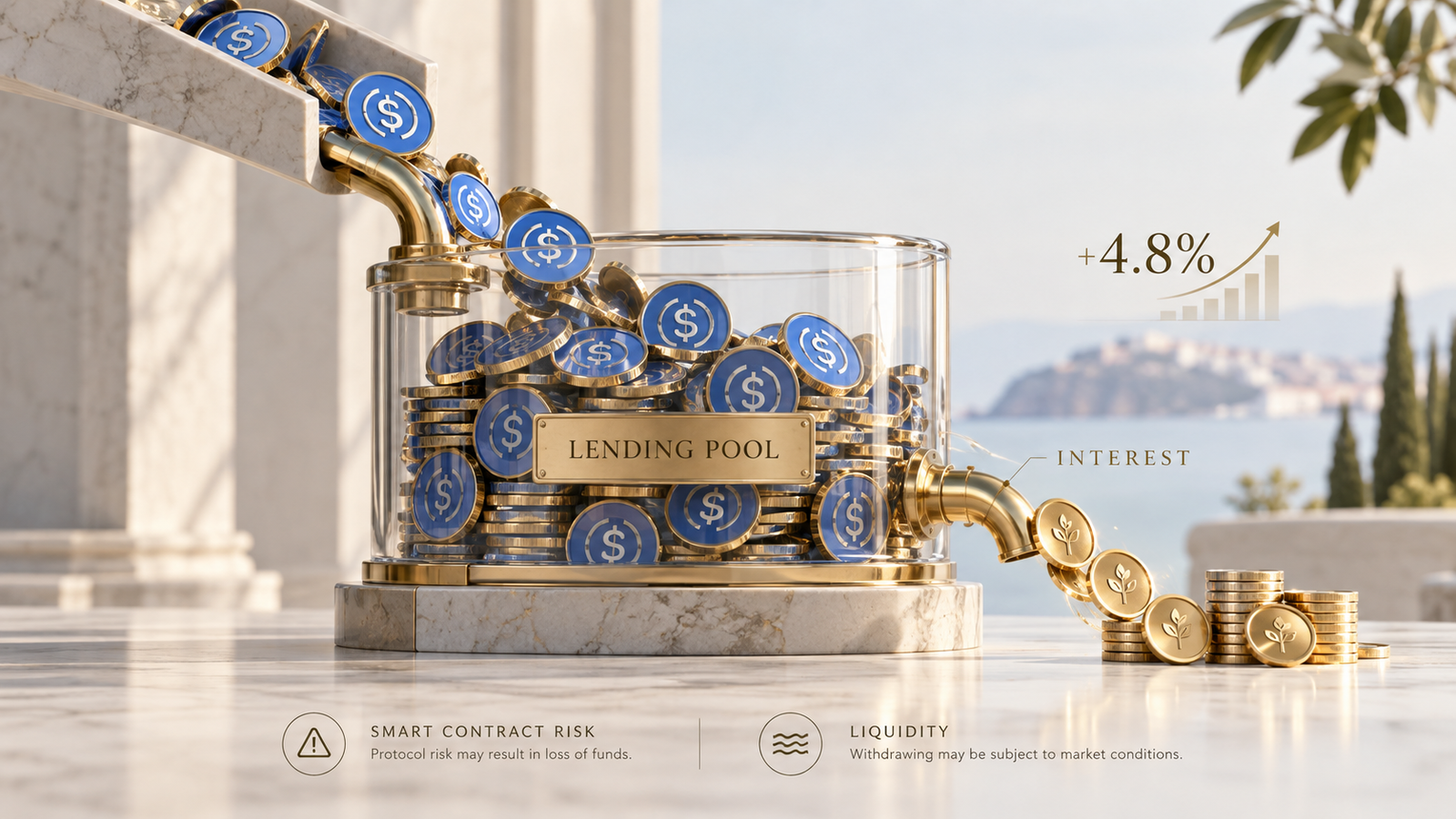
Holding 5,000 USDC in a self-custody wallet normally generates no interest. Supply those tokens to a decentralized lending market, however, and they may begin earning yield from borrowers who pay to access liquidity.
A 5% annualized supply rate would produce approximately 250 USDC over a full year on a 5,000 USDC deposit, before fees and assuming the rate stays unchanged. That income isn’t guaranteed. Lending rates change with borrowing demand, and withdrawing funds depends on the liquidity available in the market.
USDC lending also introduces risks that ordinary wallet storage doesn’t carry, including smart contract vulnerabilities, collateral liquidation failures, and stablecoin depegging.
This guide explains how to earn yield on USDC through DeFi lending, where the interest comes from, and how to calculate whether the potential return justifies the costs and risks.
How Does USDC Lending Work in DeFi?
Decentralized lending protocols connect users who supply cryptocurrency with borrowers seeking liquidity.
When you supply USDC to a lending market, the protocol records your deposit and makes eligible liquidity available for borrowing under its rules.
Borrowers generally provide collateral, such as ETH or other supported cryptocurrencies, and pay interest on outstanding loans.
A portion of that interest is distributed to USDC suppliers, often after protocol reserves or other applicable charges.
The lending process typically involves four stages:
- A user deposits USDC into a lending smart contract.
- Borrowers access available USDC against eligible collateral.
- Interest accrues according to the market’s utilization and interest-rate model.
- Suppliers earn interest and can request withdrawal according to the protocol’s liquidity conditions.
Unlike a bank savings account, the arrangement usually doesn’t involve a bank guaranteeing repayment of your deposit.
Smart contracts manage accounting, collateral requirements, borrowing limits, and liquidations.
Some protocols issue interest-bearing receipt tokens. Others track a growing deposit balance or exchange rate representing the lender’s claim on the market.
Where Does USDC Lending Yield Come From?
The main source of ordinary USDC lending yield is interest paid by borrowers.
Borrowers may use USDC for leveraged positions, liquidity management, hedging, or obtaining spending liquidity without selling their collateral.
The amount suppliers earn depends partly on how much deposited USDC is currently borrowed.
This relationship is called utilization.
Utilization Rate = Total USDC Borrowed / Total USDC Supplied × 100
Suppose a lending market contains 10 million USDC in supplied liquidity, with 7.5 million USDC borrowed.
Utilization equals 75%.
At this level, the protocol has 2.5 million USDC remaining in its simplified available-liquidity balance.
If borrowing demand rises while deposits remain unchanged, utilization increases.
Many lending protocols raise borrowing rates as utilization approaches a configured threshold, encouraging new deposits and discouraging excessive borrowing.
How Utilization Affects Lending Rates
| Market Condition | Utilization | Typical Rate Behavior | Withdrawal Liquidity |
|---|---|---|---|
| Low borrowing demand | 30% | Lower supply APR | Relatively abundant |
| Moderate demand | 60% | Higher than low utilization | Generally available |
| High demand | 85% | Rates may increase sharply | More constrained |
| Near-full utilization | 98% | Potentially very high rates | Very limited |
Utilization figures are illustrative. Actual interest-rate curves and available liquidity vary by market.
High utilization can improve the advertised return while making it harder to withdraw a large deposit immediately.
This trade-off is easy to overlook when comparing yields.
USDC DeFi Lending Options: Aave, Compound and Lending Vaults
Several established DeFi systems support USDC lending, but their market structures differ.
The relevant distinction is how each system allocates capital, calculates interest, and manages risk.
Comparing USDC Lending Models
| Feature | Aave | Compound III | Morpho Lending Vaults |
|---|---|---|---|
| Lending structure | Shared liquidity pools | Markets centered on a base asset | Vaults allocate funds to lending markets |
| Yield source | Borrower interest | Borrower interest on the base asset | Underlying lending interest |
| Interest rates | Variable | Variable | Depends on underlying markets |
| Risk considerations | Collateral, oracles, pool configuration | Base-asset market and collateral risk | Underlying markets and curator decisions |
| Withdrawal | Subject to available pool liquidity | Subject to market liquidity | Depends on vault and underlying market liquidity |
| Additional management | Protocol governance | Protocol governance | Vault curators and allocators |
Aave: Pooled USDC Lending
Aave allows users to supply USDC to supported lending pools.
The supply rate varies with borrowing activity and the reserve’s interest-rate configuration.
Suppliers receive an interest-bearing position representing their claim on deposited assets and accrued interest.
Withdrawals depend on sufficient unborrowed liquidity being available.
Compound III: Base-Asset Lending
Compound III organizes markets around a base asset, which may be USDC depending on the deployment.
Users who supply the base asset can earn interest according to a utilization-based rate model.
An important technical detail is that supplying a collateral asset isn’t necessarily the same as supplying the interest-bearing base asset.
Before depositing, check that USDC is the actual interest-earning asset in the selected market.
Morpho: Curated Lending Vaults
Morpho supports lending markets and vault structures that can allocate deposits across selected lending opportunities.
Vault curators define investment parameters and risk limits, while allocators manage how liquidity is distributed.
This introduces additional considerations involving curator authority, eligible collateral, vault fees, underlying market exposure, and withdrawal arrangements.
A higher displayed yield does not automatically indicate a better risk-adjusted return.
How to Lend USDC: Step-by-Step
The basic process is similar across many non-custodial lending interfaces.
Step 1: Choose the Blockchain Network
USDC exists on multiple blockchains, including Ethereum and several Layer 2 networks.
Check which networks the intended lending market supports and whether it accepts the specific native or bridged USDC asset you hold.
Different token contracts with similar names are not automatically interchangeable.
Step 2: Check the Lending Market
Before connecting your wallet, review the market’s supply APY, utilization, available liquidity, collateral configuration, and any applicable fees.
Check whether the displayed yield comes entirely from borrower interest or partly from additional token incentives.
Step 3: Connect Your Wallet
Use the protocol’s verified official interface.
Confirm the connected blockchain and USDC contract address.
Keep enough of the network’s fee asset available to pay transaction costs.
Step 4: Approve and Supply USDC
Some interfaces require an initial token allowance before the lending contract can transfer your USDC.
Review the spender address and approved amount.
Then submit the supply transaction and confirm it in your wallet.
A limited approval can reduce unnecessary spending permissions, although the interface may require future approvals for additional deposits.
Step 5: Monitor Your Position
After supplying USDC, verify that the deposit appears in the lending dashboard.
Monitor your accrued interest, current supply rate, utilization, and available withdrawal liquidity.
Keep a record of your deposit amount and transaction costs for return calculations.
How Much Interest Can You Earn on USDC?
USDC lending rates are variable, so projected earnings should be treated as scenarios rather than promised returns.
The simplified interest calculation without compounding is:
Interest = Deposit × APR × Days / 365
USDC Lending Returns at Different Rates
| Supply APR | $1,000 After 1 Year | $5,000 After 1 Year |
|---|---|---|
| 2% | $20 | $100 |
| 3% | $30 | $150 |
| 5% | $50 | $250 |
| 7% | $70 | $350 |
| 10% | $100 | $500 |
Hypothetical fixed APR scenarios before fees, taxes, and changes in USDC’s market value.
At 5% APR, a $5,000 position earns approximately $250 over a full year if the rate remains constant.
For a 90-day holding period:
$5,000 × 0.05 × (90 / 365) = $61.64
The shorter holding period produces significantly less income, making transaction costs particularly relevant.
How Gas Fees Reduce Real USDC Yield
A displayed lending APY doesn’t necessarily account for the costs of entering and exiting a position.
Depending on the blockchain and protocol, these expenses can include token approvals, supply transactions, withdrawals, and vault fees.
Consider a 90-day deposit earning a constant 5% APR without compounding.
USDC Lending After Transaction Fees
| Metric | Small Deposit | Larger Deposit |
|---|---|---|
| Initial USDC | $1,000 | $5,000 |
| Supply APR | 5% | 5% |
| Holding period | 90 days | 90 days |
| Gross interest | $12.33 | $61.64 |
| Total transaction costs | $15 | $15 |
| Net return | -$2.67 | $46.64 |
| Net return on initial deposit | -0.27% | 0.93% |
The example demonstrates why small deposits can be economically inefficient when transaction costs are relatively high.
Even a positive advertised APR can produce a negative realized return over a short holding period.
Lower-cost networks may reduce fees, but they introduce their own infrastructure and security assumptions.
When comparing usdc lending rates, calculate the expected net return using actual network costs rather than comparing headline APYs alone.
Why USDC Lending Rates Change
DeFi lending rates respond to supply and borrowing demand.
If more USDC enters a market while borrowing stays constant, utilization generally falls and supply rates may decline.
If borrowers demand more USDC, utilization rises and rates may increase.
Protocol governance can also adjust interest-rate parameters.
A market offering 8% APR today could pay substantially less over the following months.
For example, consider a $5,000 position earning 8% APR for three months and 3% for the next nine months.
Ignoring compounding, fees, and using proportional year fractions, the annual return would be approximately:
$5,000 × (0.08 × 3/12 + 0.03 × 9/12) = $212.50
That equals 4.25% of the starting deposit, well below the initially displayed 8% annualized rate.
Historical average rates can help evaluate the stability of a lending market, but they cannot guarantee future yields.
USDC Lending Risks: What Can Go Wrong?
Stablecoin lending reduces direct exposure to the price volatility of assets such as Bitcoin and Ethereum, but it introduces other risks.
Main Risks of Lending USDC
| Risk | What Can Happen | What to Check |
|---|---|---|
| Smart contract exploit | Deposited assets may be stolen or become inaccessible | Audits, contract upgrades, incident history |
| USDC depeg | USDC trades below its intended $1 value | Issuer reserves, redemption conditions |
| Collateral liquidation failure | Borrower collateral may not cover outstanding debts | Collateral rules, liquidation incentives |
| Withdrawal liquidity shortage | Immediate withdrawals may be restricted | Utilization and available liquidity |
| Oracle failure | Incorrect asset pricing affects liquidations | Oracle design and safeguards |
| Governance or curator risk | Changes alter market exposure or operations | Administrative roles and timelocks |
| Network or bridge failure | Funds become temporarily or permanently inaccessible | Chain and bridge dependencies |
Smart Contract Risk
Even established lending systems can contain vulnerabilities.
Security audits reduce uncertainty but cannot eliminate the possibility of bugs, malicious upgrades, or exploits involving integrated infrastructure.
USDC Depeg Risk
USDC is intended to maintain a value close to $1, but its market price can deviate from that level.
For example, if 5,000 USDC becomes worth $0.95 per token, its market value falls to $4,750.
That represents a $250 decline before accounting for any lending interest.
A 5% annual lending return would not provide substantial protection against that immediate valuation loss.
USDC also carries issuer, banking, redemption, and address-freezing risks.
Withdrawal Liquidity Risk
USDC lending doesn’t necessarily guarantee instant withdrawals.
If most available liquidity has already been borrowed, a user may need to wait until borrowers repay or new suppliers add funds.
For example, a lending pool holding 10 million USDC with 9.8 million borrowed has only 200,000 USDC in simplified unborrowed liquidity.
A lender attempting to withdraw 500,000 USDC might not be able to complete the entire withdrawal immediately.
Some vaults introduce additional allocation and withdrawal mechanics that make liquidity management more complex.
How to Compare USDC Lending Opportunities
A useful comparison should go beyond the highest advertised yield.
Before supplying USDC, examine the following:
- Base supply APR or APY, excluding temporary token incentives.
- Historical rate stability over several weeks or months.
- Current utilization and immediately available liquidity.
- Supported blockchain and transaction costs.
- Smart contract audits and administrative permissions.
- Collateral types, oracle dependencies, and liquidation mechanisms.
- Deposit and withdrawal conditions.
- Any additional vault management or performance fees.
An opportunity paying 7% with concentrated collateral exposure and very limited withdrawal liquidity may carry substantially different risks from a market offering 4% with more diversified collateral and greater available liquidity.
The rate difference alone does not establish which position is economically preferable.
For investors focused on usdc passive income defi, the critical question is how much yield remains after costs and what risks must be accepted to earn it.
Frequently Asked Questions
Can you earn interest on USDC through DeFi?
Yes. Lending protocols can pay USDC suppliers interest funded primarily by borrowers. Returns depend on market utilization, interest-rate models, and applicable fees.
Is USDC lending guaranteed?
No. Rates change, smart contracts can fail, borrowers’ collateral can become insufficient, and withdrawals may be constrained by available liquidity.
How much APY can USDC lending generate?
There is no fixed rate. Supply APY varies by protocol, blockchain, utilization, and market conditions. Advertised rates should be checked immediately before depositing.
Is USDC lending safer than lending ETH?
USDC lending generally has lower direct exposure to cryptocurrency price volatility, assuming USDC maintains its peg. However, stablecoin, smart contract, collateral, and liquidity risks remain.
Can I withdraw USDC whenever I want?
Most standard lending markets allow withdrawal requests without a fixed lockup, but execution depends on available liquidity and the protocol’s operating conditions.
Does lending USDC involve impermanent loss?
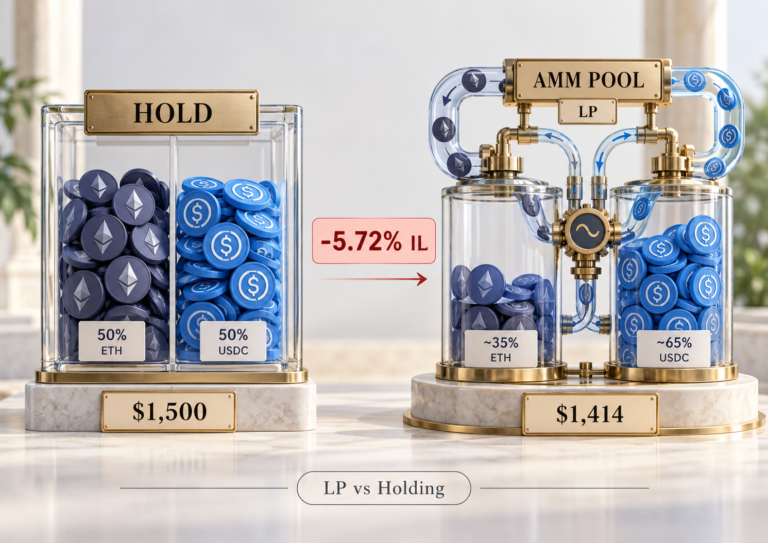
Ordinary single-asset USDC lending doesn’t involve the conventional impermanent loss associated with two-asset AMM liquidity pools. It can still experience losses from other causes.
Do I need ETH to lend USDC?
On Ethereum Mainnet, standard transactions generally require ETH for gas. Other networks use their own fee assets, while certain interfaces may support sponsored transactions.
Is USDC DeFi lending the same as a savings account?
No. DeFi lending uses smart contracts and does not automatically provide deposit insurance, fixed interest rates, or bank-style depositor protections.