
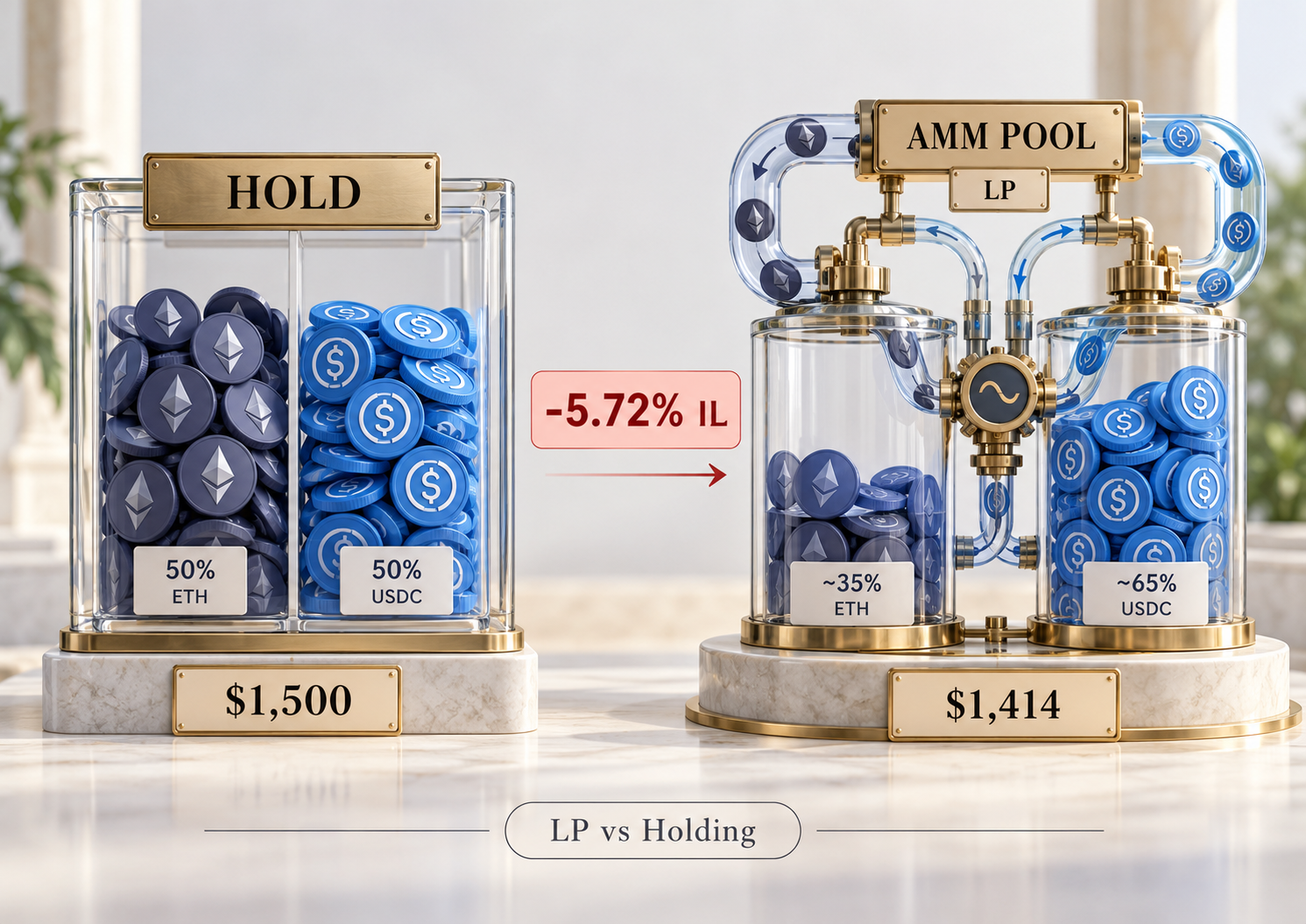
You deposit $1,000 into an ETH/USDC liquidity pool. ETH subsequently doubles in price, but your position grows to only $1,414 instead of the $1,500 you would have earned by simply holding the original tokens.
The missing $86 is impermanent loss.
Your liquidity pool position has gained value in dollar terms. The problem is that an automated market maker (AMM) continuously changes the quantities of ETH and USDC you hold as traders swap against the pool.
When prices move, this automatic rebalancing can leave liquidity providers worse off than investors who kept their original assets untouched.
The difference can be calculated precisely for a conventional 50/50 constant-product pool. Trading fees may offset it, but the amount of compensation depends on actual trading activity.
What Is Impermanent Loss in DeFi?
Impermanent loss (IL) is the difference between the current value of assets deposited in a liquidity pool and the value those same assets would have had if they had simply remained in your wallet.
It is a relative loss, not necessarily a decline in your investment’s dollar value.
Suppose you deposit $500 worth of ETH and $500 USDC.
If ETH appreciates, both your LP position and the original assets may increase in value. However, the liquidity pool automatically reduces its ETH holdings relative to its USDC holdings as traders rebalance the pool.
You therefore participate in less of ETH’s price appreciation than you would have by holding the initial amount.
The opposite happens when ETH falls. The pool accumulates more ETH, leaving you more exposed to the declining asset.
Impermanent loss measures this difference before trading fees and other costs.
Why Does Impermanent Loss Happen?
Traditional constant-product AMMs use a mathematical relationship between the quantities of two assets:
x × y = k
Here, x and y represent token quantities in the pool, while k is their constant product, ignoring the effect of trading fees.
Imagine an ETH/USDC pool containing:
- 10 ETH
- 20,000 USDC
- ETH market price: $2,000
The pool initially holds $40,000 in assets, split equally between ETH and USDC.
If ETH rises to $3,000, arbitrage trading changes the pool’s token quantities until its exchange rate reflects the external market.
Ignoring fees, the new balances are approximately 8.165 ETH and 24,495 USDC.
The pool now contains fewer ETH and more USDC.
This is not a discretionary portfolio decision. It follows from the AMM’s pricing formula and traders taking advantage of price differences.
The same mechanism operates in reverse when ETH declines: the pool ends up holding more ETH and less USDC.
For a liquidity provider, those changing token balances explain why returns differ from simply holding the original assets.
How to Calculate Impermanent Loss
The standard impermanent loss formula for a full-range 50/50 constant-product liquidity pool is:
IL = [2 × √r / (1 + r) − 1] × 100%
Where r represents the new relative price divided by the original relative price.
For an ETH/USDC pool, assuming USDC remains at $1:
r = New ETH Price / Initial ETH Price
If ETH increases from $2,000 to $3,000:
r = 3,000 / 2,000 = 1.5
Substituting into the formula:
IL = [2 × √1.5 / 2.5 − 1] × 100%
IL ≈ -2.02%
The negative result means the LP position is worth approximately 2.02% less than the value of holding the original tokens at the new prices.
It does not mean the entire investment has declined by 2.02%.
The percentage is measured relative to the holding benchmark, not the initial deposit.
Impermanent Loss at 20%, 50% and 100% Price Changes
The following table shows how a conventional 50/50 liquidity pool responds to changes in the relative price between its assets.
The calculations assume one asset changes in price while the other remains stable.
Impermanent Loss Calculation Table
| Price Change | Price Ratio | Impermanent Loss |
|---|---|---|
| -50% | 0.50 | -5.72% |
| -20% | 0.80 | -0.62% |
| 0% | 1.00 | 0.00% |
| +20% | 1.20 | -0.41% |
| +50% | 1.50 | -2.02% |
| +100% | 2.00 | -5.72% |
| +200% | 3.00 | -13.40% |
| +300% | 4.00 | -20.00% |
The figures reveal two useful characteristics.
First, impermanent loss increases nonlinearly. A relatively small price movement causes limited divergence, while substantial changes produce much larger losses against holding.
Second, a 100% price increase and a 50% price decrease produce the same 5.72% impermanent loss.
That symmetry comes from the reciprocal price ratios: 2 and 0.5.
However, a 20% rise and a 20% decline are not reciprocal changes. Their impermanent loss percentages therefore differ.
Impermanent Loss Example: $1,000 ETH/USDC Position
Consider an investor depositing $1,000 into a 50/50 ETH/USDC pool.
At the starting ETH price of $2,000, the deposit consists of:
- 0.25 ETH worth $500
- 500 USDC worth $500
Compare two strategies.
The first investor provides liquidity and receives a proportional claim on the pool’s changing balances.
The second investor keeps the original 0.25 ETH and 500 USDC in a wallet.
Assume no trading fees, gas costs, token depegging, or additional deposits.
Liquidity Pool vs Holding: Dollar Returns
| ETH Price Change | Holding Value | LP Value | LP Underperformance |
|---|---|---|---|
| -50% | $750.00 | $707.11 | $42.89 |
| -20% | $900.00 | $894.43 | $5.57 |
| 0% | $1,000.00 | $1,000.00 | $0.00 |
| +20% | $1,100.00 | $1,095.45 | $4.55 |
| +50% | $1,250.00 | $1,224.74 | $25.26 |
| +100% | $1,500.00 | $1,414.21 | $85.79 |
The LP value is calculated using:
LP Value = Initial Deposit × √r
This applies to the simplified 50/50 pool where one token remains at a constant dollar price.
At +100%, the investor’s LP position is worth approximately $1,414.21.
That represents a 41.42% gain on the original $1,000 investment.
Holding the original tokens would have generated a 50% gain.
The difference, approximately $85.79, is the dollar value of impermanent loss before fees.
Why Is Impermanent Loss Different From an Actual Portfolio Loss?
Impermanent loss and negative investment returns can occur independently.
An LP position can appreciate in value while underperforming holding, as demonstrated by the ETH doubling example.
It can also decline in dollar value while still collecting trading fees.
The comparison always requires two values at the same market prices:
- The current value of the LP position.
- The current value of the exact tokens originally deposited, assuming they were never traded.
This distinction is particularly important when using a liquidity pool loss calculator.
A tool showing -5.72% impermanent loss does not mean your account balance must have fallen by 5.72%.
It means the pool position is worth 5.72% less than the equivalent buy-and-hold portfolio before considering fee income.
Can Trading Fees Offset Impermanent Loss?
Trading fees are the main source of compensation for liquidity providers in ordinary AMM pools.
When users trade through the pool, a fee is charged according to its fee structure.
Liquidity providers earn a share based on their participation in the relevant liquidity.
Those earnings can partially or completely offset impermanent loss.
Consider the earlier example where ETH doubles.
| Metric | Amount |
|---|---|
| Initial deposit | $1,000.00 |
| LP value before fees | $1,414.21 |
| Holding value | $1,500.00 |
| Impermanent loss in dollars | $85.79 |
| Hypothetical earned fees | $100.00 |
| LP value including fees | $1,514.21 |
| LP advantage after fees | +$14.21 |
In this scenario, $100 in accumulated trading fees is enough to compensate for the $85.79 difference.
The liquidity provider ends up approximately $14.21 ahead of the holding strategy before gas and other costs.
However, the result depends on actually earning those fees.
High trading volume doesn’t guarantee sufficient fee income for every LP position. Returns depend on the pool’s fee rate, available liquidity, trading volume, and the provider’s share.
In some AMMs, fees accumulate within pool reserves. Other designs account for them separately and allow providers to claim them.
The mathematical comparison must avoid counting the same fees twice.
How Much Fee Income Is Needed to Break Even?
The break-even point occurs when earned trading fees equal the dollar difference between the holding portfolio and the LP position.
For the $1,000 example:
Break-Even Fees = Holding Value − LP Value
The required fee income depends on the size of the relative price change.
Break-Even Trading Fees for a $1,000 LP Deposit
| ETH Price Change | Impermanent Loss in Dollars | Fees Needed to Match Holding |
|---|---|---|
| -20% | $5.57 | $5.57 |
| +20% | $4.55 | $4.55 |
| +50% | $25.26 | $25.26 |
| +100% | $85.79 | $85.79 |
These numbers assume fees are earned in assets whose value is measured at the comparison date, with no other costs.
To estimate the required trading volume, you would also need the pool’s fee rate and your effective share of fee-generating liquidity.
For example, if an LP earns 0.03% of eligible traded volume as its effective fee income, generating $85.79 would require approximately $285,967 in such volume.
This is a simplified calculation. A provider’s liquidity share changes over time, and fees may accumulate across multiple price levels or transaction types.
Is Impermanent Loss Really Temporary?
The word “impermanent” refers to the possibility that the relative token price returns to its original level.
If the price ratio returns to 1 in a conventional constant-product pool, the theoretical impermanent loss falls back to zero, excluding fees and other effects.
That does not guarantee the price will return.
If you withdraw liquidity while the token ratio has changed, the difference compared with holding is realized in the assets you receive.
Even without withdrawing, the position’s current market value reflects the same relative underperformance.
An extended price trend can leave the pool substantially behind holding for an indefinite period.
For this reason, impermanent loss should be monitored as an ongoing portfolio exposure rather than dismissed as a temporary accounting issue.
What a Liquidity Pool Loss Calculator Should Include
A useful liquidity pool loss calculator should compare the value of an LP position with the unchanged original holdings.
For a conventional 50/50 pool, the required inputs are:
- Initial deposit amount.
- Initial prices of both assets.
- Current prices of both assets.
- Total accumulated trading fees.
- Gas, withdrawal, and other applicable transaction costs.
The output should show the value of holding, LP value before fees, impermanent loss percentage, impermanent loss in dollars, and net LP result after fees.
For two volatile assets, the relevant variable is their relative price ratio, not simply the USD change of one token.
If both assets appreciate 30% against the dollar while maintaining their original price ratio, the simplified pool experiences no impermanent loss despite a positive dollar return.
If one asset appreciates faster, the relative ratio changes and impermanent loss appears.
Does This Formula Work for Concentrated Liquidity?
Not directly.
The standard formula assumes a full-range 50/50 constant-product pool, similar to a conventional Uniswap v2-style AMM.
Concentrated liquidity positions operate within selected price ranges.
Their token composition changes according to the position’s lower and upper price boundaries.
A narrow liquidity range may produce larger underperformance relative to holding for the same price movement.
If price moves outside the active range, the position can become entirely composed of one token and stop earning fees until the market reenters that range.
Concentrated liquidity calculations therefore require additional inputs, including the entry price, range boundaries, and starting token quantities.
Weighted pools and other AMM designs also require different formulas.
Applying the standard 50/50 impermanent loss equation to every liquidity pool can produce misleading results.
Frequently Asked Questions
How do you calculate impermanent loss?
For a full-range 50/50 constant-product AMM, use IL = [2 × √r / (1 + r) − 1] × 100%, where r is the current relative token price divided by its initial value.
How much is impermanent loss if a token doubles?
A 100% increase in the relative token price produces approximately 5.72% impermanent loss compared with holding the original assets, excluding trading fees.
Is impermanent loss always negative?
Under the standard 50/50 constant-product model, impermanent loss is zero when relative prices are unchanged and negative when the relative price moves away from its initial value.
Can trading fees completely cover impermanent loss?
Yes. If accumulated fee income exceeds the dollar difference between the LP position and the holding benchmark, liquidity provision can outperform holding before other expenses.
Does impermanent loss happen in stablecoin pools?
It can occur whenever the relative prices of the deposited assets change. Stablecoin pairs may have smaller price movements under normal conditions, but depegging can create substantial losses.
Does impermanent loss disappear when prices recover?
In a simplified full-range constant-product pool, returning to the original relative price eliminates theoretical impermanent loss before fees. Real trading costs, contract mechanics, and changes in the position can affect the final result.
Is impermanent loss the same as losing money?
No. It measures underperformance compared with holding the original tokens. An LP investment can gain value in dollars while still experiencing impermanent loss.
Does impermanent loss apply to every AMM?
The general concept of comparing LP returns against holding applies broadly, but the standard 50/50 formula doesn’t apply unchanged to concentrated liquidity, weighted pools, or other AMM designs.