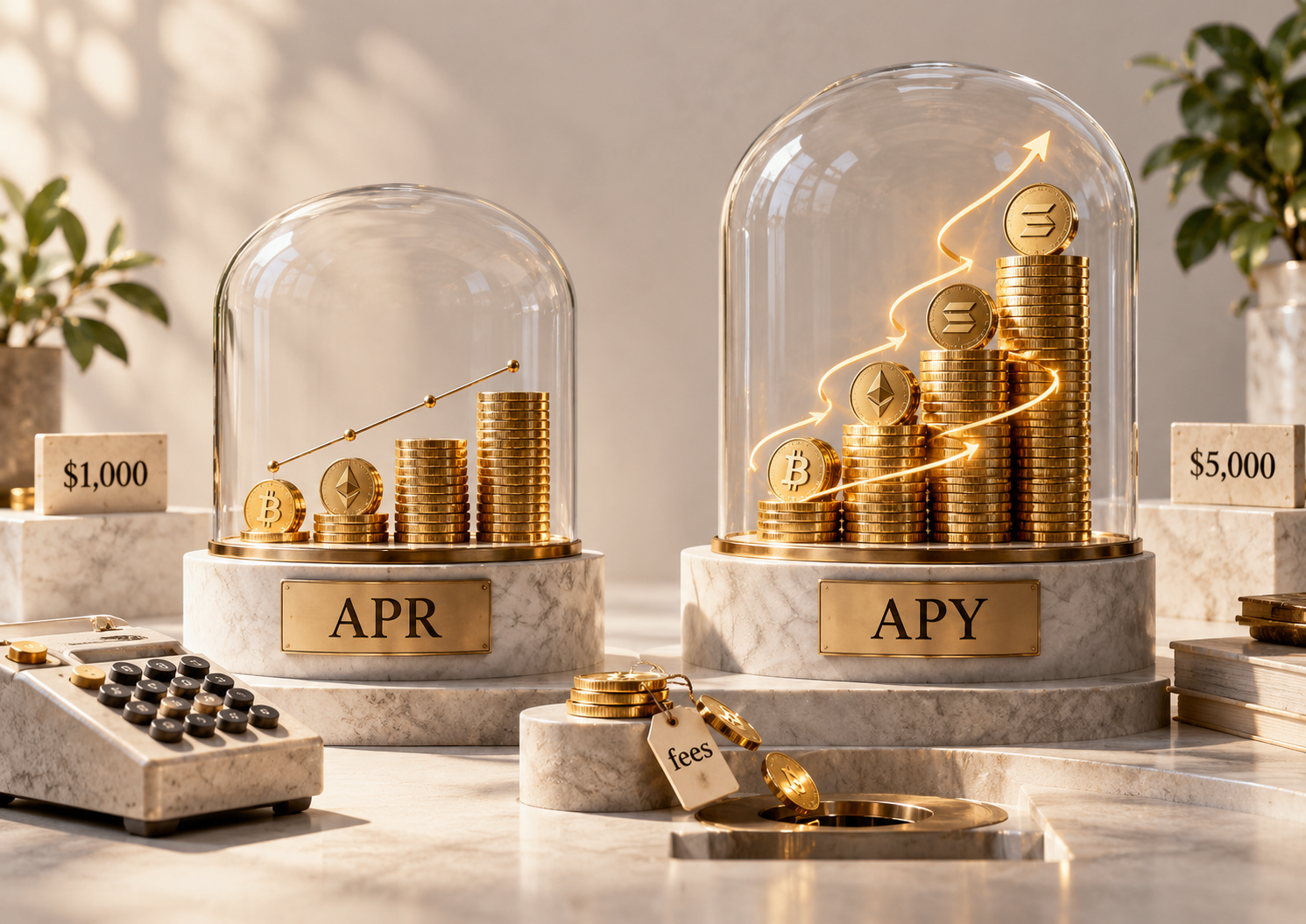
A DeFi dashboard advertises 12% APR. Another shows 12.7% APY. The second number looks more attractive, but both could describe almost identical returns.
The difference comes from compounding: whether earned interest is reinvested and begins generating additional interest.
For smaller deposits, transaction costs can matter more than the difference between APR and APY. A $1,000 position earning 12% annually generates only $120 before fees if returns aren’t compounded. Spending $40 on gas and reward claims would consume one-third of those earnings.
Accurately calculating crypto yield requires four inputs: the quoted rate, compounding frequency, investment period, and actual costs. Variable interest rates and token price movements add further uncertainty.
APR vs APY in Crypto: What’s the Difference?
APR (Annual Percentage Rate) expresses an annualized interest rate without including compound interest.
APY (Annual Percentage Yield) incorporates the effect of reinvesting earnings.
Suppose a position earns 12% APR on a $1,000 deposit.
Without compounding, the annual return is $120, bringing the balance to $1,120.
If earnings are added to the balance monthly at the same nominal APR, each month’s interest contributes to the next month’s interest calculation.
After one year, the balance reaches approximately $1,126.83.
The effective yield is 12.68% APY.
| Feature | APR | APY |
|---|---|---|
| Full name | Annual Percentage Rate | Annual Percentage Yield |
| Includes compounding | No | Yes |
| Assumes reinvestment | Not required | Yes, when yield compounds |
| Depends on compounding frequency | No | Yes |
| Includes gas fees automatically | No | No |
| Guarantees annual returns | No | No |
| Best used for | Simple annualized yield | Compounded annualized yield |
Neither APR nor APY necessarily represents the return an investor will actually receive.
DeFi dashboards frequently annualize current or recent earnings rates. Those rates may change substantially during the investment period.
How to Calculate DeFi APR
The basic APR calculation is straightforward.
Annual Interest = Principal × APR
For investments held for less than one year:
Interest = Principal × APR × (Days / 365)
This simplified formula assumes the quoted APR remains unchanged and interest accrues proportionally over time.
APR Returns on $1,000 and $5,000
Assume a constant 12% APR without compounding.
| Holding Period | $1,000 Deposit | $5,000 Deposit |
|---|---|---|
| 30 days | $9.86 | $49.32 |
| 90 days | $29.59 | $147.95 |
| 180 days | $59.18 | $295.89 |
| 365 days | $120.00 | $600.00 |
For a $5,000 deposit held 90 days:
$5,000 × 0.12 × (90 / 365) = $147.95
The calculation excludes fees and changes in the asset’s market value.
It’s also important to distinguish annualized rates from returns already earned. A dashboard displaying 12% APR doesn’t mean a 30-day position earns 12%.
APY Formula: How Compounding Changes Returns
Compounding occurs when earned yield is added to the amount generating future yield.
The standard formula is:
APY = (1 + APR / n)^n − 1
Where:
- APR is the nominal annual rate expressed as a decimal.
- n is the number of compounding periods per year.
For example, 12% APR compounded monthly gives:
APY = (1 + 0.12 / 12)^12 − 1
APY = 12.6825%
The formula assumes that the nominal rate stays constant, earned yield is reinvested every period, and fees don’t reduce the amount compounded.
In practice, some contracts automatically compound returns. Others distribute rewards separately, requiring additional transactions or conversions before reinvestment.
The displayed APY should match the actual compounding mechanism.
How Much Does Compounding Frequency Matter?
More frequent compounding increases the effective annual return when the nominal APR stays constant.
The additional benefit becomes progressively smaller as compounding frequency increases.
12% APR With Different Compounding Frequencies
| Compounding | Effective APY | $1,000 Annual Profit | $5,000 Annual Profit |
|---|---|---|---|
| None (annual) | 12.00% | $120.00 | $600.00 |
| Quarterly | 12.55% | $125.51 | $627.54 |
| Monthly | 12.68% | $126.83 | $634.13 |
| Weekly | 12.73% | $127.34 | $636.70 |
| Daily | 12.75% | $127.47 | $637.37 |
Illustrative calculations at a fixed 12% nominal APR, assuming all earnings are reinvested and no fees apply.
Moving from no compounding to daily compounding adds approximately $7.47 annually on a $1,000 deposit.
Moving from monthly to daily compounding adds only about $0.64.
For small balances, repeatedly paying transaction fees to compound more frequently could easily eliminate that additional return.
The optimal compounding frequency therefore depends on costs, not just the mathematical APY.
How to Calculate Real Yield After Gas Fees
Gas fees reduce the amount investors actually keep.
A DeFi position may require transactions to deposit funds, claim rewards, compound earnings, or withdraw assets.
Some strategies also charge management fees, performance fees, or withdrawal fees.
To measure net returns, subtract the costs from the value generated by the position.
Net Profit = Gross Earnings − Gas Fees − Other Costs
Net Return (%) = (Net Profit / Initial Investment) × 100
Example: 12% APR After Fees
Assume two investors deposit $1,000 and $5,000 for one year.
Both receive a fixed 12% APR without compounding and incur $40 in total fees.
| Metric | $1,000 Position | $5,000 Position |
|---|---|---|
| Initial investment | $1,000 | $5,000 |
| Gross annual earnings | $120 | $600 |
| Total fees | $40 | $40 |
| Net profit | $80 | $560 |
| Net annual return | 8.00% | 11.20% |
The same $40 expense reduces returns very differently depending on the deposit size.
For the $1,000 position, costs consume 33.3% of gross earnings.
For the $5,000 position, they consume only 6.7%.
This is why smaller DeFi deposits are particularly sensitive to network fees.
The calculation assumes fees are paid from the investment’s proceeds or otherwise charged against its economic return. If transaction costs are paid separately, they still belong in the investor’s total profit calculation.
Can Frequent Compounding Reduce Your Profit?
Yes. When compounding requires on-chain transactions, the additional interest may be smaller than the fees required to earn it.
Consider a $1,000 investment earning 12% APR.
Annual gross profit with monthly compounding is approximately $126.83.
Daily compounding produces approximately $127.47.
The additional annual return is only $0.64.
If switching to daily compounding requires even one extra transaction costing $2, the additional strategy is already less profitable under these assumptions.
Compounding Frequency vs Transaction Costs
| Metric | Monthly | Daily |
|---|---|---|
| Gross annual profit | $126.83 | $127.47 |
| Extra profit over monthly | — | $0.64 |
| Additional fees required | $0 | $10 |
| Profit after additional fees | $126.83 | $117.47 |
This comparison counts only incremental compounding fees, not baseline deposit, withdrawal, or other costs.
Automatic compounding mechanisms may avoid separate user-paid transactions or incorporate operational costs into their reported returns. Always check how fees are charged.
A higher theoretical APY is not necessarily a higher realized return.
How Changing APR Affects Your Actual Earnings
DeFi interest rates are often variable.
A position may display 15% APR today and 6% next month. Market demand, utilization, protocol incentives, and other factors can change the rate.
Annualizing a temporary high rate over 365 days can substantially overstate likely earnings.
Consider a $1,000 investment with monthly compounding.
For the first three months, APR is 12%. For the remaining nine months, it falls to 6%.
The calculation is:
Final Balance = $1,000 × (1 + 0.12 / 12)^3 × (1 + 0.06 / 12)^9
Final Balance ≈ $1,077.60
The actual modeled annual return is approximately 7.76%, not 12%.
Fixed vs Changing Rates
| Rate Scenario | Annual Return on $1,000 |
|---|---|
| 12% APR, no compounding | $120.00 |
| 12% APR, monthly compounding | $126.83 |
| 6% APR, monthly compounding | $61.68 |
| 12% APR for 3 months, then 6% for 9 months | $77.60 |
These are hypothetical scenarios, not historical DeFi performance figures.
For variable-rate investments, calculate returns using the rate applicable to each period rather than applying today’s displayed APR to the entire year.
Historical realized yield is often more informative than a single current rate, although it cannot guarantee future returns.
Crypto APY Explained: Why High Advertised Rates Can Mislead
A quoted APY is only as useful as the assumptions behind it.
Several factors can cause actual dollar returns to differ substantially from the headline percentage.
Reward Token Price Changes
Some yield calculations include rewards distributed in a separate cryptocurrency.
Suppose an investor receives 100 reward tokens valued at $2 each when the yield is quoted.
Their estimated reward value is $200.
If the token later trades at $1, those same 100 tokens are worth $100.
The investor still received the promised token quantity, but its dollar value declined by 50%.
Fees Not Included in APY
Quoted rates may exclude claiming costs, withdrawal fees, swap fees, slippage, or other expenses.
Always confirm whether the dashboard displays gross or net yield.
Short-Term Rates Annualized
A protocol may annualize returns observed during a brief period.
For instance, an unusually profitable day can produce an impressive projected APY that may not persist.
A displayed annual percentage is not evidence that the same return has been earned for a full year.
Changing Principal Value
If the deposited cryptocurrency changes in market value, dollar-denominated returns may differ from token-denominated returns.
Earning 5% more units of an asset doesn’t guarantee a positive USD return if the asset’s price falls significantly.
How to Use a DeFi Yield Calculator
A useful defi yield calculator should accept more than the advertised APR.
To calculate a realistic estimate, enter:
- Initial principal and its valuation currency.
- APR or APY, with the correct rate type.
- Holding period in days or months.
- Compounding frequency.
- Estimated deposit, withdrawal, and reward-related fees.
- Expected changes in interest rates, where applicable.
- Reward-token price assumptions if rewards are not denominated in the deposited asset.
For a constant APR with periodic compounding, the gross future balance is:
Future Value = Principal × (1 + APR / n)^(n × Years)
For a simple fixed-fee model:
Net Profit = Future Value − Principal − Total Fees
These formulas are suitable for straightforward yield calculations. More complex positions may require separate accounting for fees taken from principal, performance-based charges, changing balances, and rewards paid in other assets.
APR vs APY Crypto: Frequently Asked Questions
Is APR or APY better for comparing DeFi returns?
APY is useful when earnings actually compound. APR is useful for comparing nominal annualized rates. Convert both opportunities to the same basis and account for fees before comparing projected returns.
Is 10% APR equal to 10% APY?
Only when compounding does not increase returns over the year. At 10% APR with monthly compounding, effective APY is approximately 10.47%.
How much does $1,000 earn at 12% APY?
At a constant 12% APY over one full year, $1,000 grows to $1,120 before fees and asset-price changes. A 12% APR compounded monthly would instead produce about $126.83 in earnings.
Does APY include gas fees?
Not necessarily. Many advertised APY figures exclude user transaction costs. Review the calculation methodology and subtract applicable fees to estimate net returns.
Can DeFi APY change every day?
Yes. Variable interest rates, token incentives, and market conditions can change frequently. A displayed APY usually reflects current or recent conditions, not a guaranteed future return.
What is real yield after fees?
In personal return calculations, real yield after fees means the earnings remaining after transaction and other applicable costs. In DeFi industry terminology, “real yield” can also refer specifically to returns generated from economic revenue rather than token emissions. These meanings should not be confused.
Can daily compounding produce lower net returns than monthly compounding?
Yes. Daily compounding increases gross returns at a fixed APR, but additional transaction costs can outweigh the small compounding benefit.