A hardware wallet can be replaced. A lost or stolen recovery phrase is much harder to recover from.
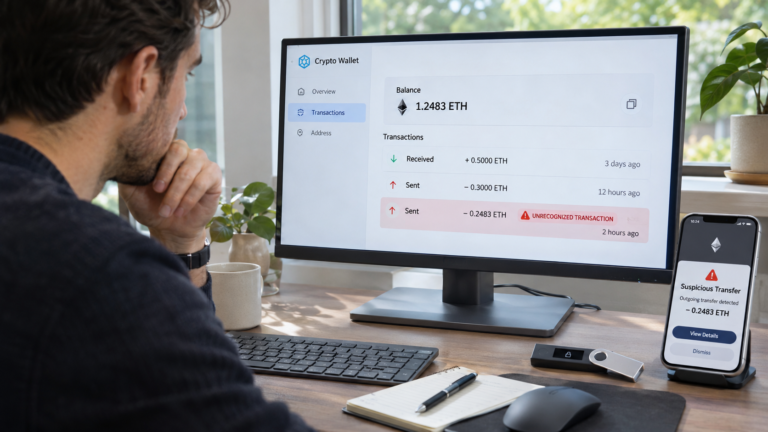
If someone obtains your crypto seed phrase, they may be able to restore your wallet on another device and transfer its assets without your permission. If both your wallet and its only backup are destroyed, access to your cryptocurrency may be permanently lost.
The challenge is protecting the same information against two opposite threats: unauthorized access and accidental destruction.
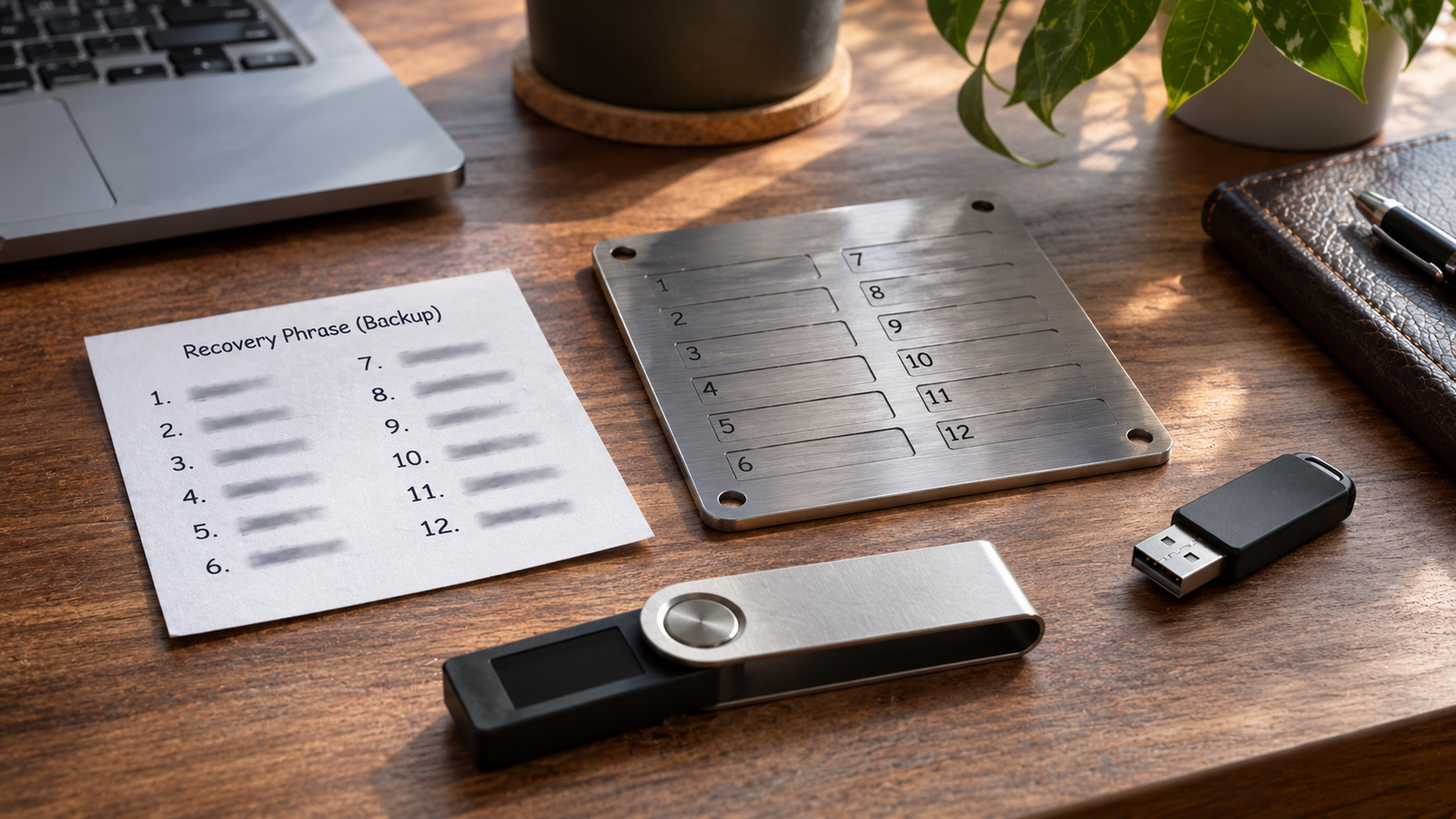
Paper backups are inexpensive and easy to create. Metal storage offers better resistance to physical damage. Digital backups are convenient but introduce additional cybersecurity risks.
The best way to store a seed phrase depends on the value being protected, your physical environment, and whether you can reliably recover the wallet when needed.
What Is a Crypto Seed Phrase?
A seed phrase, also called a recovery phrase or mnemonic, is an ordered sequence of words used to recover the private keys associated with a cryptocurrency wallet.
Many Bitcoin and Ethereum wallets use the BIP39 standard, which converts cryptographically generated random data into a human-readable list of words.
A recovery phrase isn’t the same as the password used to unlock a wallet application.
The password typically protects access to the software or device. The recovery phrase can restore the underlying wallet independently.
BIP39 Seed Phrase: Key Numbers
| Parameter | 12-Word Phrase | 24-Word Phrase |
|---|---|---|
| Initial entropy | 128 bits | 256 bits |
| Checksum | 4 bits | 8 bits |
| Total encoded bits | 132 | 264 |
| English wordlist | 2,048 words | 2,048 words |
| Words required in correct order | 12 | 24 |
Both lengths provide substantial security when generated correctly by trusted wallet software or hardware.
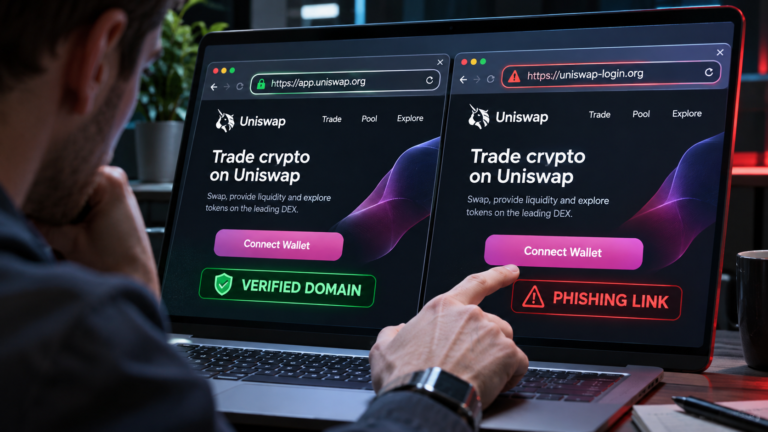
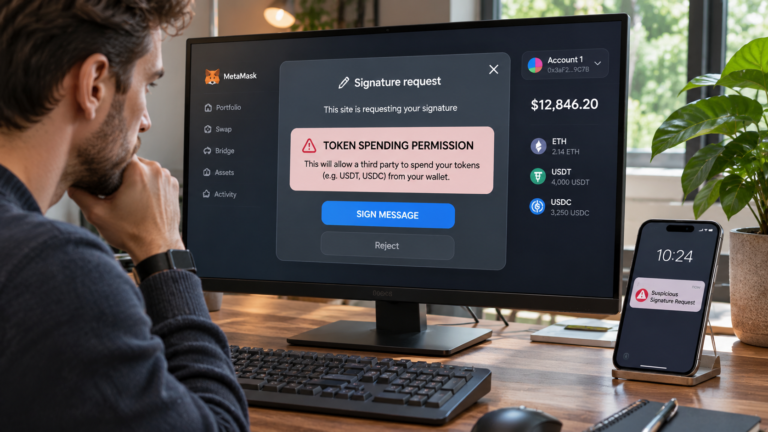
The larger concern for most users is not someone mathematically guessing their phrase. It’s phishing, unsafe storage, physical theft, or losing the backup.
Other recovery standards exist, including SLIP39. Always identify which standard your wallet uses before selecting a backup method.
Paper vs Metal vs Digital Seed Phrase Storage
Each storage method protects against different threats.
Seed Phrase Backup Methods Compared
| Feature | Paper | Metal | Digital |
|---|---|---|---|
| Typical initial cost | Very low | Low to high | Often free |
| Fire resistance | Poor | Generally better | Depends on storage system |
| Water resistance | Poor without protection | Generally strong | Depends on storage system |
| Remote hacking exposure | None while offline | None while offline | Potentially significant |
| Physical theft risk | Yes | Yes | Depends on access |
| Long-term durability | Limited | Generally high | Requires ongoing maintenance |
| Ease of recovery | Simple | Simple if readable | Depends on format and access |
| Suitable for offline backup | Yes | Yes | Only under carefully designed offline procedures |
Metal is usually the stronger choice for long-term physical durability.
Paper can still be adequate when protected and stored securely.
Ordinary digital copies, particularly unencrypted cloud files, create risks that physical backups avoid.
1. Paper Seed Phrase Backup: Cheap but Vulnerable
Writing recovery words on paper is the simplest backup method.
It requires no special equipment, software, or online service.
Paper also has an important security advantage: a handwritten phrase that has never been photographed, scanned, or entered into an internet-connected device cannot be remotely downloaded from that piece of paper.
However, paper is vulnerable to environmental damage.
Water can destroy writing, ink may fade, and fire can eliminate the backup entirely.
How to Store a Paper Seed Phrase Safely
Write the words clearly and preserve their exact order.
Use durable paper and permanent, water-resistant ink. Check every word against the original wallet setup screen.
Keep the backup inside a protective envelope or sleeve, then store it in a secure location with appropriate fire and water protection.
Avoid labeling the container with obvious descriptions such as “Bitcoin Password” or “Crypto Recovery Key.”
A paper backup should also be protected against unauthorized physical access.
If someone photographs or copies the recovery phrase, moving the paper afterward doesn’t invalidate the exposed secret.
When Paper Makes Sense
Paper is reasonable for beginners, small experimental wallets, and situations where the backup can be stored securely.
For substantial long-term holdings, its vulnerability to physical destruction may justify upgrading to metal.
2. Metal Seed Phrase Storage: Better for Long-Term Protection
Metal backups preserve recovery words using engraved, stamped, or punched characters.
Common materials include stainless steel and titanium.
Unlike paper, appropriately constructed metal backups can survive moisture and temperatures that would destroy ordinary documents.
However, not every product provides the same protection.
Common Metal Backup Designs
| Design | Main Advantage | Main Limitation |
|---|---|---|
| Stamped steel plate | Durable permanent markings | Setup requires care |
| Engraved titanium | Strong corrosion resistance | Can cost more |
| Removable letter tiles | Easier to assemble | Components may shift or escape |
| Punched metal template | Compact and durable | Incorrect punching can be difficult to correct |
Independent physical testing has shown that backup construction matters as much as the metal itself.
A poorly designed tile holder may fail under deformation, while a simple stamped plate can remain readable.
Metal storage doesn’t protect against someone stealing or photographing the phrase.
It improves durability, not confidentiality.
Is Metal Worth the Extra Cost?
The relevant comparison isn’t simply the purchase price of a steel plate.
It’s the potential loss if your only backup becomes unreadable.
For a wallet holding significant assets over many years, a durable physical backup may be a sensible expense.
For a small educational wallet, properly protected paper may be sufficient.
3. Is It Safe to Store a Seed Phrase Digitally?
Saving recovery words digitally is convenient, but convenience introduces new attack surfaces.
A screenshot may automatically synchronize to cloud storage.
A notes application may preserve copies across several devices.
A compromised email account could expose an attachment containing the recovery phrase.
Even deleting a file doesn’t guarantee that every synchronized or backed-up copy disappears.
Digital Seed Phrase Storage Risks
| Storage Method | Main Security Concern |
|---|---|
| Screenshot on smartphone | Cloud synchronization and device compromise |
| Google Drive or iCloud file | Account takeover or unauthorized sharing |
| Email draft | Email account compromise |
| Plaintext document | Malware and accidental disclosure |
| Password manager | Account or device compromise |
| USB drive | Theft, device failure and malware exposure |
| Purpose-built encrypted backup | Key management, recovery dependencies and provider risks |
For an ordinary self-custody wallet, the safer default is to keep the recovery phrase offline.
A dedicated encrypted recovery service is different from an unprotected text file. Some hardware-wallet providers offer systems that encrypt and distribute recovery information through specialized infrastructure.
However, these systems introduce their own security, identity verification, provider, and recovery assumptions.
Users should understand those trade-offs before choosing such a service.
Why Cloud Backup Is Particularly Risky
Cloud storage can create several copies of a recovery phrase without the owner realizing it.
A photo saved on one smartphone may become accessible through a tablet, computer, or web browser connected to the same account.
Attackers who compromise that account may obtain the image even without physical access to the original phone.
Two-factor authentication reduces account takeover risk but doesn’t eliminate every possible exposure.
For this reason, a conventional seed phrase should not be stored in Google Photos, iCloud Notes, email drafts, or ordinary cloud documents.
The same warning applies to websites offering to “check” or “validate” recovery phrases.
Legitimate blockchain explorers do not need your seed phrase.
Where Should You Keep a Physical Seed Phrase Backup?
A physically durable backup still needs a secure storage location.
The main considerations are unauthorized access, fire, flooding, accidental disposal, and your ability to retrieve it when necessary.
Physical Storage Options
| Location | Potential Advantage | Important Risk |
|---|---|---|
| Secure home safe | Convenient controlled access | Theft or local disaster |
| Bank safe deposit box | Separate physical location | Access restrictions and availability |
| Secure offsite storage | Protection from a single-site disaster | Additional custody risk |
| Hidden household location | Low cost | Accidental disposal or discovery |
| Multiple secured locations | Greater redundancy | More opportunities for exposure |
Keeping every backup in one building creates a single point of failure.
For larger holdings, a second securely stored copy at a separate location can reduce the risk of a fire or flood destroying all recovery information.
However, more copies also create more potential exposure points.
A good strategy balances redundancy with confidentiality.
Don’t create additional copies unless each can be protected adequately.
Should You Split Your Seed Phrase Into Multiple Parts?
Some users try to improve security by dividing a 24-word phrase into two groups of 12 words.
They then store each half in a different location.
This approach can create unexpected problems.
If either half is lost, recovery may become impossible. Improvised splitting also doesn’t provide the same security properties as a properly designed secret-sharing system.
For users who genuinely need distributed recovery, supported solutions such as SLIP39 or appropriately designed multisignature wallets may be more suitable.
These approaches require additional planning and careful backup verification.
For most beginners, one complete offline recovery phrase with carefully managed redundant copies is easier to maintain.
What Is a BIP39 Passphrase?
A BIP39 passphrase is an optional secret used together with the recovery phrase to derive a different wallet.
It is sometimes called a 25th word, although it doesn’t have to be one word or belong to the BIP39 wordlist.
The actual cryptographic process uses both the mnemonic and the passphrase.
A wallet generated using the same 24 recovery words but a different passphrase will generally produce different addresses.
Seed Phrase vs BIP39 Passphrase
| Feature | Seed Phrase | BIP39 Passphrase |
|---|---|---|
| Generated during standard wallet setup | Usually | Optional |
| Uses a fixed word sequence | Yes | No |
| Required to restore a passphrase-protected wallet | Yes | Yes |
| Can be changed without changing wallet addresses | No | No |
| Recoverable if forgotten | No | No |
| Should be stored securely | Yes | Yes |
A passphrase can add protection if someone discovers the underlying recovery words.
But it creates another secret that must be preserved exactly.
Capitalization, spaces, punctuation, and other characters matter.
If the passphrase is lost, the seed phrase alone cannot restore the associated passphrase-protected wallet.
There is no password reset procedure.
Should You Use a Passphrase?
For experienced users protecting substantial holdings, a well-managed passphrase can add another security layer.
For beginners, it may increase the probability of self-inflicted loss.
If you use one, maintain a reliable recovery plan and keep its backup separately protected from the seed phrase.
Avoid relying entirely on memory for a secret that may be needed many years later.
How to Verify Your Seed Phrase Backup
A recovery phrase is useful only if it can restore the intended wallet.
Writing down the words is not sufficient proof that the backup works.
The safest verification methods avoid entering the phrase into an internet-connected website or untrusted application.
Safe Seed Phrase Recovery Test
- Confirm that the number of words is correct.
- Check spelling, sequence, and readability.
- Use the hardware wallet’s official backup verification feature, if available.
- Alternatively, restore the phrase on a compatible spare trusted hardware wallet.
- Confirm that the expected wallet addresses appear.
- Verify any separately required BIP39 passphrase.
- Securely store the backup after successful verification.
Do not reset your only functioning wallet simply to test a backup that has never been verified.
If the phrase contains an error, resetting the device could permanently eliminate your remaining access.
A controlled recovery test should also account for wallet compatibility and account derivation settings.
Restoring the correct recovery words into different software may not immediately display every expected account.
Seed Phrase Storage Mistakes That Can Cost You Everything
The most dangerous mistakes are often simple.
Photographing a recovery phrase creates a digital copy that may persist in cloud backups.
Saving it in an email draft exposes it to email account security failures.
Storing all physical copies together leaves them vulnerable to one disaster.
Another common mistake is confusing a wallet password with the recovery phrase.
Changing the application password does not invalidate an exposed seed phrase.
If someone may have obtained your recovery words, the safe response is to create a new wallet with a freshly generated recovery phrase and transfer the remaining assets.
The compromised phrase should no longer be trusted.
Which Seed Phrase Storage Method Should You Choose?
The practical choice depends on your needs rather than the price or appearance of a particular backup product.
Seed Phrase Storage Recommendations
| User Situation | Reasonable Starting Approach |
|---|---|
| Beginner with a small wallet | Protected offline paper backup |
| Long-term hardware wallet holder | Durable metal backup |
| Holdings vulnerable to local disasters | Secure offsite redundancy |
| Advanced user requiring distributed recovery | Supported secret-sharing or multisig system |
| User considering ordinary cloud storage | Prefer an offline alternative |
| Passphrase-protected wallet | Separate, verified recovery arrangements |
No method guarantees perfect security.
An expensive metal backup won’t help if someone discovers it, while an elaborate recovery setup can fail if the owner forgets how to reconstruct it.
The best arrangement is one you can secure, maintain, and successfully use when your wallet needs to be restored.
Frequently Asked Questions
What is the safest way to store a crypto seed phrase?
An accurately recorded offline backup in a secure location is a strong default. Metal improves physical durability, while secure redundancy can reduce the risk of losing the only copy.
Is metal better than paper for seed phrase storage?
Metal generally offers better resistance to fire, water, and deterioration. Paper is less durable but can remain practical when carefully protected.
Is it safe to store a seed phrase in Google Drive?
Ordinary cloud storage is not recommended for conventional recovery phrases because account compromise, synchronization, and unauthorized access can expose the secret.
Can I save my seed phrase in a password manager?
It creates additional digital security dependencies. For standard self-custody backups, an offline physical record is generally preferable.
Should I keep two copies of my seed phrase?
Redundant copies can protect against accidental destruction, provided each is secured and preferably kept in a separate location.
What happens if someone finds my seed phrase?
They may be able to restore your wallet and transfer its assets. Treat the phrase as compromised and move recoverable funds to a new wallet with fresh keys.
Is a 24-word seed phrase safer than 12 words?
A 24-word BIP39 phrase represents more entropy, but a properly generated 12-word phrase already provides strong protection against brute-force guessing. Storage and exposure risks are usually more immediate concerns.
What happens if I forget my BIP39 passphrase?
The passphrase-protected wallet generally cannot be recovered using the seed phrase alone. Each distinct passphrase derives a different wallet.
How often should I check my seed phrase backup?
Inspect it after initial setup and periodically afterward, particularly if the storage environment changes. Use official verification features without unnecessarily exposing the words.
Can I recover my crypto without a seed phrase?
Sometimes, if you retain another functioning device, an equivalent recovery backup, or a supported recovery arrangement. Without any valid recovery method or existing access, self-custodied assets may become permanently inaccessible.