A cryptocurrency transaction can be sent to the wrong address even when the recipient looks familiar. Attackers exploit this by placing nearly identical wallet addresses into transaction histories, hoping users will copy them during their next transfer.
The technique is called crypto address poisoning.
Unlike private-key theft or malicious smart contract approvals, address poisoning usually doesn’t require hackers to access your wallet. Instead, they manipulate what appears in its activity history.
The threat is substantial. Research by Carnegie Mellon University identified approximately 270 million poisoning attempts targeting 17 million addresses across Ethereum and BNB Smart Chain, with at least $83.8 million in confirmed losses during the study period.
A more recent Ethereum investigation covering the 12 months through July 2026 identified approximately $76.1 million in losses affecting 1,635 victims.
The main defense is straightforward: never trust a wallet address simply because it appears in your transaction history.
What Is Crypto Address Poisoning?
Crypto address poisoning is a scam in which attackers insert deceptive wallet addresses into a user’s transaction history.
The malicious address is designed to resemble an address the victim already knows or has previously used.
Cryptocurrency addresses are long strings of characters. Wallet applications frequently shorten them to display only the beginning and ending characters.
Scammers exploit this formatting.
They generate addresses matching portions of a legitimate destination, then create small or zero-value transactions that make those addresses appear in the victim’s activity history.
Later, the victim copies the wrong address and sends real funds directly to the attacker.
The blockchain processes the transaction normally because the submitted destination is technically valid.
How Does an Address Poisoning Scam Work?
A typical attack follows five stages.
Step 1: The Victim Makes a Legitimate Transfer
Suppose someone regularly sends USDT from a personal wallet to an exchange deposit address.
That transaction becomes publicly visible on the blockchain.
Automated monitoring systems can identify the sender, recipient, token, and transfer amount.
Step 2: The Attacker Generates a Similar Address
The scammer creates numerous wallet addresses until one resembles the legitimate destination.
These are often called vanity addresses.
The attacker may target the first four and last four characters because those are commonly displayed in wallet interfaces.
Step 3: A Fake Transaction Appears
The attacker sends a tiny amount of cryptocurrency or generates a deceptive token transfer event.
This inserts the lookalike address into the victim’s transaction history.
Step 4: The Victim Copies the Wrong Address
During a later transfer, the user opens recent activity and copies the seemingly familiar address.
The beginning and ending characters look correct, so the middle characters are overlooked.
Step 5: Funds Reach the Attacker
The user signs a legitimate blockchain transaction, but the destination belongs to the scammer.
Once confirmed, the transfer generally cannot be reversed.
Real vs Fake Crypto Wallet Addresses
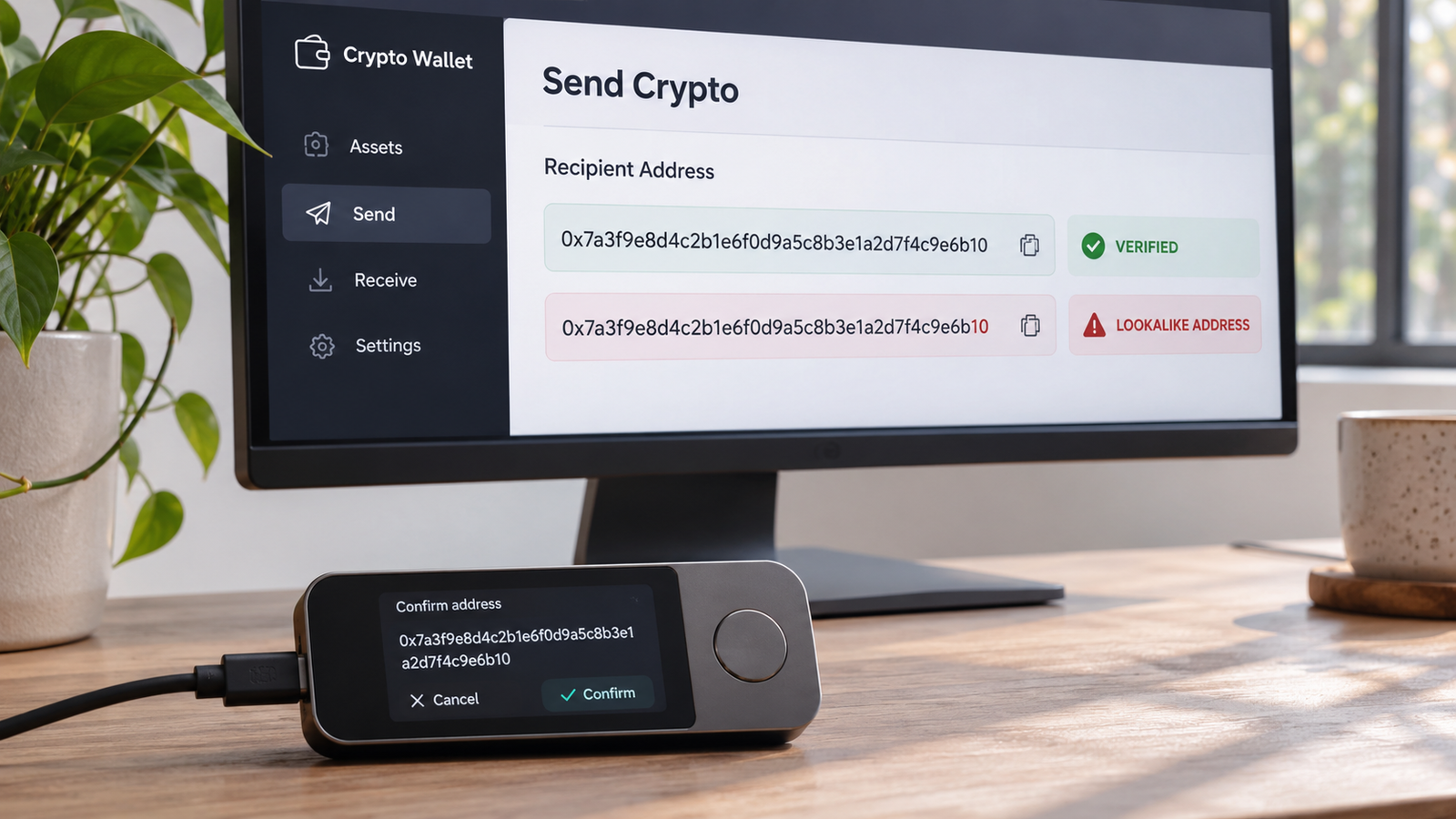
Consider two shortened Ethereum-style addresses.
| Address Type | Displayed Address |
|---|---|
| Legitimate | 0xA84F21...9C72B6 |
| Attacker-controlled | 0xA84F21...9C72B6 |
Both appear identical when shortened.
Their full addresses, however, have different middle characters.
This is why verifying only the first and last four characters is insufficient.
The examples are illustrative shortened strings, not actual wallet addresses.
Why Address Similarity Is Dangerous
| Verification Method | Risk |
|---|---|
| Check first 4 characters | High |
| Check first and last 4 characters | Still vulnerable |
| Compare 10 characters at each end | Better, but incomplete |
| Compare the entire address | Stronger verification |
| Use a previously authenticated address book | Reduces repeated copying errors |
Attackers cannot generally choose an arbitrary entire Ethereum address. They search for addresses matching selected visible characters.
Matching additional characters becomes increasingly computationally expensive, but partial matches remain feasible.
Zero-Value Token Transfers Explained
One common wallet address poisoning technique involves zero-value ERC-20 transfers.
Certain token contract implementations allow a zero-value transferFrom operation to generate a transfer event without moving tokens.
An attacker may exploit this behavior to create a misleading activity record.
The event can make it appear that a familiar address participated in a transaction, even though no genuine payment occurred.
Zero-Value Transfer vs Real Transaction
| Characteristic | Zero-Value Poisoning | Legitimate Transfer |
|---|---|---|
| Tokens moved | Usually zero | Positive amount |
| Actual recipient | Attacker’s lookalike | Intended recipient |
| Transaction history entry | May appear | Normally appears |
| Requires stolen seed phrase | No | No |
| Main objective | Mislead future transfers | Transfer assets |
Block explorers such as Etherscan have introduced protections that hide or flag suspicious zero-value transfers.
However, the same activity may appear differently across wallets and analytics platforms.
A zero-value transfer appearing in your history doesn’t, by itself, mean your private keys have been compromised.
Fake Tokens and Spoofed Transaction Histories
Attackers also use fake tokens to create believable transaction records.
For example, a malicious contract may use the same name and ticker as a legitimate stablecoin.
An interface that displays only the token symbol could make the activity look like a genuine USDT or USDC transfer.
The underlying token contract address reveals the difference.
Address Poisoning Attack Types
| Technique | How It Works | Main Warning Sign |
|---|---|---|
| Dust transfer | Sends a tiny amount from a lookalike address | Unexpected small incoming transfer |
| Zero-value transfer | Creates a misleading transfer event | Zero-token activity |
| Fake token transfer | Uses an imitation token contract | Familiar ticker, unknown contract |
| Event spoofing | Produces deceptive transaction logs | Activity inconsistent with actual transfers |
| Address impersonation | Matches parts of a known wallet address | Similar prefix and suffix |
The attacker doesn’t need to change an existing blockchain transaction.
Instead, the scam creates additional activity designed to look legitimate.
This distinction matters because historical blockchain records remain intact even when an interface displays misleading entries.
How Common Are Crypto Address Poisoning Attacks?
Address poisoning is attractive to criminals because individual attempts can be automated and relatively inexpensive.
A large campaign can target thousands of wallets without directly compromising any of them.
Address Poisoning Statistics
| Metric | Reported Finding |
|---|---|
| Attack attempts in major academic study | ~270M |
| Targeted addresses | ~17M |
| Confirmed losses in study | At least $83.8M |
| Ethereum wallets targeted in later 12-month analysis | ~8M |
| Ethereum victims who sent funds to fake addresses | 1,635 |
| Measured Ethereum losses | ~$76.1M |
| Median loss in later analysis | ~$300 |
The academic study covers July 2022–June 2024. The later Ethereum analysis covers August 2025–July 2026. These datasets overlap in subject but not in methodology or network scope and should not be combined.
The relatively small number of successful thefts compared with attempted attacks doesn’t make the technique harmless.
A single mistaken high-value transfer can generate substantial losses.
Attackers often concentrate on active addresses with significant balances or frequent stablecoin transactions.
How to Prevent Address Poisoning
The safest approach is to treat destination addresses as sensitive transaction instructions rather than ordinary text.
1. Never Copy Addresses From Recent Transaction History
Your wallet’s activity history contains public blockchain information.
Attackers can add entries without controlling your account.
For repeated transfers, retrieve the recipient’s address from a trusted, independently verified source.
For exchange deposits, open the exchange’s authenticated deposit page and confirm the address and network.
2. Verify the Full Destination Address
Before signing, compare the entire receiving address against the verified original.
Do not rely exclusively on the first and last characters.
For large transfers, confirm the address through an independent communication channel when possible.
A familiar address displayed in a wallet is not proof of ownership.
3. Use a Verified Address Book
Many exchanges and cryptocurrency wallets provide address books, contacts, or withdrawal allowlists.
These features reduce the need to copy addresses from recent activity.
Save an address only after verifying it.
If an exchange changes its deposit address, repeat the verification process instead of assuming the previous entry remains valid.
An address book protects against some copying mistakes, but it doesn’t help if the original saved address was incorrect or the account storing it is compromised.
4. Check Clipboard Contents
Clipboard malware is separate from address poisoning but can produce a similar result.
Some malicious programs replace a copied cryptocurrency address with an attacker-controlled one.
After pasting an address, compare the entire result with the trusted source.
For hardware wallets, check the destination displayed on the physical device before approving the transaction.
5. Send a Small Test Transaction
For unfamiliar destinations or large transfers, send a small amount first.
Verify that the intended recipient actually received the funds.
Only then consider transferring the remaining amount.
The test should use the same verified destination and blockchain network.
A successful test doesn’t replace full address verification. Never copy a destination from an untrusted history entry for the main transfer.
Safe Crypto Transfer Checklist
| Step | Required Check |
|---|---|
| 1 | Obtain address from trusted recipient |
| 2 | Confirm the correct blockchain network |
| 3 | Compare the full destination address |
| 4 | Check any required memo or tag |
| 5 | Verify the address after pasting |
| 6 | Send a small test amount when practical |
| 7 | Confirm receipt with the intended recipient |
| 8 | Recheck the destination before final transfer |
This process takes more time than copying a recent transaction, but it directly addresses the mechanism that makes poisoning attacks successful.
How to Check if Your Wallet Has Been Targeted
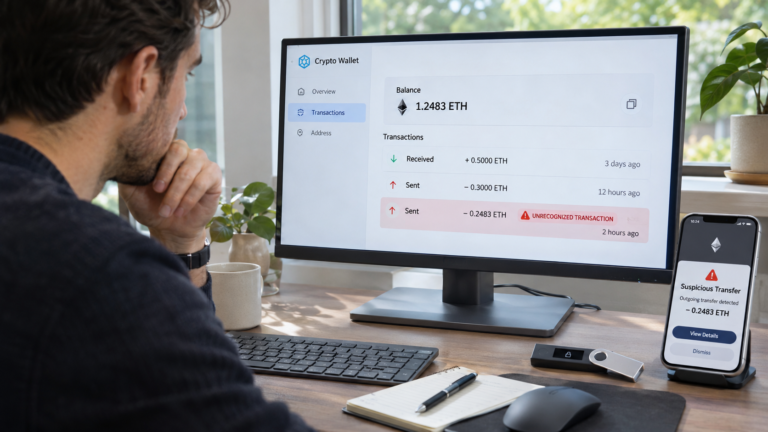
If unfamiliar transactions appear in your wallet, begin by examining them through an appropriate blockchain explorer.
Look for repeated zero-value transfers, unknown tokens, and addresses resembling previous recipients.
Inspect the actual token contract rather than relying solely on its name.
Compare suspicious wallet addresses with the legitimate destinations stored in your verified records.
If no unauthorized asset movement occurred, receiving a poisoning transaction alone generally does not require replacing your wallet or changing its seed phrase.
There is no need to interact with unsolicited tokens or send funds back to unknown addresses.
Some wallet applications also provide options to hide suspicious assets or transaction entries.
Hiding these entries can make the interface easier to use, although it doesn’t erase the underlying blockchain records.
What to Do if You Sent Crypto to a Fake Address
If a transfer has already reached an attacker-controlled address, recovery is difficult.
Confirmed blockchain transactions generally cannot be canceled by the sender.
However, preserving evidence may help an investigation.
Record the transaction hash, receiving address, amount, timestamp, and relevant wallet activity.
If the funds were subsequently transferred to a centralized exchange, report the incident through that exchange’s official support process.
You can also file a report with the relevant law enforcement or cybercrime authority.
Do not trust third parties promising guaranteed cryptocurrency recovery.
An address poisoning victim may still have secure private keys. Moving the remaining funds to a new wallet won’t reverse the mistaken payment and is not automatically necessary unless separate evidence suggests account compromise.
Address Poisoning vs Wallet Hacking
These threats are often confused, but their mechanics differ.
| Feature | Address Poisoning | Private-Key Compromise |
|---|---|---|
| Attacker controls victim’s keys | Usually no | Yes |
| Requires victim to send funds | Usually yes | Not necessarily |
| Fake activity history | Common | Not required |
| Revoke token approvals to fix | Usually irrelevant | Insufficient |
| New wallet required | Not automatically | Yes |
| Main defense | Verify recipient address | Protect keys and recovery phrase |
Address poisoning exploits the user’s destination selection.
Private-key compromise allows an attacker to authorize transactions directly.
Identifying the correct threat prevents unnecessary actions and helps users focus on the actual security problem.
Frequently Asked Questions
What is crypto address poisoning?
It is a scam where attackers place lookalike cryptocurrency addresses into transaction histories, hoping users copy them and send funds to the wrong recipient.
Can address poisoning steal crypto automatically?
Usually not. The attack generally relies on the victim signing a transfer to the fake destination. Receiving a poisoning transaction alone doesn’t grant access to private keys.
What is a zero-value transfer scam?
It involves generating a zero-token transfer event that can create misleading wallet activity without transferring actual funds.
How do scammers create similar wallet addresses?
They generate many addresses until one matches selected characters of a target address, usually the visible beginning and ending portions.
Should I change my wallet after address poisoning?
Not necessarily. If your keys remain secure and no additional compromise occurred, the main task is avoiding the fake address. A new wallet is needed when keys or recovery credentials are exposed.
Is copying an address from Etherscan safe?
Only if you independently verify that the address belongs to the intended recipient. Public transaction histories can contain deceptive entries.
Do hardware wallets prevent address poisoning?
They can provide an additional verification checkpoint by displaying the destination before signing, but users must still check the address carefully.
Can stolen crypto be recovered after an address poisoning scam?
Recovery is uncertain because confirmed blockchain transfers generally cannot be reversed. Preserve transaction evidence and report the incident through legitimate channels.