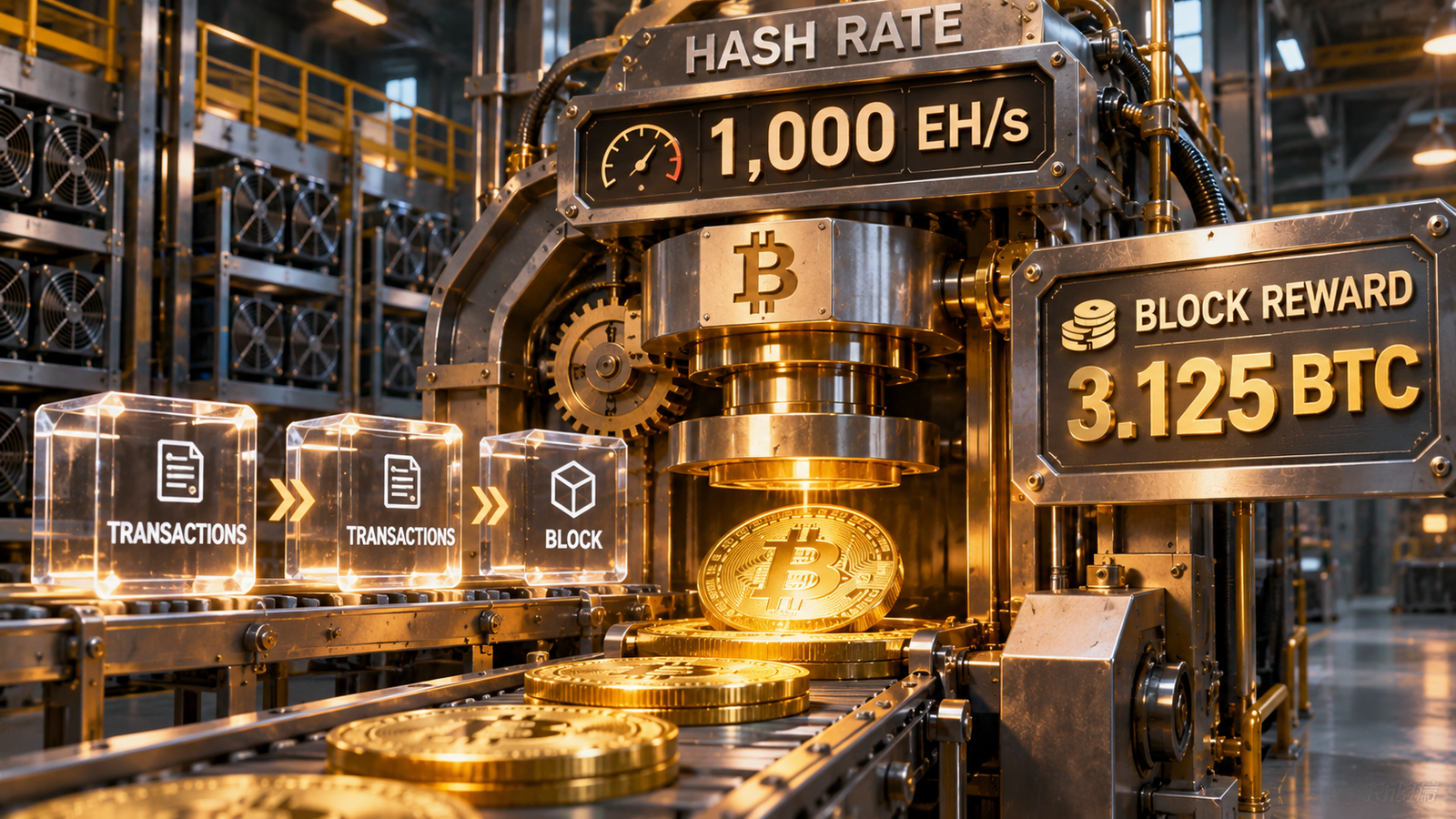
Bitcoin produces a new block approximately every 10 minutes. Behind that process are specialized computers performing trillions of calculations per second, competing for the opportunity to add transactions to the blockchain.
This is cryptocurrency mining. Despite the name, miners aren’t digging digital coins out of a database. They’re using computing power to secure a decentralized network, establish the order of transactions, and earn rewards according to rules enforced by the network.
Bitcoin miners currently receive a subsidy of 3.125 BTC for a valid block, plus the transaction fees included in that block. At the network’s target pace, that works out to roughly 450 newly issued BTC per day.
But not every cryptocurrency uses mining, and buying powerful hardware doesn’t guarantee that an individual miner will earn Bitcoin.
Understanding how does crypto mining work begins with the blockchain itself.
What Is Cryptocurrency Mining?
Cryptocurrency mining is the process of competing to create valid blocks on blockchains that use a consensus mechanism called Proof of Work (PoW).
A block contains a collection of transactions and information connecting it to the previous block.
Miners compete to produce a cryptographic result that meets the network’s difficulty requirements.
The successful miner broadcasts the block, and other network nodes independently check whether it follows the rules.
If accepted into the blockchain, the miner can earn newly issued cryptocurrency and transaction fees.
Mining serves three main purposes:
- Helps establish a shared transaction history without a central operator.
- Makes rewriting confirmed blockchain history computationally expensive.
- Distributes newly issued coins according to a predictable schedule.
Mining is most closely associated with Bitcoin, although other blockchains also use Proof of Work.
How Does Crypto Mining Work Step by Step?
The mining process becomes easier to understand when divided into the stages involved in creating a Bitcoin block.
Step 1: Users Send Bitcoin Transactions
A Bitcoin transaction begins when someone transfers BTC from one address to another.
The transaction is signed using the sender’s private key and broadcast to the network.
Bitcoin nodes check whether it follows the protocol’s rules, including whether the inputs are valid and have not already been spent.
Valid unconfirmed transactions may enter a node’s mempool, where they wait for inclusion in a block.
Step 2: Miners Build a Candidate Block
Miners select transactions for inclusion, generally considering transaction fees and the available block space.
They construct a candidate block containing those transactions, a reference to the previous block, and other required information.
The miner also includes a special transaction called a coinbase transaction, which specifies the permitted block reward.
Step 3: Mining Hardware Searches for a Valid Hash
The mining equipment repeatedly calculates cryptographic hashes of candidate block headers.
For Bitcoin, the Proof of Work calculation uses SHA-256 twice.
Each calculation produces a 256-bit result.
A valid block hash must be below the network’s current target.
Miners change values in the candidate block and try again until someone finds a qualifying result.
There is no reliable shortcut that lets a miner predict the winning hash.
Step 4: The Successful Block Is Broadcast
When a miner finds a valid hash, it sends the candidate block to other nodes.
Those nodes verify the transactions, block structure, Proof of Work, and reward amount.
If the block follows the consensus rules, nodes can accept it as part of their blockchain.
Step 5: The Miner Receives a Reward
A successful miner is entitled to the block subsidy and included transaction fees.
The coinbase transaction’s outputs cannot be spent until they reach the required maturity of 100 additional blocks.
The entire process then repeats as miners compete to produce the next block.
What Is Proof of Work Mining?
Proof of Work is the mechanism Bitcoin uses to determine which blocks can be added to its transaction history.
The miner must demonstrate that substantial computational work was performed by producing a valid hash.
Finding that hash is difficult because it requires repeated attempts.
Checking the result is comparatively easy.
This difference allows ordinary nodes to verify blocks without performing the enormous number of calculations involved in finding them.
Why Proof of Work Matters
Suppose an attacker wants to replace a previously confirmed Bitcoin transaction.
The attacker would need to rebuild the Proof of Work for the affected block and compete with the continuing work of the honest network.
As additional blocks accumulate, rewriting that history becomes increasingly difficult.
Mining therefore helps protect transaction history against unauthorized changes.
However, Proof of Work doesn’t make a blockchain completely immune to attack. Its security depends partly on the distribution and amount of mining power securing the network.
What Is Hash Rate in Crypto Mining?
Hash rate measures how many hash calculations mining equipment performs per second.
Higher hash rate generally means more attempts to discover a valid block hash.
Crypto Mining Hash Rate Units
| Unit | Hashes per Second |
|---|---|
| 1 KH/s | 1,000 |
| 1 MH/s | 1 million |
| 1 GH/s | 1 billion |
| 1 TH/s | 1 trillion |
| 1 PH/s | 1 quadrillion |
| 1 EH/s | 1 quintillion |
A Bitcoin ASIC rated at 200 TH/s performs approximately 200 trillion hash calculations per second.
That sounds enormous, but Bitcoin’s total network hash rate is much larger.
A miner’s expected share of block rewards depends on its proportion of total network computing power.
Mining Probability Example
Assume:
- Miner hash rate: 200 TH/s.
- Network hash rate: 1,000 EH/s.
- Average blocks per day: 144.
The miner controls approximately 0.00002% of network hash rate.
Its expected share of 144 daily blocks is approximately 0.0000288 blocks per day.
At 3.125 BTC per block, its expected gross subsidy is around 0.00009 BTC per day.
This calculation ignores transaction fees, mining pool fees, downtime, and changes in network difficulty.
It represents a statistical expectation, not a guaranteed daily payout.
How Bitcoin Mining Difficulty Works
Bitcoin aims to produce one block approximately every 10 minutes on average.
If miners continuously add more powerful hardware, blocks would be discovered faster unless the protocol adjusted.
Bitcoin addresses this through mining difficulty adjustments.
Every 2,016 blocks, roughly two weeks at the target pace, the network recalculates the difficulty target according to how quickly the previous interval was mined.
If blocks arrived too quickly, mining becomes harder.
If they arrived too slowly, difficulty decreases, subject to protocol limits.
Bitcoin Mining: Key Network Parameters
| Parameter | Bitcoin |
|---|---|
| Consensus mechanism | Proof of Work |
| Hash algorithm | SHA-256 |
| Target block interval | 10 minutes |
| Difficulty adjustment | Every 2,016 blocks |
| Current block subsidy (2026) | 3.125 BTC |
| Subsidy halving interval | 210,000 blocks |
| Maximum supply | Approximately 21 million BTC |
| Next expected halving | 2028 |
Difficulty adjusts the probability of discovering valid blocks. It does not determine Bitcoin’s market price or guarantee miner profitability.
Where Do Crypto Mining Rewards Come From?
Bitcoin mining rewards have two components.
The first is the block subsidy: newly created BTC issued according to the protocol’s monetary schedule.
The second is transaction fees paid by users whose transactions are included in the block.
Block Reward = Block Subsidy + Transaction Fees
For example, suppose a miner produces a block containing 0.12 BTC in transaction fees.
With the current subsidy of 3.125 BTC:
Total Block Reward = 3.125 + 0.12 = 3.245 BTC
The subsidy creates new Bitcoin.
Transaction fees transfer existing Bitcoin from users to the miner.
This distinction becomes increasingly important because the subsidy decreases over time.
Bitcoin Halving: Why Mining Rewards Keep Falling
Bitcoin reduces its block subsidy by 50% every 210,000 blocks, approximately once every four years.
This event is called the halving.
Historical Bitcoin Mining Rewards
| Period | Subsidy per Block | Approximate New BTC per Day |
|---|---|---|
| 2009–2012 | 50 BTC | 7,200 BTC |
| 2012–2016 | 25 BTC | 3,600 BTC |
| 2016–2020 | 12.5 BTC | 1,800 BTC |
| 2020–2024 | 6.25 BTC | 900 BTC |
| 2024–2028 | 3.125 BTC | 450 BTC |
| 2028–2032, expected | 1.5625 BTC | 225 BTC |
Daily issuance assumes 144 blocks. Actual production varies because block discovery is probabilistic.
The April 2024 halving reduced the subsidy from 6.25 to 3.125 BTC.
The next is expected around 2028, when the subsidy will decline to 1.5625 BTC.
Over time, Bitcoin issuance approaches its maximum supply of approximately 21 million coins.
Around 2140, the block subsidy is expected to reach zero.
At that stage, transaction fees would become the only direct block rewards available to Bitcoin miners.
Whether those fees will provide sufficient long-term security incentives remains an important economic question.
What Equipment Do Crypto Miners Use?
Mining equipment depends on the cryptocurrency and its Proof of Work algorithm.
Early Bitcoin miners could use ordinary computer processors.
As competition increased, mining moved toward graphics cards and eventually specialized machines known as ASICs.
Mining Hardware Compared
| Hardware | Main Characteristics | Typical Use |
|---|---|---|
| CPU | General-purpose processor | Selected CPU-oriented PoW coins |
| GPU | Parallel computing hardware | GPU-compatible mining algorithms |
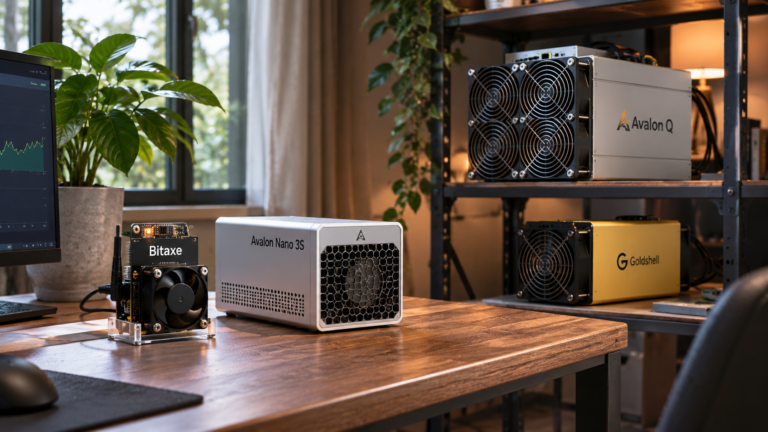
| ASIC | Specialized mining hardware | Bitcoin and other supported algorithms |
| Mining farm | Large collection of mining devices | Industrial-scale operations |
Modern Bitcoin mining is dominated by ASIC hardware designed specifically for SHA-256 calculations.
A normal laptop can technically perform Bitcoin hashes, but its mining output would be negligible compared with specialized equipment.
Electricity consumption and cooling requirements also make hardware efficiency important.
Solo Mining vs Mining Pools
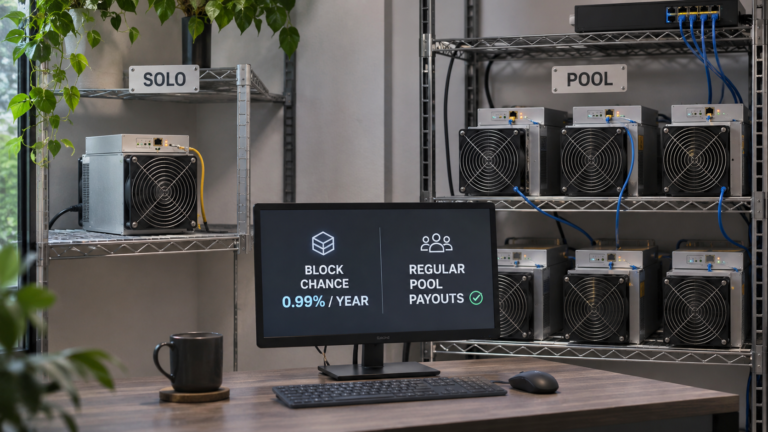
A miner can compete independently or contribute computing power to a mining pool.
Solo miners receive the available block reward when they successfully mine a block, but the time between successful discoveries can be extremely long.
Mining pools combine hash rate from many participants.
When a pool earns a reward, it distributes proceeds according to its payout method, contribution measurements, and fees.
Solo Mining vs Pool Mining
| Feature | Solo Mining | Mining Pool |
|---|---|---|
| Block discovery | Independent | Combined hash power |
| Payout frequency | Highly unpredictable | Generally more regular |
| Individual payout | Full eligible reward when successful | Share under pool rules |
| Revenue variability | Very high | Lower, but still variable |
| Pool operator fee | No pool fee | Usually applies |
Pools don’t increase the total Bitcoin rewards available to the network.
They redistribute reward variability among participants.
Is Crypto Mining Profitable?
Mining profitability depends on Bitcoin’s price, electricity costs, hardware efficiency, network difficulty, and operating expenses.
The number of coins mined is only one part of the calculation.
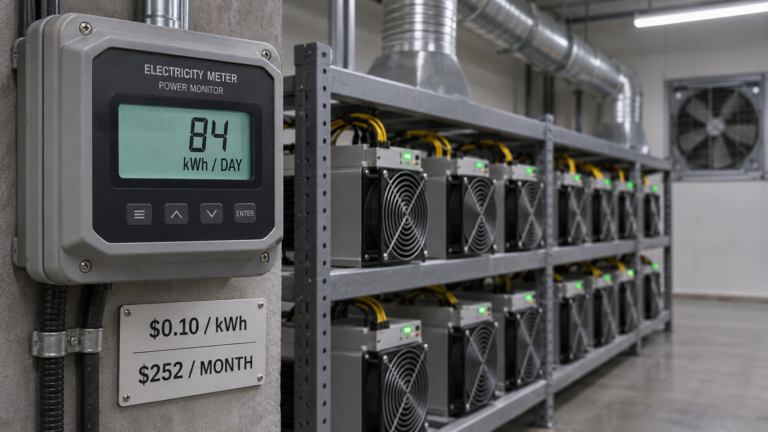
Consider a hypothetical ASIC consuming 3.5 kilowatts continuously.
Its daily electricity consumption is:
3.5 kW × 24 hours = 84 kWh
Mining Electricity Cost Example
| Electricity Price | Daily Cost | 30-Day Cost |
|---|---|---|
| $0.05/kWh | $4.20 | $126 |
| $0.10/kWh | $8.40 | $252 |
| $0.15/kWh | $12.60 | $378 |
| $0.20/kWh | $16.80 | $504 |
These figures include electricity only, not hardware purchases, cooling, repairs, hosting, taxes, or pool fees.
A miner earning $7 per day before electricity would lose money on operating expenses at $0.10/kWh with this equipment, even before accounting for other costs.
Mining is therefore not automatically profitable simply because the equipment produces cryptocurrency.
Can Every Cryptocurrency Be Mined?
No. Only cryptocurrencies using a mining-based consensus mechanism can be mined in the traditional Proof of Work sense.
Many major blockchain networks use Proof of Stake or other methods instead.
Which Cryptocurrencies Can Be Mined?
| Cryptocurrency | Consensus | Traditional Mining? |
|---|---|---|
| Bitcoin (BTC) | Proof of Work | Yes |
| Litecoin (LTC) | Proof of Work | Yes |
| Dogecoin (DOGE) | Proof of Work | Yes |
| Monero (XMR) | Proof of Work | Yes |
| Ethereum (ETH) | Proof of Stake | No |
| Solana (SOL) | Proof of Stake-based consensus | No |
| Cardano (ADA) | Proof of Stake | No |
| XRP | XRP Ledger consensus | No |
Ethereum originally used Proof of Work but transitioned to Proof of Stake during The Merge in September 2022.
ETH is no longer mined.
Instead, Ethereum validators stake assets and participate in the network’s block production and security processes.
A token issued on another blockchain, such as a typical ERC-20 token, also cannot automatically be mined just because it is a cryptocurrency.
Proof of Work vs Proof of Stake
Proof of Work and Proof of Stake solve a similar fundamental problem: allowing distributed participants to agree on the state of a blockchain.
They use different economic resources.
Proof of Work relies on computational work and electricity.
Proof of Stake relies on validators committing cryptocurrency that can be penalized under the network’s rules.
PoW vs PoS Comparison
| Feature | Proof of Work | Proof of Stake |
|---|---|---|
| Main resource | Computing power | Staked cryptocurrency |
| Block production | Mining competition | Validator selection |
| Specialized hardware | Often required | Usually not ASIC mining hardware |
| Electricity consumption | Potentially substantial | Generally much lower |
| Rewards | Subsidy and transaction fees | Protocol-defined validator rewards |
| Security penalties | Mining costs and lost work | Potential staking penalties |
| Example | Bitcoin | Ethereum |
Neither approach is automatically superior in every respect.
Their trade-offs involve energy use, hardware and capital concentration, network security, and the economic incentives of participants.
Frequently Asked Questions
How does crypto mining work in simple terms?
Miners use computers to find valid Proof of Work hashes, allowing them to propose new blockchain blocks. Successful miners receive rewards under the network’s rules.
Does crypto mining create new coins?
Yes. On Bitcoin, newly issued BTC enters circulation through the block subsidy awarded to successful miners.
How much Bitcoin can miners earn per block in 2026?
The current Bitcoin block subsidy is 3.125 BTC, plus transaction fees included in the block.
Can I mine Bitcoin on my laptop?
A laptop can calculate hashes, but it is not competitive with modern Bitcoin ASIC hardware and is unlikely to generate meaningful mining income.
What is hash rate in cryptocurrency mining?
Hash rate measures the number of hash calculations performed per second. Higher hash rate increases a miner’s expected share of block discoveries, all else equal.
Why does Bitcoin mining use so much electricity?
Miners continuously perform computational work while competing for rewards. The network’s difficulty mechanism adjusts to changes in total mining power.
Can Ethereum still be mined?
No. Ethereum switched from Proof of Work to Proof of Stake in September 2022.
What happens when all Bitcoin is mined?
Around 2140, Bitcoin’s block subsidy is expected to reach zero. Miners will then depend on transaction fees as their direct block rewards.