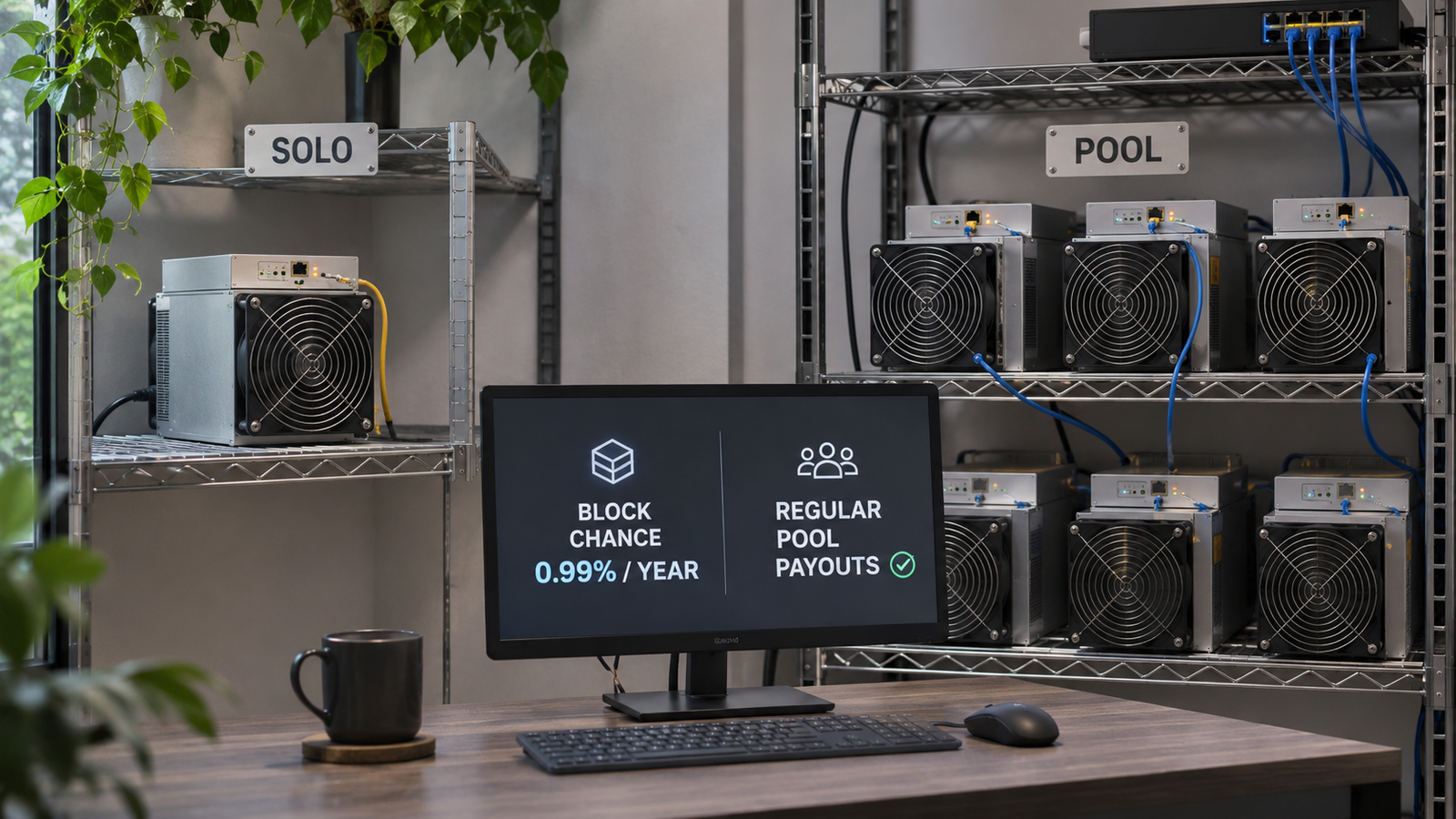
A Bitcoin miner running at 200 TH/s could theoretically earn an entire block reward worth more than $250,000. The problem is finding that block.
With Bitcoin’s network hash rate near 1,060 EH/s in early November 2026, a single 200 TH/s miner has approximately a 0.98% chance of finding at least one block over an entire year.
Joining a mining pool changes the economics. Instead of waiting for a rare block discovery, miners combine computing power and receive smaller payments based on their contribution.
The total expected mining revenue may be similar before fees, but payout frequency and financial risk are dramatically different.
For small miners, the choice between solo mining vs pool mining is primarily about reward volatility, not simply which method offers the biggest potential payout.
What Is Solo Mining?
Solo mining means attempting to discover cryptocurrency blocks independently rather than sharing ordinary mining rewards with other miners.
When a solo Bitcoin miner finds a valid block, it receives the eligible block subsidy and transaction fees, less any service fee charged by its setup.
Bitcoin’s current block subsidy is 3.125 BTC. Transaction fees provide additional revenue.
At a hypothetical Bitcoin price of $80,000, the subsidy alone is worth:
3.125 BTC × $80,000 = $250,000
That’s a substantial reward for one successful block.
However, solo miners compete against the entire Bitcoin network. An individual machine’s probability of success depends on its share of total computing power.
A miner with extremely limited hash rate might operate for decades without finding anything.
Solo mining therefore involves significant reward uncertainty, even when the machine runs continuously.
What Is Pool Mining?
A mining pool combines the hash rate of many independent participants.
Members submit proof of completed mining work, commonly called shares, to demonstrate their contribution.
When the pool discovers blocks, rewards are distributed according to its payout rules.
Instead of waiting for a full Bitcoin block, a small miner can accumulate fractional BTC payments.
The pool operator typically charges a fee for coordinating work, maintaining infrastructure, and sometimes assuming payout risk.
Solo Mining vs Pool Mining Compared
| Feature | Solo Mining | Pool Mining |
|---|---|---|
| Reward frequency | Extremely unpredictable | More regular |
| Potential reward from one block | Full eligible reward | Shared among participants |
| Expected gross revenue | Based on hash rate share | Based on hash rate share |
| Operator fees | None if fully independent | Usually applies |
| Income volatility | Very high | Lower |
| Infrastructure requirements | Usually more demanding | Easier |
| Operator dependence | Lower when self-hosted | Higher |
| Best suited for | Experimental or variance-tolerant miners | Most small commercial miners |
Pool mining doesn’t create extra Bitcoin rewards.
It changes how mining income is distributed and how much uncertainty each participant faces.
Bitcoin Solo Mining Odds: What Are Your Chances?
The basic relationship is:
Miner’s Hash Rate Share = Miner Hash Rate / Network Hash Rate
Bitcoin produces approximately 144 blocks daily at its target 10-minute interval.
Assume the network hash rate remains constant at 1,060 EH/s.
Solo Bitcoin Mining Probability
| Miner Hash Rate | Approx. Chance of a Block in One Year | Average Waiting Time |
|---|---|---|
| 10 TH/s | 0.050% | ~2,017 years |
| 100 TH/s | 0.50% | ~202 years |
| 200 TH/s | 0.99% | ~101 years |
| 500 TH/s | 2.45% | ~40 years |
| 1 PH/s | 4.84% | ~20 years |
Illustrative calculations assuming constant network hash rate and difficulty-adjusted block production. Actual results are random.
A 200 TH/s miner has roughly a 1-in-101 chance of finding at least one block during a year.
The average waiting time is not a countdown.
Mining follows a probabilistic process. One machine might discover a block tomorrow, while another identical machine never finds one during its operating lifetime.
Each new hash is an independent attempt.
How to Calculate Solo Mining Probability
For a specified period, an approximate probability of finding at least one block can be calculated using:
Probability = 1 − e^(−Expected Blocks)
Expected Blocks = Miner Hash Rate / Network Hash Rate × Network Blocks During Period
For a 200 TH/s miner:
200 TH/s / 1,060,000,000 TH/s ≈ 0.0000001887
With approximately 52,560 Bitcoin blocks per year:
Expected Blocks = 0.0000001887 × 52,560 ≈ 0.00992
The probability of finding at least one block is approximately 0.987%.
This is why solo mining can produce enormous occasional payouts while generating no income for most small operators over relatively short periods.
Pool Mining Payout Methods: PPS vs FPPS vs PPLNS
Not every mining pool calculates earnings the same way.
The payout model determines whether miners receive relatively predictable income or remain exposed to the pool’s block-discovery luck.
Three widely used structures are PPS, FPPS, and PPLNS.
Mining Pool Payout Methods Compared
| Model | How Payments Work | Transaction Fees | Income Stability |
|---|---|---|---|
| PPS | Fixed expected subsidy payment per valid share | Usually excluded | High |
| FPPS | Expected subsidy plus estimated transaction fee component | Included in calculation | High |
| PPLNS | Rewards distributed across recent shares when blocks are found | Depends on pool rules | Variable |
PPS: Pay Per Share
Under PPS, miners receive a predetermined payment for valid shares based on expected block subsidy revenue.
The pool operator takes on much of the risk associated with finding fewer blocks than statistically expected.
This produces relatively predictable earnings, although the payout rate changes with network conditions.
Traditional PPS generally excludes transaction fee revenue.
FPPS: Full Pay Per Share
FPPS extends PPS by incorporating a transaction fee component.
Instead of depending directly on whether the pool happens to discover a block during a particular period, payments are based on expected mining revenue.
Braiins Pool, for example, currently uses FPPS and distributes transaction fees through its payout calculation.
For small miners who need predictable operating cash flow, FPPS is often an attractive choice.
PPLNS: Pay Per Last N Shares
PPLNS distributes rewards when the pool successfully finds blocks.
The payout depends on the miner’s eligible contributions within a defined recent share window.
When the pool experiences good luck, payments can exceed expectations.
During unlucky periods, earnings may be considerably lower.
PPLNS can suit miners who operate continuously and accept more variable income.
Switching pools frequently may also affect payouts depending on the share window.
How Much Do Mining Pools Charge?
Mining pool fees vary according to payout method, operator, cryptocurrency, and service arrangement.
A common reference range for Bitcoin pools is approximately 1%–4%, although some arrangements charge less or more.
Braiins Pool publishes a 2.5% mining fee for its FPPS service.
Separate withdrawal charges or payout thresholds may apply.
Pool Fee Impact on Monthly Earnings
Assume a miner earns $200 in expected gross monthly mining revenue.
| Pool Fee | Fee Amount | Revenue After Fee |
|---|---|---|
| 0% | $0 | $200 |
| 1% | $2 | $198 |
| 2% | $4 | $196 |
| 2.5% | $5 | $195 |
| 4% | $8 | $192 |
These calculations isolate the operator fee.
A lower fee isn’t automatically the better deal if another pool provides more favorable transaction fee sharing, reliable payouts, or stronger infrastructure.
Similarly, a PPLNS pool advertising zero fees can still produce irregular short-term earnings.
Practical Example: One Small Bitcoin Miner
Consider a home miner using an ASIC with these specifications:
| Parameter | Assumption |
|---|---|
| Hash rate | 200 TH/s |
| Power consumption | 3,500 W |
| Network hash rate | 1,060 EH/s |
| BTC block subsidy | 3.125 BTC |
| Assumed BTC price | $80,000 |
| Electricity rate | $0.10/kWh |
| Pool fee | 2.5% |
The miner’s expected daily subsidy earnings are approximately 0.0000849 BTC.
At $80,000 per BTC, that equals about $6.79 per day before fees and electricity.
Assuming a 2.5% pool fee:
Expected daily revenue after fee ≈ $6.62
The miner consumes:
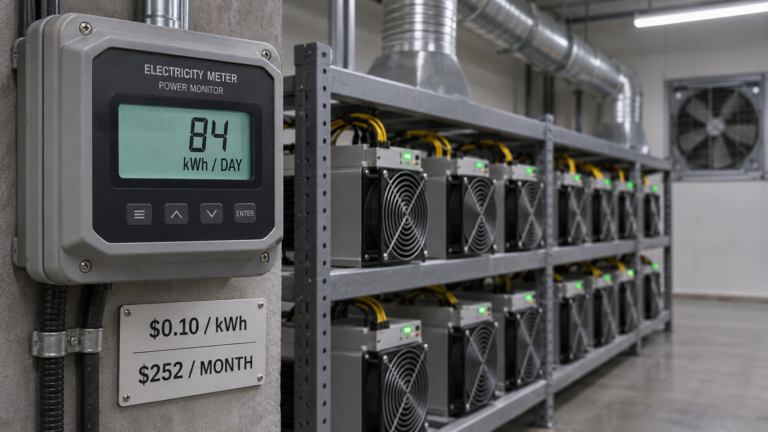
3.5 kW × 24 hours = 84 kWh daily
Electricity cost:
84 × $0.10 = $8.40 per day
Solo vs Pool Mining Economics
| Metric | Solo Mining | FPPS Pool |
|---|---|---|
| Expected gross daily subsidy | ~$6.79 | ~$6.79 |
| Illustrative pool fee | $0 | ~$0.17 |
| Expected revenue after fee | ~$6.79 | ~$6.62 |
| Daily electricity cost | $8.40 | $8.40 |
| Expected daily operating result | -$1.61 | -$1.78 |
| Payment behavior | Mostly zero, rare large wins | Relatively steady |
Hypothetical calculations excluding transaction fees, cooling, hardware depreciation, downtime, and taxes.
The key finding is that neither model solves an underlying profitability problem.
With electricity costing $8.40 daily and expected subsidy revenue below that figure, the machine operates at an expected loss under these assumptions.
Pool mining makes payments more predictable, but it doesn’t make unprofitable hardware profitable.
Does Solo Mining Offer Higher Profitability?
Solo mining can generate slightly higher expected revenue when there are no pool fees.
However, that advantage comes with extremely high income volatility.
Consider a miner spending $252 per month on electricity.
Over five years, electricity alone would cost approximately $15,120, assuming constant consumption and price.
If the miner discovers no blocks during that period, its mining revenue is zero.
A successful solo block could generate enough revenue to cover those costs many times over.
But the probability of finding that block remains very small.
Pool mining replaces much of this uncertainty with smaller recurring payments.
For someone paying monthly electricity bills, predictable cash flow is generally more practical than a highly uncertain jackpot.
Real Solo Mining Wins: Why They Don’t Change the Odds
Occasionally, small solo miners find entire Bitcoin blocks.
In October 2026, reported solo mining successes included a FutureBit Apollo home miner and participants using solo mining services.
These events demonstrate that individual miners can still win.
They do not imply that solo mining has suddenly become statistically attractive for ordinary hardware.
Millions of mining attempts occur across the network, so rare outcomes are expected to happen somewhere.
Stories about successful solo miners naturally attract attention, while the much larger population of miners who receive nothing remains less visible.
A few unusual successes should not replace probability calculations.
Mining Pool Risks Small Miners Should Consider
Pool mining reduces income variance but introduces operational and counterparty risks.
Common Mining Pool Risks
| Risk | Why It Matters |
|---|---|
| Pool downtime | Interrupts mining and earnings |
| Delayed payouts | Funds may remain with operator |
| Hidden fees | Reduce actual revenue |
| Centralized block construction | Concentrates influence over transaction selection |
| Poor server connectivity | Increases stale or rejected shares |
| Unclear payout rules | Creates earnings uncertainty |
| Account compromise | Can redirect mining rewards |
A pool with a large network share may offer stable operations, but excessive concentration of hash rate among a few operators creates wider decentralization concerns.
Some miners prefer smaller pools or decentralized alternatives to reduce dependence on major operators.
Is Solo Mining Worth It for Small Miners?
The answer depends on the miner’s objective.
For a user trying to cover electricity bills and generate regular BTC payments, conventional pool mining is generally the more practical model.
For someone experimenting with Bitcoin mining, operating a personal node, or accepting an extremely low probability of winning a full block, solo mining can still be appealing.
Which Mining Method Fits Your Goals?
| Mining Goal | More Suitable Approach |
|---|---|
| Predictable mining revenue | PPS or FPPS pool |
| Low operator fees | Compare PPLNS and other models |
| Independent block production | Solo mining |
| Low hash rate, regular payouts | Pool mining |
| Willingness to accept rare large rewards | Solo mining |
| Limited technical experience | Established pool |
| Decentralization-focused mining | Independent solo setup or decentralized pool |
A solo-pool service is another option. Such services let individuals attempt to find full blocks using shared server infrastructure, typically without distributing ordinary rewards among participants.
The operator may charge a fee if a block is found.
This preserves solo-style reward uncertainty while simplifying some technical requirements.
How to Choose a Mining Pool
Before connecting your ASIC, examine more than the advertised fee.
Check the payout method and whether transaction fees are included.
Review the minimum payout threshold, payment schedule, supported withdrawal methods, and any additional charges.
Pool connectivity matters, especially for miners operating far from the pool’s servers.
Monitor stale or rejected share rates after connecting.
A miner losing several percent of its effective work through connection problems may earn less than expected, regardless of the operator’s headline fee.
Finally, compare actual earnings over a meaningful period rather than selecting a pool based on one lucky day.
For most small Bitcoin miners, FPPS offers a reasonable balance between payment stability and operational simplicity. PPLNS can also be competitive when its fee structure and payout variability match the miner’s preferences.
Frequently Asked Questions
Is solo mining better than pool mining?
Solo mining offers the possibility of receiving an entire block reward but involves substantial payout uncertainty. Pool mining provides more regular income in exchange for fees and greater operator dependence.
What are the odds of solo mining a Bitcoin block?
At 200 TH/s against a 1,060 EH/s network, the probability of finding at least one block over a year is approximately 0.99%.
Can one ASIC mine Bitcoin solo?
Yes. A single ASIC can attempt solo Bitcoin mining, but its probability of finding a block depends on the network difficulty and the machine’s hash rate.
Do mining pools increase total mining profitability?
Pools generally reduce reward variance rather than increasing the miner’s fundamental expected share of network rewards. Fees can slightly reduce expected income.
What is the difference between PPS and FPPS?
PPS pays for valid shares based primarily on expected block subsidy revenue. FPPS also includes a transaction fee component.
Is PPLNS better than FPPS?
PPLNS may offer competitive long-term returns and lower fees, but payouts depend on pool luck. FPPS generally provides more predictable earnings.
How much do Bitcoin mining pools charge?
Pool fees commonly range around 1%–4%, though actual pricing depends on the provider and payout model. Some pools also impose separate payout fees.
Can solo mining be profitable?
Yes, but profitability is highly uncertain. A miner might discover a valuable block or spend years paying for electricity without receiving any reward.