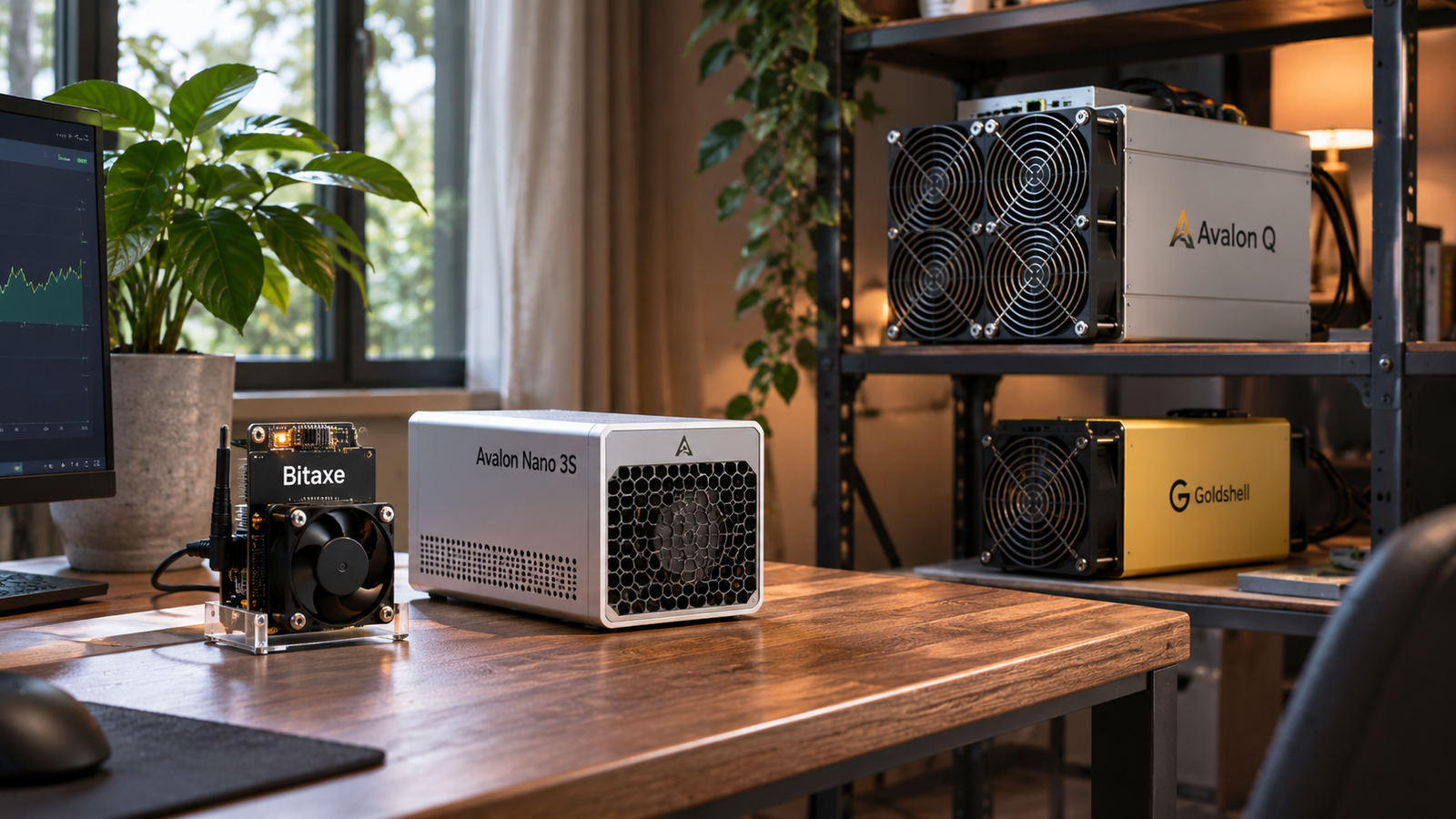
A home Bitcoin miner doesn’t have to consume 3,500 watts or sound like industrial ventilation equipment. Compact ASIC devices can operate at just 15–140 watts, making them considerably easier to accommodate in an apartment or home office.
But there is a substantial difference between a $150 hobby miner and a $1,900 machine designed to generate more meaningful mining revenue.
The Bitaxe Gamma is quiet and uses very little electricity, but its 1.3 TH/s hash rate represents a tiny share of Bitcoin’s network. The Avalon Q delivers up to 90 TH/s, although its electricity demand and heat output are much greater.
Goldshell offers compact alternatives for mining Litecoin, Dogecoin and Aleo, but these devices cannot mine Bitcoin because they use different algorithms.
This comparison examines the best ASIC miners for home use in 2026, focusing on real specifications, acquisition costs, efficiency, noise, and electricity expenses.
Best ASIC Miners for Home Use: 2026 Comparison
The following models represent different approaches to small-scale mining.
Home ASIC Miner Specifications and Prices
| ASIC Miner | Coin / Algorithm | Hash Rate | Power | Advertised Noise | Reference Price |
|---|---|---|---|---|---|
| Bitaxe Gamma 601 | BTC / SHA-256 | 1.3 TH/s | 15 W | Under 15 dB | From €139 |
| Avalon Nano 3S | BTC / SHA-256 | 6 TH/s | 140 W | 30–40 dB | $299 |
| Avalon Q | BTC / SHA-256 | 90 TH/s | 1,674 W | 45–65 dB | $1,888 |
| Goldshell Mini DOGE III Plus | LTC, DOGE / Scrypt | 810 MH/s | 500 W | Up to 35 dB | Around $474 |
| Goldshell AE BOX II | ALEO / zkSNARK | 54 MH/s | 530 W | Up to 35 dB | Around $299, without PSU |
Specifications reflect published operating modes. Prices are November 2026 reference offers, not guaranteed quotations. Currency, shipping, VAT, power supply inclusion, and availability vary.
Hash rates cannot be compared directly across different algorithms.
For example, 810 MH/s of Scrypt performance isn’t equivalent to 810 MH/s of Bitcoin SHA-256 mining.
The most useful comparison begins with the cryptocurrency you want to mine.
1. Bitaxe Gamma 601: Best Low-Power Bitcoin Miner for Beginners
The Bitaxe Gamma is one of the most accessible options for people interested in learning how Bitcoin mining works.
<AsyncImage query=”Bitaxe Gamma 601 Bitcoin open source small ASIC miner hardware on desk” aspectRatio=”16:9″ maxHeight={250}/>
It uses a single BM1370 ASIC chip, the same chip family associated with modern industrial mining hardware, but in a much smaller device.
Typical performance is approximately 1.3 TH/s at 15 watts.
Its open-source AxeOS firmware allows users to configure mining pools, monitor temperatures, and adjust operating parameters.
The device connects through Wi-Fi and doesn’t require a separate computer to remain running.
Key Specifications
| Feature | Bitaxe Gamma 601 |
|---|---|
| Bitcoin hash rate | ~1.3 TH/s |
| Power consumption | ~15 W |
| Efficiency | ~11.5–14 J/TH |
| Advertised noise | Under 15 dB |
| Connection | 2.4 GHz Wi-Fi |
| Price | From €139 |
The most important limitation is profitability.
A single Bitaxe contributes extremely little hash power relative to the Bitcoin network.
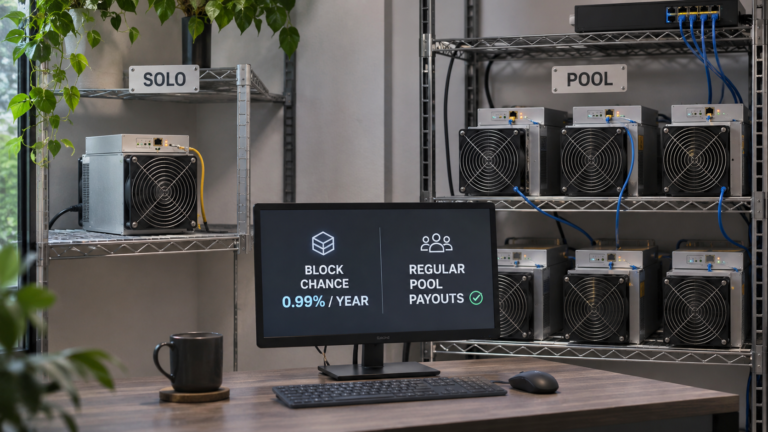
Solo mining is therefore closer to a lottery than a predictable income source.
The Bitaxe Gamma makes sense for education, experimentation, and contributing independently to Bitcoin’s mining ecosystem. It is not a practical substitute for a commercial mining operation.
2. Canaan Avalon Nano 3S: Best Compact Bitcoin Miner
The Avalon Nano 3S is a more powerful home-oriented Bitcoin miner from Canaan.
<AsyncImage query=”Canaan Avalon Nano 3S compact bitcoin miner white product on desk” aspectRatio=”16:9″ maxHeight={250}/>
It offers approximately 6 TH/s while consuming up to 140 watts.
Unlike industrial ASICs, the Nano 3S is designed to fit comfortably into a smaller workspace.
Canaan lists a noise range of approximately 30–40 dB depending on operating conditions.
At $299, it provides an accessible option for people who want more computing power than a single-chip hobby miner.
Avalon Nano 3S Specifications
| Feature | Value |
|---|---|
| Hash rate | 6 TH/s |
| Power consumption | Up to 140 W |
| Advertised noise | 30–40 dB |
| Weight | 0.86 kg |
| Cooling | Air |
| Reference price | $299 |
The Nano 3S can work as a modest heat source in colder conditions, although most of its electrical consumption ultimately becomes room heat.
Its expected Bitcoin earnings remain low relative to modern network competition.
The main advantage is combining straightforward setup, limited noise, and manageable electricity consumption.
3. Canaan Avalon Q: Best Higher-Performance Home Bitcoin Miner
The Avalon Q occupies a different category.
<AsyncImage query=”Canaan Avalon Q 90 TH/s home Bitcoin ASIC miner device” aspectRatio=”16:9″ maxHeight={250}/>
With up to 90 TH/s, it provides substantially more Bitcoin mining capacity than the Bitaxe Gamma or Avalon Nano 3S.
Canaan advertises a power rating of 1,674 watts and energy efficiency of approximately 18.6 J/TH.
The machine supports different operating power levels, allowing users to adjust performance according to their environment.
However, home suitability comes with several compromises.
A 1,674 W device produces considerable heat, requiring suitable ventilation.
Canaan specifies a noise range of 45–65 dB, depending on operation.
That can be noticeable in a residential space, particularly during continuous operation.
Avalon Q Specifications
| Feature | Value |
|---|---|
| Hash rate | Up to 90 TH/s |
| Power | 1,674 W |
| Efficiency | 18.6 J/TH |
| Noise | 45–65 dB |
| Network | Ethernet and Wi-Fi |
| Reference price | $1,888 |
For users with a garage, utility room, or dedicated mining space, the Avalon Q is a more serious option.
However, higher hash rate doesn’t guarantee profitability. Electricity pricing remains decisive.
4. Goldshell Mini DOGE III Plus: Best Compact Scrypt Miner
Bitcoin isn’t the only cryptocurrency available to home miners.
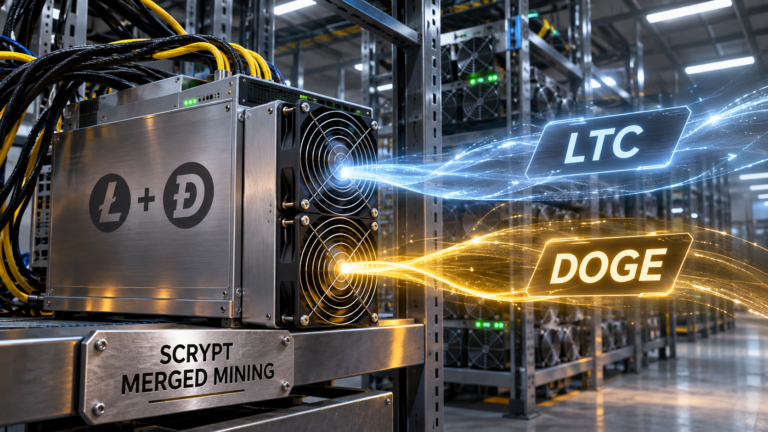
The Goldshell Mini DOGE III Plus is designed for the Scrypt algorithm, used by Litecoin and Dogecoin.
Its standard operating mode delivers approximately 810 MH/s at 500 watts.
A lower-power mode provides around 620 MH/s while consuming approximately 300 watts.
Goldshell Mini DOGE III Plus
| Mode | Hash Rate | Power |
|---|---|---|
| Standard | 810 MH/s | 500 W |
| Low power | 620 MH/s | 300 W |
Goldshell advertises noise of up to 35 dB under its specified testing conditions.
Actual noise can be higher depending on temperature, fan speed, and the surrounding room.
An independent test of the earlier Mini DOGE III measured approximately 51.5 dB despite a lower manufacturer rating.
That result doesn’t establish the exact noise of the Plus model, but it demonstrates why real-world acoustic measurements matter.
The Mini DOGE III Plus is worth considering for users specifically interested in Scrypt mining.
It should not be purchased under the assumption that it can switch to Bitcoin mining.
5. Goldshell AE BOX II: Compact ASIC for Aleo
The Goldshell AE BOX II targets a different cryptocurrency ecosystem.
It performs zkSNARK-related mining computations for Aleo.
The device delivers approximately 54 MH/s while consuming 530 watts.
Goldshell publishes an advertised noise rating of up to 35 dB.
Its compact dimensions make placement easier than an industrial ASIC, but 530 watts still produces significant continuous heat.
Some retail offers exclude the external power supply, making the final purchase cost higher than the advertised machine price.
The AE BOX II is suitable only for buyers who specifically want exposure to Aleo mining economics.
Its profitability should be calculated using Aleo’s network conditions rather than Bitcoin mining calculators.
How Much Electricity Do Home ASIC Miners Cost?
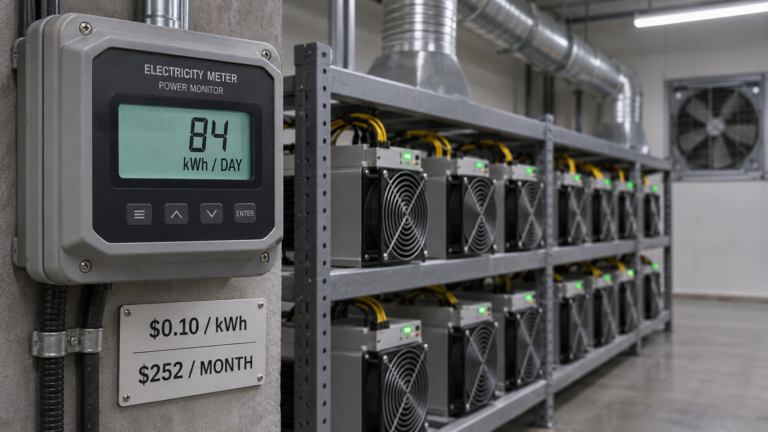
Electricity consumption is the most predictable ongoing expense.
The calculation is:
Monthly Electricity Cost = Power (kW) × 24 × 30 × Electricity Rate
Monthly Electricity Costs at $0.10/kWh
| ASIC Miner | Daily Energy | Monthly Cost |
|---|---|---|
| Bitaxe Gamma | 0.36 kWh | $1.08 |
| Avalon Nano 3S | 3.36 kWh | $10.08 |
| Avalon Q | 40.18 kWh | $120.53 |
| Goldshell Mini DOGE III Plus | 12.00 kWh | $36.00 |
| Goldshell AE BOX II | 12.72 kWh | $38.16 |
Assumes continuous operation for 30 days at rated power, without additional cooling.
At $0.20/kWh, these expenses double.
For the Avalon Q, monthly electricity costs would rise from approximately $121 to $241.
That difference can determine whether a mining setup generates an operating profit or loss.
How Much Heat Do Home ASIC Miners Produce?
Almost all the electrical energy consumed by an ASIC eventually becomes heat.
A 500 W miner releases approximately the same amount of heat as a 500 W electric resistance heater.
One watt of continuous electrical power corresponds to approximately 3.412 BTU per hour of heat output.
Home ASIC Heat Output
| Power Consumption | Approximate Heat Output |
|---|---|
| 15 W | 51 BTU/h |
| 140 W | 478 BTU/h |
| 300 W | 1,024 BTU/h |
| 500 W | 1,706 BTU/h |
| 530 W | 1,808 BTU/h |
| 1,674 W | 5,711 BTU/h |
A Bitaxe Gamma produces relatively little heat.
An Avalon Q can significantly warm a small room and may require continuous ventilation.
During winter, some users may benefit from the heat. During summer, removing it can add cooling expenses.
Heating value should be considered a secondary benefit, not free energy.
How Loud Is a Home ASIC Miner?
Noise specifications can be misleading if they’re treated as guarantees.
Manufacturers measure equipment under particular conditions, including distance, ambient temperature, and operating mode.
A miner rated at 35 dB in a controlled environment may sound noticeably louder in a small room when cooling fans accelerate.
ASIC Noise Levels Explained
| Noise Level | Practical Interpretation |
|---|---|
| Under 20 dB | Very quiet under suitable conditions |
| 30–40 dB | May suit a quiet office or living space |
| 45–55 dB | Clearly noticeable during continuous operation |
| 60–65 dB | Potentially disruptive in shared residential areas |
| Above 70 dB | Generally unsuitable for ordinary living spaces |
The sound character matters too.
High-pitched fan noise can be more irritating than a lower-frequency sound at the same measured decibel level.
Before buying, look for independent acoustic tests of the exact model and operating mode.
Hobby ASIC Miners vs Profit-Oriented Equipment
One of the most important distinctions is the purpose of the device.
Hobby miners prioritize low power consumption, compact dimensions, quiet operation, and accessibility.
Profit-oriented ASICs prioritize computational output and cost per unit of hash rate.
Which Type of ASIC Should You Choose?
| Goal | Suitable Category |
|---|---|
| Learn Bitcoin mining | Bitaxe Gamma |
| Quiet, compact BTC mining | Avalon Nano 3S |
| Higher BTC hash rate at home | Avalon Q |
| Mine Litecoin or Dogecoin | Goldshell Mini DOGE III Plus |
| Mine Aleo | Goldshell AE BOX II |
| Maximize industrial-scale revenue | Commercial ASIC with dedicated facilities |
Even the Avalon Q is modest compared with high-performance industrial miners.
Its advantage is a more residential-friendly design, not superior profitability in every environment.
For small miners, purchasing a device solely because it has a low price can be a mistake if its output cannot cover operating costs.
How to Calculate Home ASIC Mining Profitability
The appropriate calculation is:
Daily Operating Profit = Mining Revenue − Electricity Cost − Pool Fees − Other Operating Costs
For example, assume an ASIC earns a hypothetical $7 per day before expenses.
If it consumes 1,674 watts at $0.10/kWh, electricity costs approximately $4.02 per day.
With a 2% pool fee, the remaining operating profit is:
$7 − $4.02 − $0.14 = $2.84 per day
This example doesn’t describe actual Avalon Q revenue. It simply shows how to calculate operating margins.
Hardware depreciation, cooling, taxes, and equipment purchase costs must also be considered before assessing investment returns.
A machine generating positive daily operating profit may still take years to recover its original purchase price.
What to Check Before Buying an ASIC Miner for Home
Start with the cryptocurrency and algorithm.
Bitcoin miners using SHA-256 cannot automatically mine coins requiring Scrypt, RandomX, or zkSNARK computations.
Next, verify the manufacturer’s rated hash rate and electricity consumption.
Check whether the power supply is included. Some compact devices require an external PSU that may cost extra.
Noise and cooling deserve particular attention in apartments.
Finally, compare the complete purchase cost, including shipping, import taxes, accessories, and potential repairs.
Buying a quiet ASIC miner is sensible only when its operating characteristics match the actual room where it will run.
Frequently Asked Questions
What is the best ASIC miner for home use in 2026?
For quiet hobby Bitcoin mining, the Bitaxe Gamma and Avalon Nano 3S are practical options. The Avalon Q offers substantially higher hash rate but requires more electricity and ventilation.
What is the quietest Bitcoin ASIC miner?
The Bitaxe Gamma is among the quietest compact options, with some configurations advertised below 15 dB. Real-world noise depends on cooling and operating conditions.
Can I make money with a small home ASIC miner?
Possibly, but profitability depends on network difficulty, cryptocurrency prices, electricity costs, and hardware efficiency. Hobby miners frequently produce very small expected returns.
Is the Avalon Nano 3S profitable?
Its profitability depends on Bitcoin’s mining difficulty, the miner’s operating mode, electricity rates, and acquisition cost. Low power consumption alone doesn’t guarantee a positive return.
Can Goldshell Mini DOGE III Plus mine Bitcoin?
No. It uses the Scrypt algorithm for compatible cryptocurrencies such as Litecoin and Dogecoin, not Bitcoin’s SHA-256 algorithm.
How much electricity does a home ASIC miner use?
Compact devices range from around 15 W to several hundred watts. Higher-performance home ASICs such as the Avalon Q can consume over 1,600 W.
Are ASIC miners safe to operate in an apartment?
They can be operated safely with appropriate electrical infrastructure, ventilation, and equipment maintenance. High-power devices require additional attention to circuit capacity, heat, and continuous fan noise.