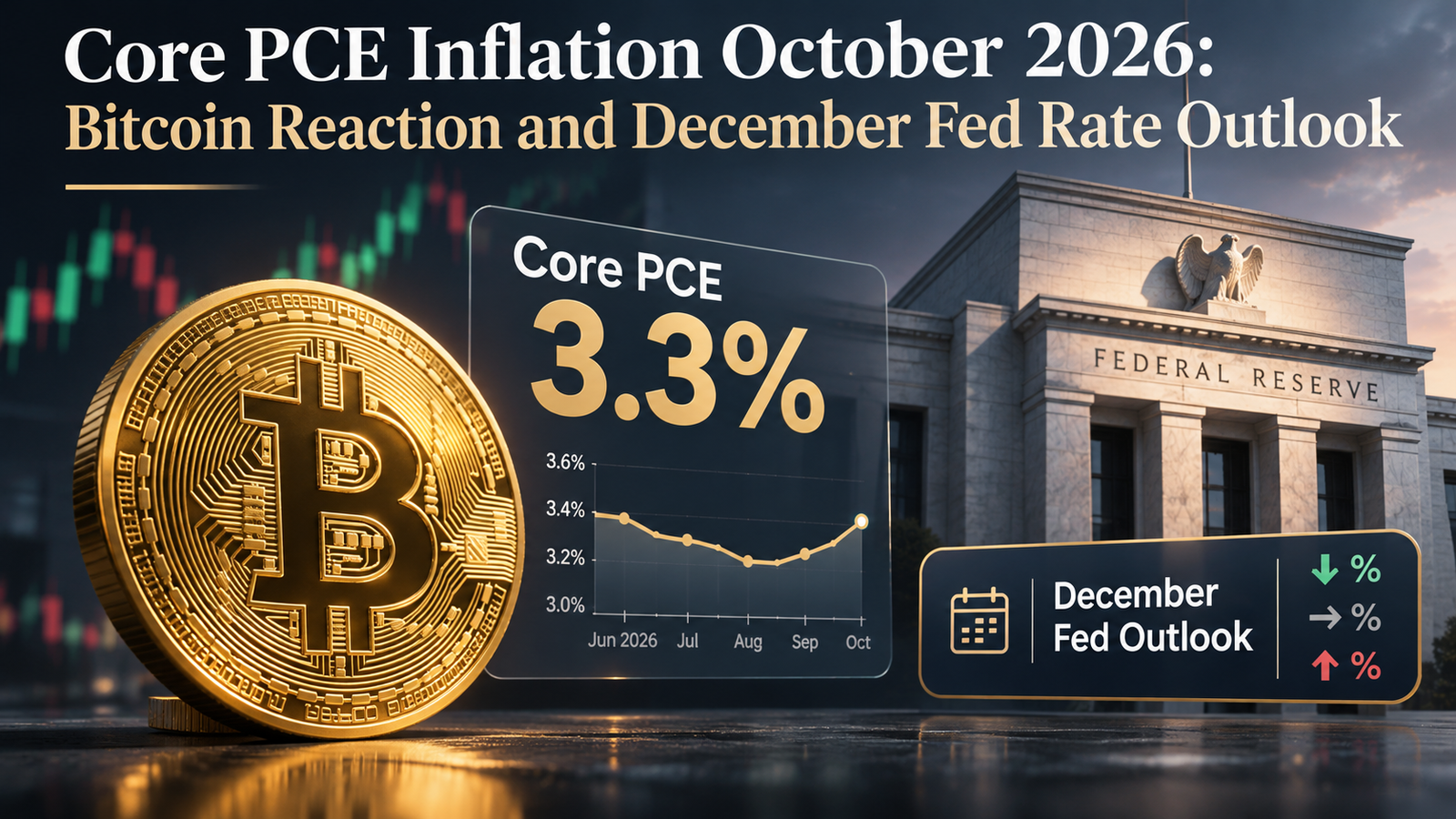
US core PCE inflation accelerated to 3.3% in October 2026, exceeding the market forecast of 3.2% and strengthening the case for another Federal Reserve interest rate increase in December.
The report, released on November 25, initially coincided with a sharp decline across cryptocurrency and equity markets. Bitcoin fell toward $57,300 before recovering above $60,000, while Ethereum experienced a similar reversal.
Despite the stronger annual inflation reading, Treasury yields declined and US equities recovered much of their early losses. The divergence suggests that inflation was only one of several factors driving market activity.
October 2026 Core PCE Inflation Data vs Market Expectations
The Bureau of Economic Analysis (BEA) released its October Personal Income and Outlays report on November 25 at 8:30 a.m. Eastern Time.
Annual inflation accelerated across both headline and core measures, although monthly price growth remained broadly consistent with expectations.
| Inflation Indicator | October 2026 | Forecast | September 2026 |
|---|---|---|---|
| Core PCE YoY | 3.3% | 3.2% | 3.1% |
| Core PCE MoM | 0.3% | 0.3% | 0.3% |
| Headline PCE YoY | 3.8% | 3.8% | 3.6% |
| Headline PCE MoM | 0.3% | 0.3% | 0.5% |
Sources: BEA and pre-release market consensus reported by Investing.com and BabyPips.
The main surprise came from annual core inflation, which exceeded expectations by 0.1 percentage point. Monthly core inflation remained unchanged, suggesting persistent price pressure rather than a sudden acceleration in monthly inflation.
Headline PCE inflation now stands 1.8 percentage points above the Federal Reserve’s 2% longer-run objective.
For a detailed explanation of the relationship between inflation, interest rates and cryptocurrency valuations, see our guide on how PCE inflation affects Bitcoin.
Bitcoin and Ethereum Reaction to the PCE Report
Bitcoin was already trading below its previous daily close when the inflation figures were published.
Binance spot market data compiled by Goodman Macro shows that selling intensified during the first 30 minutes following the announcement.
Bitcoin Price Reaction on November 25
| Time (EST) | BTC Price (USDT) | Change Since Release |
|---|---|---|
| 08:30 — PCE release | 58,858 | — |
| 08:45 | 58,298 | -0.95% |
| 09:00 | 58,081 | -1.32% |
| 09:45–10:00 — Intraday low | 57,300 | -2.65% |
| End of UTC trading day | 60,458 | +2.72% |
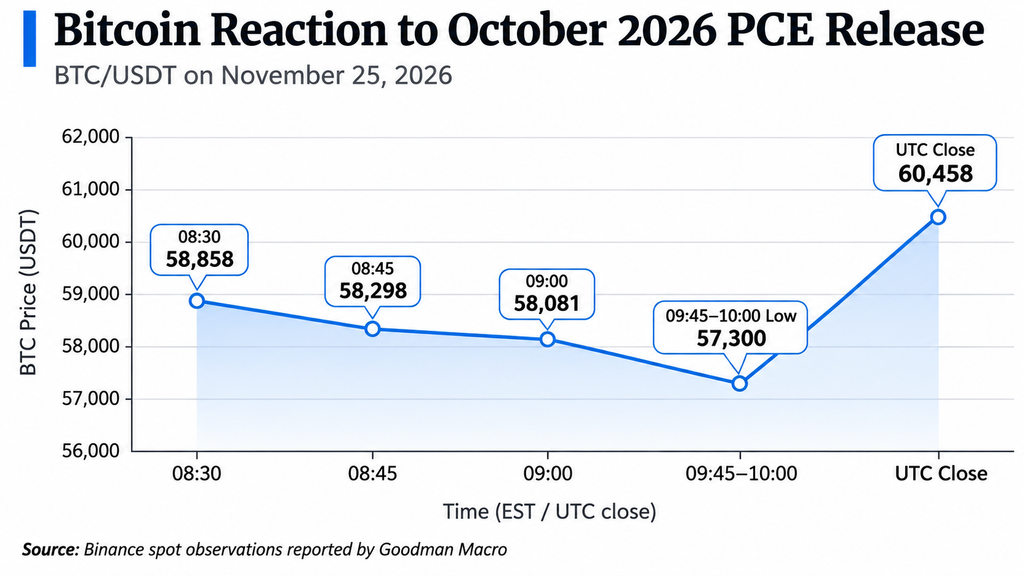
Source: Binance BTC/USDT observations reported by Goodman Macro. Percentage changes calculated relative to the 08:30 EST reference price.
Bitcoin recovered approximately 5.51% from its intraday low to the UTC daily close.
Ethereum followed a similar pattern, reaching an intraday low near 1,609 USDT before finishing the UTC session around 1,693 USDT.
The recovery does not necessarily mean investors interpreted the inflation report positively. Proposed US tariffs, selling pressure in technology stocks and existing expectations of higher interest rates also influenced trading conditions.
How US Equities and Treasury Yields Reacted
Traditional financial markets experienced substantial intraday volatility before recovering toward the end of Wednesday’s trading session.
| Asset | November 25 Reference Level | Daily Change |
|---|---|---|
| Bitcoin | 60,458 USDT | +1.05% |
| Ethereum | 1,693 USDT | +0.75% |
| S&P 500 | 7,182.78 | -0.25% |
| Nasdaq Composite | 23,585.80 | -0.62% |
| US 10-Year Treasury Yield | 4.85% | -6 basis points |
| US 2-Year Treasury Yield | 4.61% | -2 basis points |
Sources: Binance spot data as reported by Goodman Macro, Associated Press market closing figures and US Treasury daily yield curve rates.
Crypto returns use UTC daily closing prices. Equity and Treasury figures follow their respective US market reporting conventions.
Falling Treasury yields were particularly notable given the stronger-than-expected annual core inflation reading. Demand for government bonds during the broader equity selloff helped counter the upward pressure on yields normally associated with persistent inflation.
Bitcoin’s recovery alongside technology stocks also illustrates why the Bitcoin and Nasdaq correlation remains relevant during periods of macroeconomic uncertainty.
December 2026 Fed Rate Decision: Is Another Hike Expected?
The Federal Reserve maintained its benchmark interest rate at 3.75%–4.00% during its October 28 monetary policy meeting.
The next Federal Open Market Committee meeting is scheduled for December 8–9, 2026.
On November 25, market expectations reported by Kiplinger, citing CME FedWatch, indicated a probability above 97% for a 25-basis-point rate increase.
A quarter-point hike would move the federal funds target range to 4.00%–4.25%.
The inflation report was accompanied by an upward revision to third-quarter US economic growth. According to the BEA’s second GDP estimate, real GDP expanded at a 4.3% annualized rate, compared with the initial estimate of 3.4%.
Persistent inflation combined with stronger economic growth gives policymakers less reason to ease monetary conditions.
However, much of the expected December rate increase was already reflected in market pricing. The Fed’s updated economic projections and guidance for 2027 could therefore have a greater influence on Bitcoin than the December decision itself.
Traders can monitor changes in interest rate expectations through the CME FedWatch Tool.
Why Bitcoin Recovered Despite Higher Inflation
The November 25 trading session highlights an important distinction between an unfavorable economic report and an unexpected economic shock.
Annual core PCE exceeded forecasts, but monthly inflation matched expectations. Markets were also anticipating tighter monetary policy before the data arrived.
Bitcoin’s recovery suggests that the inflation release did not fundamentally overturn existing expectations. Lower Treasury yields and a partial recovery in equities provided additional support.
Institutional demand remains another consideration. Persistent Bitcoin ETF outflows could limit the strength of a recovery even if broader financial conditions stabilize.
A single rebound is insufficient evidence of a sustained change in market direction.
Key Economic Events to Watch in December 2026
The next major US inflation reports are scheduled after the December Fed decision, making employment figures particularly important in the coming days.
| Date | Economic Event |
|---|---|
| December 1 | October JOLTS job openings |
| December 4 | November US employment report |
| December 8–9 | FOMC meeting |
| December 9 | Fed rate decision and economic projections |
| December 10 | November CPI inflation |
| December 23 | November PCE inflation |
Sources: Bureau of Labor Statistics release calendar, Federal Reserve FOMC calendar and BEA.
The November employment report will provide policymakers with additional evidence about labor demand and economic resilience before their December meeting.
For cryptocurrency markets, the more consequential question may be whether the Fed signals further tightening in 2027. With a December rate increase already widely anticipated, changes in the longer-term interest rate outlook could trigger a larger repricing than the immediate decision.
Sources and References
- US Bureau of Economic Analysis — Personal Income and Outlays, October 2026
- US Bureau of Economic Analysis — Q3 2026 GDP Second Estimate
- Federal Reserve — October 28 FOMC Statement
- Federal Reserve — FOMC Meeting Calendar
- CME Group — FedWatch
- Goodman Macro — November 26 Crypto Market Review
- US Department of the Treasury — Daily Treasury Rates
- Bureau of Labor Statistics — December 2026 Release Schedule
Market data reflects historical observations from November 25, 2026. Futures-implied interest rate probabilities are subject to change and do not guarantee future Federal Reserve decisions.