
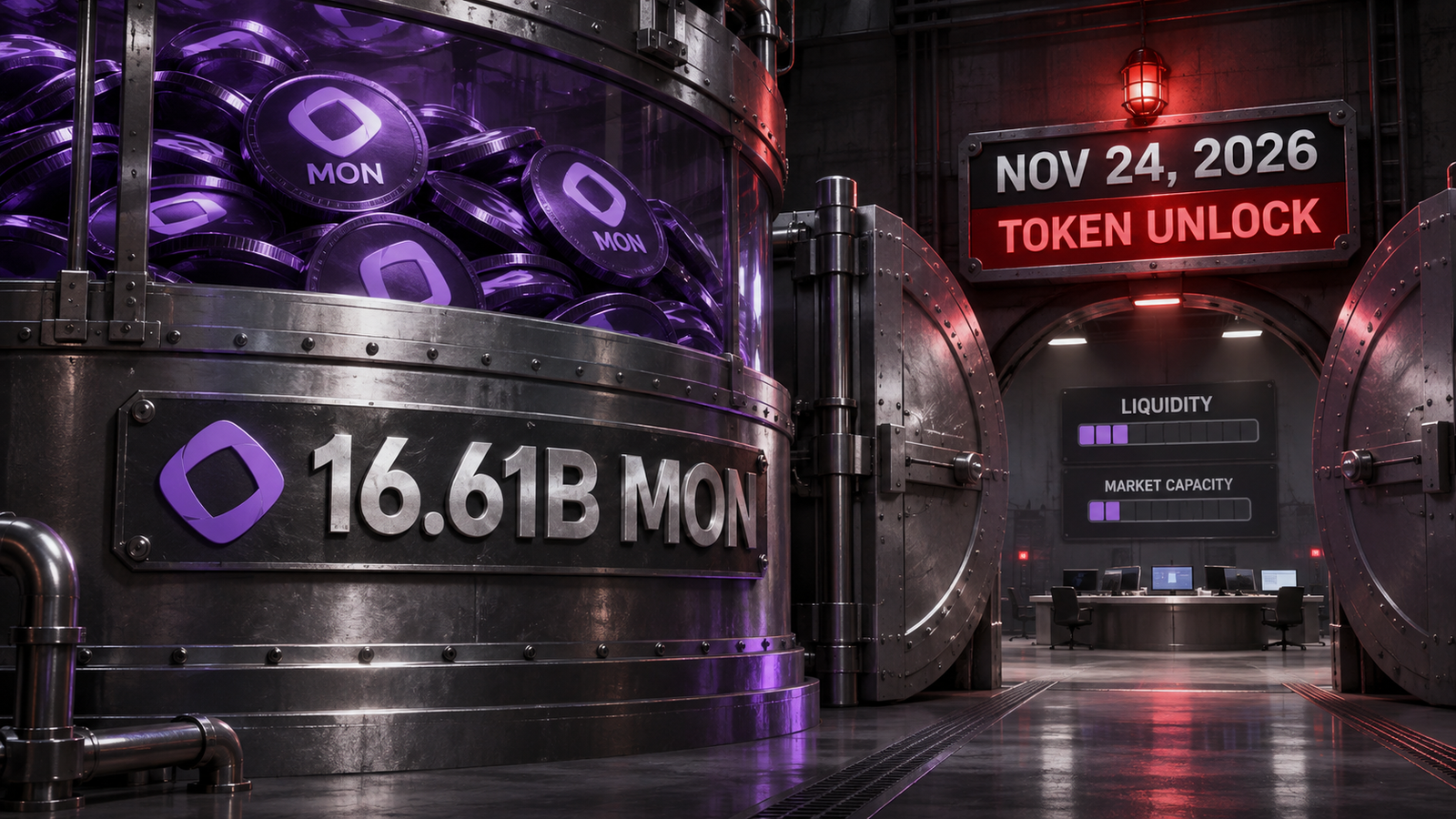
Monad faces one of its largest scheduled token releases on November 24, 2026, with approximately 16.61 billion MON becoming eligible for unlocking across team, investor and treasury allocations.
At a reference price of $0.0123, the release carries an estimated market value of $204 million, exceeding Monad’s current circulating market capitalization of roughly $145 million.
The event comes as MON trades under pressure. On November 23, the token was changing hands near $0.012–$0.0124, with market data indicating a weekly decline of approximately 19%.
For investors, the central question isn’t simply how many tokens unlock. It is how much additional supply could reach exchanges and whether existing liquidity can absorb potential selling.
Monad Token Unlock November 24: Key Figures
November 24 marks the first anniversary of Monad’s public mainnet launch and the expiration of the initial lockup period for several insider allocations.
MON Token Unlock: November 2026
| Metric | Value |
|---|---|
| Unlock date | November 24, 2026 |
| Scheduled release | 16.61 billion MON |
| Reference MON price | $0.0123 |
| Estimated unlock value | $204.3 million |
| Original token supply | 100 billion MON |
| Unlock as share of original supply | 16.6% |
| Reported circulating supply | 11.825 billion MON |
| Unlock relative to circulating supply | 140.5% |
| Estimated circulating market cap | $145.4 million |
Market estimates as of November 23, 2026. Token prices and circulating-supply figures vary between data providers.
The scheduled release is approximately 1.4 times the currently reported circulating supply.
That makes it a significant event for MON tokenomics, although not every newly unlocked token will necessarily become immediately tradable.
Who Receives the 16.61 Billion MON?
The November release primarily affects three allocation categories.
Team members account for the largest share, followed by private investors and the Category Labs treasury.
November 24 MON Distribution Breakdown
| Allocation | Tokens Unlocking | Approximate Value |
|---|---|---|
| Team | 10.70B MON | $131.6M |
| Private investors | 4.925B MON | $60.6M |
| Category Labs Treasury | 0.988B MON | $12.2M |
| Total | 16.613B MON | $204.3M |
Values calculated using $0.0123 per MON. Figures are rounded.
The team accounts for approximately 64% of the scheduled release.
Investor tokens represent roughly 30%, while treasury allocations make up the remaining 6%.
The distribution matters because different recipients face different incentives.
Early investors may evaluate whether to realize gains or reduce exposure. Team allocations can involve individual vesting agreements, while treasury funds may remain allocated to ecosystem development.
These categories shouldn’t be treated as identical sources of immediate selling pressure.
Why Monad’s One-Year Cliff Matters
Monad launched with an initial supply of 100 billion MON, allocating tokens across public participants, ecosystem development, team members, private investors and treasury operations.
The November 2026 event marks the end of the first major lockup period for selected insiders.
Private investor and Category Labs treasury allocations follow a one-year cliff, after which 25% of their original allocations becomes eligible for release.
Additional monthly vesting continues over the following 36 months.
Team allocations follow individual schedules, with approximately 10.7 billion MON estimated to have vested by the anniversary.
This distinction is important: the event releases previously allocated tokens rather than creating 16.61 billion new tokens through additional minting.
It changes transfer restrictions and potential market availability, not the original allocation of ownership.
How Much Could MON Circulating Supply Increase?
This is the most important question for existing MON holders.
The circulating supply reported by major market trackers is approximately 11.825 billion MON.
If all 16.613 billion unlocked tokens were classified as circulating immediately, the supply would increase substantially.
Hypothetical MON Supply Impact
| Metric | Before Unlock | Full Inclusion Scenario |
|---|---|---|
| Circulating MON | 11.825B | 28.438B |
| Increase | — | +16.613B |
| Percentage increase | — | +140.5% |
| Share of initial 100B supply | 11.8% | 28.4% |
The post-unlock column is a hypothetical maximum-inclusion calculation, not a confirmed circulating-supply forecast.
Unlock trackers use different definitions of released and circulating supply.
Some include previously unlocked ecosystem allocations that remain outside active trading markets.
For example, one vesting-based estimate places previously released supply above 51 billion MON, substantially higher than the 11.825 billion counted as circulating by market capitalization trackers.
The same November unlock therefore represents roughly 32% of already released supply under one methodology, but about 140% of reported market circulating supply under another.
Neither percentage means that the entire amount will be deposited on exchanges.
Investors should monitor actual token movements and changes in exchange balances before drawing conclusions about immediate sellable supply.
MON Price and Trading Volume Before the Unlock
MON entered the November 24 event with considerable downside momentum.
On November 23, market observations placed MON near $0.0122, down approximately 8% over 24 hours and around 19% over seven days.
The token had also fallen substantially from its historical peak near $0.0488.
MON Market Snapshot: November 23
| Indicator | Approximate Value |
|---|---|
| MON price | $0.0122 |
| 24-hour price change | -8% |
| Seven-day performance | -19% |
| Circulating market cap | $144M–$145M |
| Total reported 24-hour trading volume | $14M–$16M |
| Estimated unlock value | $204M |
Indicative figures from November 23 market observations; not synchronized exchange quotes.
The estimated unlock value is roughly 13–15 times the reported daily trading volume in this snapshot.
That ratio highlights the scale of the event, but it doesn’t predict market impact directly.
Trading volume measures completed transactions over time. It is not equivalent to the amount of buy orders currently available.
A smaller quantity of aggressive selling can generate significant slippage if exchange order books are thin.
Conversely, greater liquidity, staggered sales and market-maker participation can reduce immediate price pressure.
Could the November 24 Unlock Crash MON?
A large scheduled unlock creates potential selling pressure, but a price decline isn’t automatic.
Markets can anticipate a known supply event weeks or months before it happens.
MON’s recent weakness may already reflect some investor positioning ahead of November 24.
The market reaction will depend on whether actual selling exceeds expectations.
Three Possible MON Price Scenarios
| Scenario | Market Conditions | Potential Reaction |
|---|---|---|
| Bearish | Large exchange inflows, thin bids, aggressive selling | Additional downside |
| Neutral | Gradual transfers, stable liquidity, limited selling | Consolidation |
| Bullish | Weak selling pressure, stronger demand, short covering | Relief rally |
A bearish outcome becomes more likely if large token holders move substantial amounts to exchanges while buyers fail to replenish order books.
A neutral scenario could emerge if newly unlocked balances remain in custody, staking arrangements or long-term holdings.
A bullish reaction is also possible if traders positioned for a major selloff discover that actual selling pressure is smaller than anticipated.
However, even a short-term rebound wouldn’t eliminate the additional supply scheduled for future months.
MON Price Outlook: Why Liquidity Matters More Than the Headline Figure
The headline figure of $204 million is useful for understanding scale.
It isn’t the amount investors should automatically expect to be sold.
Consider three hypothetical selling scenarios.
Potential Selling Pressure Example
| Share of Unlock Sold | MON Sold | Value at $0.0123 |
|---|---|---|
| 1% | 166.1M | $2.04M |
| 5% | 830.7M | $10.22M |
| 10% | 1.661B | $20.43M |
| 25% | 4.153B | $51.08M |
Illustrative scenarios, not forecasts of insider behavior.
Even a 5% sale would represent more than $10 million at the reference price.
Whether the market can absorb that amount depends on where and how transactions execute.
Large holders can use negotiated over-the-counter transactions, staggered market orders or liquidity providers instead of selling entire balances at once.
For ordinary traders, available bid depth within 1% or 2% of the current market price provides more useful information than daily turnover alone.
What Traders Should Watch on November 24
Several indicators can help distinguish genuine supply pressure from speculative volatility.
MON Unlock Monitoring Checklist
| Indicator | Potential Warning Sign |
|---|---|
| Exchange inflows | Large deposits from newly unlocked wallets |
| Spot trading volume | Rising volume alongside falling price |
| Order-book depth | Weak bids and widening spreads |
| Futures open interest | Rapid leverage expansion |
| Funding rates | Crowded directional positioning |
| Circulating supply | Material increase confirmed by trackers |
| Whale transfers | Large movements requiring further investigation |
On-chain transfers deserve particular attention.
Moving tokens between wallets doesn’t necessarily represent selling.
Similarly, sending MON to an exchange may reflect custody arrangements or market-maker inventory rather than an immediate sale.
The strongest evidence of sustained selling pressure would be a combination of increased exchange supply, aggressive spot sales and deteriorating liquidity.
Futures liquidations can amplify short-term price movements in either direction.
What Happens After the November Unlock?
November 24 isn’t the end of Monad’s vesting schedule.
Investor and Category Labs treasury allocations continue releasing tokens monthly over approximately three years.
Together, these two categories are scheduled to release roughly 492 million MON per month after the initial cliff.
Team vesting continues under separate schedules.
Upcoming MON Unlock Schedule
| Date | Scheduled Development |
|---|---|
| November 24, 2026 | Major team, investor and treasury cliff |
| December 24, 2026 | Next scheduled monthly release |
| January 2027 | Continued vesting distributions |
| 2027–2029 | Ongoing team and investor releases |
| Late 2029 | Expected completion of major initial vesting schedules |
The long-term risk isn’t necessarily concentrated in one trading session.
Continued emissions can create supply overhang if the circulating token base expands faster than investor demand.
For MON holders, monitoring future distributions alongside actual network activity will remain important well beyond the anniversary unlock.
Frequently Asked Questions
When is the next Monad token unlock?
The next major Monad token unlock is scheduled for November 24, 2026, coinciding with the first anniversary of the network’s public mainnet launch.
How many MON tokens will unlock?
Approximately 16.61 billion MON are scheduled for release across team, investor and Category Labs treasury allocations.
How much is the November MON unlock worth?
At a reference price of $0.0123, the scheduled release is valued at approximately $204 million. Its actual market value changes with the MON price.
Will the Monad token unlock increase circulating supply?
Potentially. The unlock removes transfer restrictions from allocated tokens, but the amount immediately counted as circulating depends on distribution, custody arrangements and the methodology used by data providers.
Will MON price fall after November 24?
A decline is possible if significant selling overwhelms available demand. However, the event is publicly scheduled and may already be partly reflected in prices. An immediate selloff is not guaranteed.
Who receives the November 2026 MON unlock?
Approximately 10.7 billion MON are allocated to the team, 4.925 billion to private investors and 988 million to the Category Labs treasury.
Are more MON token unlocks coming?
Yes. Additional investor, treasury and team distributions are scheduled through 2029 under the original vesting arrangements.