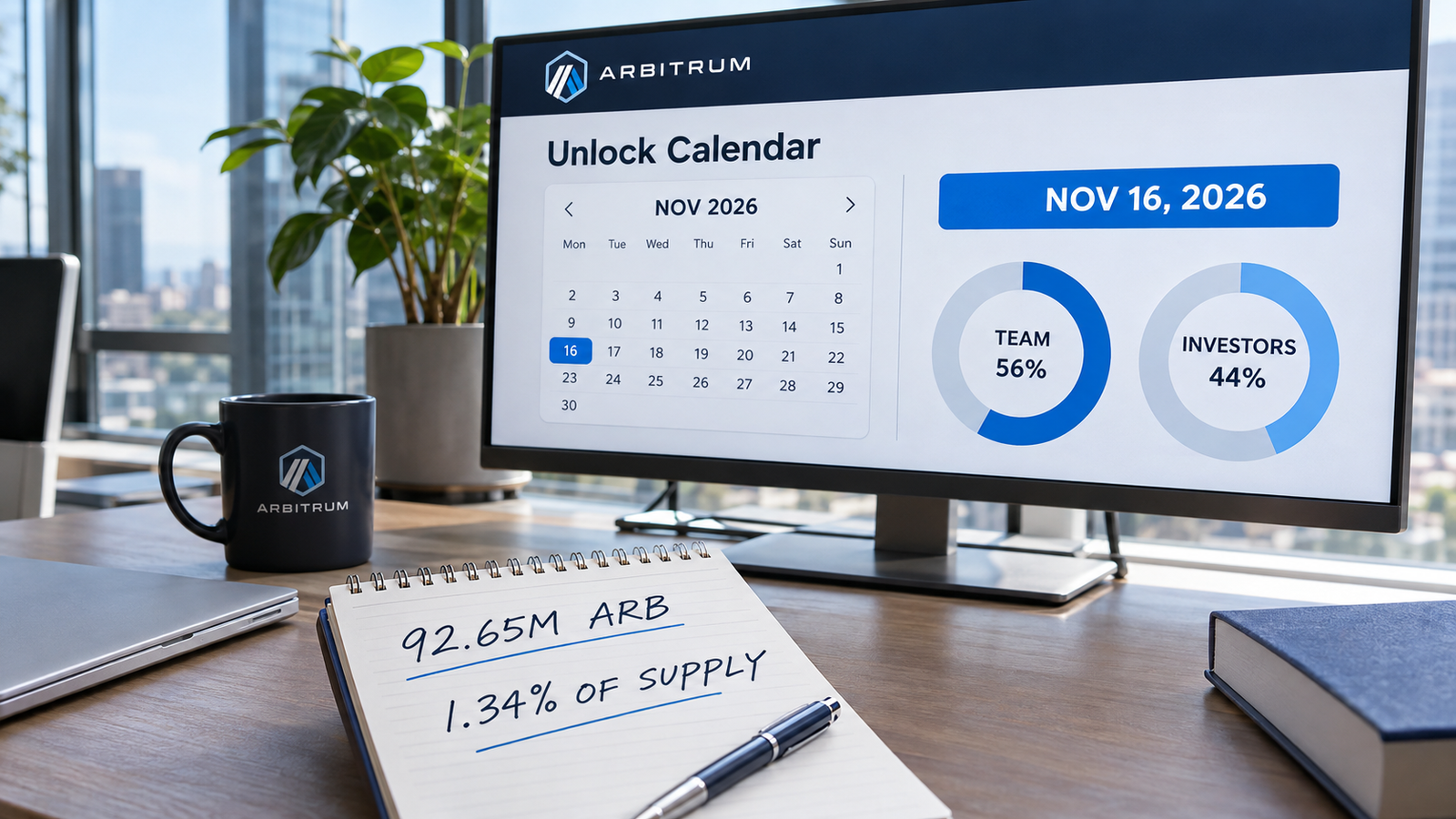
Arbitrum faces another scheduled token unlock in mid-November 2026, with approximately 92.65 million ARB becoming available to team members, advisors, and early investors.
At a reference price near $0.13, the release is worth approximately $12 million. It represents 1.34% of ARB’s circulating supply of roughly 6.89 billion tokens.
Most major vesting trackers list November 16 as the unlock date, although some calendars place the event on November 15 because of differences in scheduling conventions.
The release comes as ARB trades near $0.13, significantly below its January 2024 all-time high of approximately $2.40.
For investors, the key question isn’t simply how many tokens unlock. It’s whether recipients transfer those tokens to exchanges and how much buying demand exists to absorb potential selling.
Arbitrum Token Unlock: November 2026 Key Details
The upcoming release belongs to Arbitrum’s scheduled vesting program, which gradually distributes tokens allocated to early contributors and investors.
ARB November 2026 Unlock Overview
| Metric | Value |
|---|---|
| Scheduled date | November 15–16, 2026 |
| Main tracker date | November 16 |
| Tokens unlocking | 92.65 million ARB |
| Estimated USD value | ~$12.0 million |
| Circulating supply | ~6.89 billion ARB |
| Maximum supply | 10 billion ARB |
| Unlock / circulating supply | 1.34% |
| Unlock / maximum supply | 0.93% |
| Reference ARB price | ~$0.13 |
| Approximate market capitalization | $896 million |
Figures checked November 15, 2026. Token values are estimates based on reference market prices. Scheduled unlocks do not guarantee immediate token sales.
The event is relatively modest compared with Arbitrum’s overall token supply, but its dollar value remains meaningful for short-term market liquidity.
A 1.34% increase in potentially transferable supply can create pressure if recipients decide to sell during weak market conditions.
Who Receives the November ARB Unlock?
The November allocation is divided between two recipient groups.
Team members, future contributors, and advisors receive the larger share. The remainder goes to investors who participated in earlier funding rounds.
November ARB Unlock Allocation
| Recipient | ARB Tokens | Share of Unlock |
|---|---|---|
| Team, Future Team and Advisors | 56.13M | 60.6% |
| Investors | 36.52M | 39.4% |
| Total | 92.65M | 100% |
At $0.13 per ARB, the team allocation is worth approximately $7.3 million, while the investor allocation represents around $4.7 million.
These categories matter because recipients may have different financial objectives.
Early investors could rebalance portfolios or realize gains and losses. Team members may hold tokens for governance participation, treasury management, or longer-term exposure.
However, vesting eligibility alone doesn’t establish that any recipient intends to sell.
The most useful evidence comes from actual token transfers after the release.
How Will the Unlock Affect ARB Circulating Supply?
Arbitrum has a maximum supply of 10 billion ARB.
Approximately 6.89 billion tokens are currently classified as circulating by major market-data providers.
If the full November release were newly included in circulating supply, that figure would rise to approximately 6.985 billion ARB.
ARB Supply Before and After the Unlock
| Metric | Before | After Full Inclusion |
|---|---|---|
| Circulating supply | 6.892B | 6.985B |
| Increase | — | 92.65M |
| Percentage growth | — | 1.34% |
| Share of maximum supply | 68.92% | 69.85% |
This calculation assumes every unlocked token enters reported circulation.
In practice, circulating supply and vested supply are different measurements.
Tokens may become transferable without immediately reaching exchanges. Some market-data providers also use different methodologies when classifying treasury holdings and unlocked allocations.
Consequently, the reported circulating supply may not increase by exactly 92.65 million on the event date.
Arbitrum Tokenomics: Why Monthly Unlocks Matter
ARB launched in March 2023 as the governance token of the Arbitrum ecosystem.
The original token allocation covered investors, team members, advisors, individual users, ecosystem organizations, and the ArbitrumDAO treasury.
Original ARB Token Allocation
| Allocation | Share of Total Supply |
|---|---|
| ArbitrumDAO Treasury, including initially unspecified portion | 42.78% |
| Team, Future Team and Advisors | 26.94% |
| Investors | 17.53% |
| Individual Wallets | 11.62% |
| DAOs in Arbitrum Ecosystem | 1.13% |
Team and investor allocations followed an initial lockup period, with subsequent monthly releases extending into March 2027.
The November event is therefore part of an established schedule rather than an unexpected supply increase.
That distinction is important for price analysis.
Because vesting dates are publicly known, traders can adjust positions before tokens actually become transferable.
An unlock’s impact may appear days before the event, during the release, or over the following weeks.
Could the November Unlock Create Selling Pressure?
A crypto token unlock creates potential selling capacity, not automatic selling.
The market impact depends on the proportion of released tokens that recipients actually transfer or sell.
Consider the November release of 92.65 million ARB at an assumed constant price of $0.13.
Hypothetical ARB Selling Scenarios
| Share of Unlock Sold | Tokens Sold | Notional Value |
|---|---|---|
| 0% | 0 | $0 |
| 10% | 9.27M | $1.20M |
| 25% | 23.16M | $3.01M |
| 50% | 46.33M | $6.02M |
| 100% | 92.65M | $12.04M |
Illustrative calculations only. These are not forecasts of actual sales or execution prices.
Even if 25% of the allocation were sold, the resulting notional selling value would exceed $3 million.
Whether that amount significantly affects ARB depends on available liquidity.
Daily trading volume alone cannot answer the question.
A market reporting $150 million in 24-hour turnover might still experience substantial slippage if several million dollars of market sell orders arrive within minutes.
Order-book depth, execution speed, and the availability of buyers determine the immediate price impact.
What Previous ARB Unlocks Tell Us
Arbitrum’s vesting history provides useful context, although historical price movements cannot establish causation.
One tokenomics dataset recorded the following maximum drawdowns during the 14 days after selected monthly unlocks.
Historical ARB Post-Unlock Drawdowns
| Unlock Month | Reported Maximum Drawdown |
|---|---|
| May 2026 | -28.3% |
| June 2026 | -14.8% |
| July 2026 | -15.9% |
| August 2026 | -15.2% |
| September 2026 | -16.6% |
| October 2026 | -15.8% |
Provider-calculated maximum post-unlock drawdowns, not returns attributable specifically to vesting events.
The figures show that ARB experienced considerable downside volatility around several previous releases.
However, cryptocurrency prices react to multiple factors simultaneously.
Bitcoin movements, leverage liquidations, macroeconomic announcements, and changes in market sentiment may all contribute.
A post-unlock decline does not prove that recipients sold their tokens.
Likewise, these historical drawdowns should not be used as direct predictions for November.
ARB Price Outlook: Three Scenarios After the Unlock
ARB’s near-term outlook depends on both token-specific supply and broader cryptocurrency market conditions.
Scenario 1: Bearish — Selling Pressure Accelerates
If team or investor wallets transfer substantial ARB amounts to exchanges, the market may face additional selling pressure.
The risk increases if trading liquidity is thin and Bitcoin continues to weaken.
A breakdown below the recent $0.1235 reference low could signal renewed downside pressure.
However, a price decline by itself would not prove that unlock recipients caused the selling.
Scenario 2: Neutral — The Market Absorbs New Supply
If recipients hold most of their allocations or distribute them gradually, the immediate impact may remain limited.
ARB could continue consolidating while buyers and sellers adjust positions.
A return above the recent $0.1345 area would provide an early indication of stabilization, although a sustained recovery would require broader market support.
Scenario 3: Bullish — Limited Selling Supports Recovery
The release may already be reflected in market expectations.
If actual exchange deposits remain limited and buying demand improves, ARB could recover despite the additional transferable supply.
Stronger activity across Arbitrum’s Layer 2 ecosystem may support sentiment, although network adoption doesn’t automatically generate buying demand for the ARB governance token.
ARB Price Scenarios
| Scenario | Main Signal | Potential Outcome |
|---|---|---|
| Bearish | Heavy exchange inflows, weak demand | Additional downside volatility |
| Neutral | Limited transfers, balanced trading | Consolidation |
| Bullish | Low realized selling, improving demand | Price recovery |
These are conditional scenarios rather than price forecasts.
What Happens After the November Unlock?
The November event is not the end of Arbitrum’s vesting program.
Monthly team and investor releases are expected to continue into March 2027.
Upcoming ARB Unlock Schedule
| Expected Date | Estimated Release | Recipients |
|---|---|---|
| November 16, 2026 | 92.65M ARB | Team and Investors |
| December 16, 2026 | 92.65M ARB | Team and Investors |
| January 16, 2027 | 92.65M ARB | Team and Investors |
| February 16, 2027 | 92.65M ARB | Team and Investors |
| March 16, 2027 | 92.65M ARB | Team and Investors |
Dates follow the principal monthly team/investor vesting model. Foundation distributions may occur separately, and individual trackers can use different accounting dates.
This schedule means investors should consider future supply additions alongside the November event.
At 92.65 million ARB per month, five consecutive releases would represent approximately 463.25 million tokens.
Not every released token necessarily enters liquid trading markets, but the vesting calendar remains relevant to future valuations.
What Traders Should Monitor Around November 16
The most informative signals are those connecting potential supply with actual market activity.
First, examine transactions from identifiable team and investor vesting addresses.
Large transfers to centralized exchanges may indicate preparation for trading, although they don’t prove that a sale will occur.
Second, monitor spot-market order books. Bid liquidity determines how much selling the market can absorb before prices move materially.
Third, compare trading volume with changes in derivatives open interest.
A sharp price decline accompanied by rising liquidations and falling open interest could indicate forced position closures rather than purely unlock-driven selling.
Finally, watch Bitcoin and Ethereum.
Arbitrum remains exposed to broader altcoin market sentiment, and an unfavorable macroeconomic environment can outweigh token-specific developments.
Frequently Asked Questions
When is the Arbitrum token unlock in November 2026?
Major vesting trackers schedule the release for November 16, 2026. Some calendars use November 15 because of differences in event timing and reporting conventions.
How many ARB tokens will unlock?
Approximately 92.65 million ARB are scheduled for release to team members, advisors, and investors.
What percentage of ARB circulating supply is unlocking?
The release represents approximately 1.34% of the reported 6.89 billion circulating ARB supply.
How much is the November ARB unlock worth?
At a reference price of $0.13, the release is worth approximately $12 million. The actual value changes with ARB’s market price.
Will the Arbitrum token unlock cause ARB to fall?
Not necessarily. An unlock increases potential selling capacity, but actual price movement depends on recipient behavior, liquidity, demand, and broader market conditions.
When will Arbitrum token vesting end?
The principal team and investor vesting schedule is expected to conclude in March 2027.
Is ARB the gas token on Arbitrum?
No. ETH is used to pay transaction fees on Arbitrum One, while ARB primarily serves as a governance token.
What should investors watch after the unlock?
The most useful indicators include recipient wallet transfers, exchange inflows, spot-market liquidity, trading volume, derivatives positioning, and Bitcoin’s direction.