Mining Litecoin and Dogecoin doesn’t require two separate ASIC miners. Both cryptocurrencies use the Scrypt proof-of-work algorithm, and Dogecoin supports a mechanism called Auxiliary Proof of Work (AuxPoW), allowing the same mining work to contribute to both networks.
With a compatible Scrypt ASIC and a mining pool supporting merged mining, miners can earn LTC and DOGE rewards without dividing their hashrate between the two coins.
The additional revenue can improve mining economics, but profitability still depends on electricity prices, network difficulty, hardware efficiency, pool fees and cryptocurrency prices.
This guide explains how Litecoin Dogecoin merged mining works, how to configure a mining pool and how to calculate whether operating a dual-coin setup makes financial sense.
What Is Litecoin Dogecoin Merged Mining?
Merged mining allows miners to use compatible proof-of-work calculations to participate in more than one blockchain.
Litecoin typically acts as the parent chain, while Dogecoin accepts auxiliary proof of work derived from the same Scrypt mining process.
Dogecoin adopted merged mining in 2014 to strengthen network security by allowing Litecoin miners to contribute their computational power.
The key advantage is that a miner doesn’t need to dedicate half its hashrate to LTC and the other half to DOGE.
The same hardware performs one Scrypt hashing workload, and the pool manages valid work submissions for both networks.
Litecoin vs Dogecoin Mining Characteristics
| Metric | Litecoin (LTC) | Dogecoin (DOGE) |
|---|---|---|
| Mining algorithm | Scrypt | Scrypt |
| Consensus mechanism | Proof of Work | Proof of Work with AuxPoW |
| Target block interval | 2.5 minutes | 1 minute |
| Block subsidy, November 2026 | 6.25 LTC | 10,000 DOGE |
| Approximate blocks per day | 576 | 1,440 |
| Approximate daily block subsidies | 3,600 LTC | 14.4 million DOGE |
| Mining hardware | Scrypt ASIC | Scrypt ASIC |
These figures represent protocol targets and subsidy schedules, not guaranteed daily production. Actual block times fluctuate.
Unlike Litecoin, which periodically halves its mining subsidy, Dogecoin maintains a fixed 10,000 DOGE subsidy per block.
This creates a different long-term issuance profile for each cryptocurrency.
How Does AuxPoW Work?
Auxiliary Proof of Work allows a secondary blockchain to accept valid mining proofs generated through a compatible parent-chain mining process.
For LTC DOGE merged mining, the pool prepares Scrypt mining work containing a cryptographic commitment to a Dogecoin block.
The ASIC performs ordinary Scrypt hashing.
When a hash satisfies the relevant difficulty requirements, the pool can submit a corresponding block candidate to Litecoin, Dogecoin, or both, depending on which targets are met.
Dogecoin nodes verify the auxiliary proof before accepting the block.
The two blockchains remain independent.
Litecoin and Dogecoin still have separate transactions, block histories, difficulty adjustments and currencies.
Merged Mining vs Running Two Miners
| Feature | Merged Mining | Separate Mining Setups |
|---|---|---|
| ASIC hardware | One compatible Scrypt miner | Separate machines or workloads |
| Hashrate allocation | Same work supports both chains | Hashrate allocated separately |
| Mining pool | LTC pool supporting DOGE | Separate arrangements |
| Rewards | LTC and eligible DOGE | Depends on each setup |
| Additional hashing requirement | No separate DOGE workload | Additional resources required |
| Electricity | Approximately normal ASIC consumption | Depends on total hardware |
Merged mining doesn’t create free cryptocurrency.
It allows compatible networks to recognize the same computational work, potentially increasing the revenue earned from operating existing hardware.
What Hardware Do You Need to Mine LTC and DOGE?
Modern Litecoin and Dogecoin mining is dominated by specialized Scrypt ASIC equipment.
CPU and GPU mining are generally not economically competitive against ASIC-based networks.
Compatible machines include the Antminer L7, Antminer L9 and various Scrypt models from Goldshell and other manufacturers.
The important requirement is genuine Scrypt ASIC compatibility.
A Bitcoin ASIC using SHA-256 cannot mine Litecoin or Dogecoin simply by changing its pool address.
Antminer L9 Mining Specifications
| Specification | Antminer L9 (16G) |
|---|---|
| Mining algorithm | Scrypt |
| Typical hashrate | 16 GH/s |
| Rated power consumption | 3,360 W |
| Energy efficiency | 210 J/GH |
| Daily electricity use | 80.64 kWh |
| Monthly electricity use (30 days) | 2,419.2 kWh |
| Supported mining | LTC and DOGE via compatible pool |
Manufacturer-rated values at specified operating conditions. Actual power draw varies with settings, temperature and equipment condition.
An L9 requires substantial electrical capacity, adequate ventilation and reliable cooling.
Its rated input voltage is 220–277 V, so it isn’t appropriate to assume compatibility with an ordinary household outlet.
Before installing one, confirm the electrical circuit, power distribution, cooling requirements and local operating costs.
How to Mine Litecoin and Dogecoin Together: Step by Step
The simplest approach is connecting a Scrypt ASIC to a Litecoin mining pool that supports Dogecoin merged mining.
Popular examples include f2pool and ViaBTC.
Step 1: Choose a Merged Mining Pool
Look for a pool that explicitly supports both LTC and DOGE.
Compare its fee structure, payout model, server locations, minimum withdrawals and merged-mining reward distribution.
| Pool | LTC/DOGE Merged Mining | Reward Features |
|---|---|---|
| f2pool | Supported | DOGE rewards under PPLNS |
| ViaBTC | Supported | LTC PPS+ or PPLNS; DOGE under PPLNS |
Pool policies can change, so confirm the current terms before connecting hardware.
Step 2: Create a Mining Account
Register with your chosen pool.
Enable account security features and locate the mining account or worker configuration section.
The pool will provide a Stratum endpoint and instructions for identifying your miner.
A worker name allows the pool to attribute accepted shares and earnings to your account.
Step 3: Access Your ASIC Dashboard
Connect the ASIC to its required power supply and network connection.
Find the device’s local IP address using the manufacturer’s recommended discovery method.
Open its management interface and sign in.
Navigate to the mining configuration or pool settings section.
Step 4: Enter Your Pool Configuration
For f2pool, a documented Litecoin configuration is:
| Setting | Example |
|---|---|
| Pool URL | stratum+tcp://ltc.f2pool.com:8888 |
| Worker | accountname.worker01 |
| Password | x |
Replace accountname with your own mining account.
The worker name identifies the machine, while the password field is commonly a placeholder rather than your actual pool login password.
Additional server ports may be available.
Do not enter your exchange password, wallet private key or recovery phrase into the mining configuration.
Step 5: Save Settings and Start Mining
Apply the configuration and allow the miner to connect.
Check the pool dashboard for:
- Worker status
- Reported hashrate
- Accepted shares
- Rejected shares
- LTC earnings
- DOGE merged-mining earnings
Pool-estimated hashrate may differ temporarily from the device’s reported hashrate because the measurements use different observation periods.
A consistent pattern of rejected shares may indicate network latency, incorrect settings or hardware instability.
Step 6: Enable DOGE Rewards and Withdrawals
This step depends on the pool.
On f2pool, miners must add a Dogecoin payout address to receive DOGE merged-mining rewards.
According to the pool’s documented rules, DOGE earnings begin accruing only after the relevant address has been successfully configured. Missing earlier rewards may not be recoverable.
ViaBTC uses a different approach: eligible DOGE rewards are credited to the mining account automatically, while transferring them to an external wallet is configured separately.
These details make payout setup just as important as connecting the ASIC.
How Are LTC and DOGE Mining Rewards Paid?
Mining pools combine the contributed hashrate of many participants and distribute rewards according to their payment rules.
Two common payout methods are PPS+ and PPLNS.
PPS+ generally provides more predictable payment for qualifying shares on the primary coin, while PPLNS depends more directly on actual pool block discoveries and recent contributed work.
For example, ViaBTC allows eligible Litecoin miners to use PPS+ or PPLNS for LTC.
However, its merged DOGE rewards follow PPLNS regardless of the selected LTC payment method.
This means LTC payments can be relatively consistent while DOGE earnings fluctuate between settlement periods.
Pool Rewards vs Wallet Payments
| Stage | Meaning |
|---|---|
| Accepted shares | Pool recognizes valid mining work |
| Estimated earnings | Projected income based on current conditions |
| Credited LTC | Litecoin rewards recorded in pool account |
| Credited DOGE | Dogecoin rewards recorded in pool account |
| Withdrawal | Coins transferred to an external wallet |
| Confirmed payout | Withdrawal recorded on the appropriate blockchain |
A reward appearing in the mining dashboard doesn’t necessarily mean it has reached your personal wallet.
For example, ViaBTC documents DOGE settlements approximately every two hours, while automatic external withdrawals follow a separate daily schedule and minimum threshold.
What Wallets Do You Need for Merged Mining?
Litecoin and Dogecoin use separate blockchains, so miners should prepare appropriate receiving addresses for each cryptocurrency.
A Litecoin wallet address cannot simply be substituted for a Dogecoin address.
Mining Wallet Requirements
| Requirement | Litecoin | Dogecoin |
|---|---|---|
| Native receiving address | LTC address | DOGE address |
| Blockchain | Litecoin | Dogecoin |
| Pool payout configuration | Required | Required for external payouts |
| Self-custody support | Available | Available |
| Exchange deposit address | Possible if supported | Possible if supported |
A self-custody wallet gives miners control over their private keys.
Exchange deposit addresses may be convenient, but exchanges can change minimum deposits, supported networks and deposit policies.
For regular mining payments, verify the correct asset and native network before configuring automatic withdrawals.
Also consider minimum payout thresholds.
If a miner produces only a small DOGE balance, the pool may retain earnings until the withdrawal minimum is reached.
Is Litecoin and Dogecoin Merged Mining Profitable?
Profitability depends on combined mining revenue minus operating expenses.
The basic formula is:
Daily Profit = LTC Revenue + DOGE Revenue − Pool Fees − Electricity − Other Operating Costs
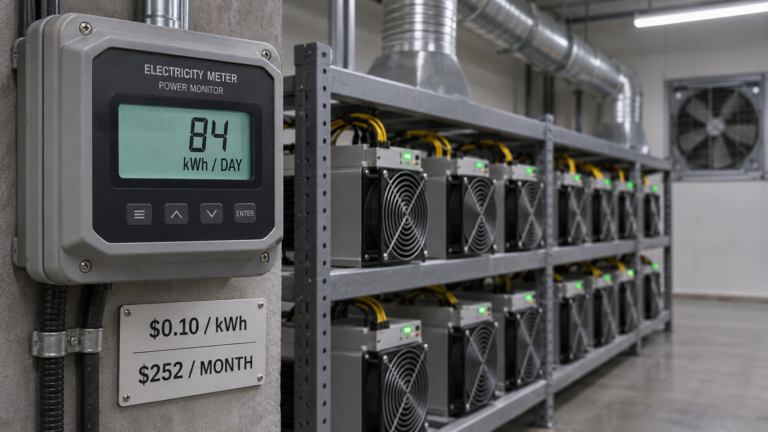
The largest predictable ongoing expense is usually electricity.
Electricity Cost for an Antminer L9
A 3,360 W ASIC consumes 3.36 kW while operating at rated power.
Daily electricity consumption:
3.36 kW × 24 hours = 80.64 kWh.
Daily and Monthly Electricity Costs
| Electricity Price | Daily Cost | 30-Day Cost |
|---|---|---|
| $0.08/kWh | $6.45 | $193.54 |
| $0.12/kWh | $9.68 | $290.30 |
| $0.20/kWh | $16.13 | $483.84 |
Calculated using continuous 3.36 kW consumption. Cooling and additional electrical losses are excluded.
A $0.12/kWh electricity tariff creates nearly $290 in monthly electricity expense before accounting for ventilation, maintenance or equipment depreciation.
That cost continues even when cryptocurrency prices decline.
Litecoin vs Dogecoin Mining Revenue: Example Calculation
Suppose an ASIC generates the following hypothetical gross daily rewards:
| Revenue Source | Daily Value |
|---|---|
| Litecoin mining | $6.00 |
| Dogecoin merged mining | $12.00 |
| Combined revenue | $18.00 |
| Example pool fees (2%) | -$0.36 |
| Net mining revenue before electricity | $17.64 |
These figures are illustrative assumptions, not current profitability estimates.
Using the L9 electricity consumption above:
Daily Mining Profit by Electricity Rate
| Electricity Price | Revenue After Pool Fee | Electricity | Daily Operating Profit |
|---|---|---|---|
| $0.08/kWh | $17.64 | $6.45 | $11.19 |
| $0.12/kWh | $17.64 | $9.68 | $7.96 |
| $0.20/kWh | $17.64 | $16.13 | $1.51 |
The example shows how electricity can determine whether a mining operation remains attractive.
At $0.20/kWh, very little operating margin remains.
The calculation also excludes ASIC purchase costs, repairs, cooling, taxes and downtime.
Why DOGE Rewards Matter
Without the hypothetical $12 in DOGE revenue, the same miner would earn just $6 in gross LTC revenue before expenses.
The additional merged-mining rewards substantially change the economics.
However, Dogecoin’s contribution fluctuates with network conditions, market prices and pool reward distribution.
Miners should calculate LTC and DOGE earnings separately rather than assume that the merged-mining bonus remains constant.
How to Estimate Mining Break-Even Electricity Cost
A useful financial metric is the maximum electricity tariff an ASIC can tolerate before its operating profit reaches zero.
Break-Even Electricity Rate = Net Daily Mining Revenue Before Electricity / Daily kWh
Using the previous example:
$17.64 / 80.64 kWh = approximately $0.219/kWh.
At this tariff, electricity consumes the entire hypothetical daily mining revenue after pool fees.
However, the true business break-even tariff is lower once hardware depreciation, cooling, maintenance and other expenses are included.
For anyone purchasing new equipment, payback calculations should account for the original ASIC cost and changes in mining difficulty over time.
Common LTC/DOGE Merged Mining Problems
| Problem | Possible Cause | What to Check |
|---|---|---|
| ASIC not appearing in pool | Incorrect URL or worker name | Stratum settings |
| Low reported hashrate | Network instability or device issues | Accepted shares and temperature |
| LTC rewards but no DOGE | Payout configuration or pool rules | DOGE eligibility and wallet settings |
| Rewards below expectations | Difficulty changes or pool variance | Hashrate and payout model |
| Coins not reaching wallet | Withdrawal threshold not met | Pool payout status |
| High electricity cost | Inefficient equipment or expensive power | Watts, kWh and tariff |
The most common configuration mistake is attempting to operate separate LTC and DOGE mining workloads when the pool already handles merged mining.
With a supported pool, one Scrypt ASIC connection is sufficient for participating in both networks.
Frequently Asked Questions
Can you mine Litecoin and Dogecoin at the same time?
Yes. Compatible Scrypt ASIC miners can participate in Litecoin and Dogecoin merged mining through pools supporting AuxPoW.
Do I need two ASIC miners for LTC and DOGE?
No. One Scrypt ASIC can provide hashing work for both chains through a compatible merged-mining pool.
Does merged mining reduce Litecoin hashrate?
Not inherently. The same Scrypt hashing work can support both networks without splitting the ASIC’s computational capacity.
Can I mine Litecoin and Dogecoin with a GPU?
Technically, Scrypt mining software exists, but modern ASIC competition makes GPU mining generally uneconomical.
Does every Litecoin mining pool pay DOGE?
No. The pool must support DOGE merged mining and have a reward distribution mechanism.
Do DOGE rewards arrive automatically?
It depends on the pool. Some credit DOGE to the mining account automatically, while others require a payout address before rewards begin accruing.
Is merged mining more profitable than mining Litecoin alone?
It can increase gross revenue by adding DOGE rewards without a separate ASIC workload. Actual profitability still depends on electricity, mining difficulty, equipment costs, pool fees and token prices.