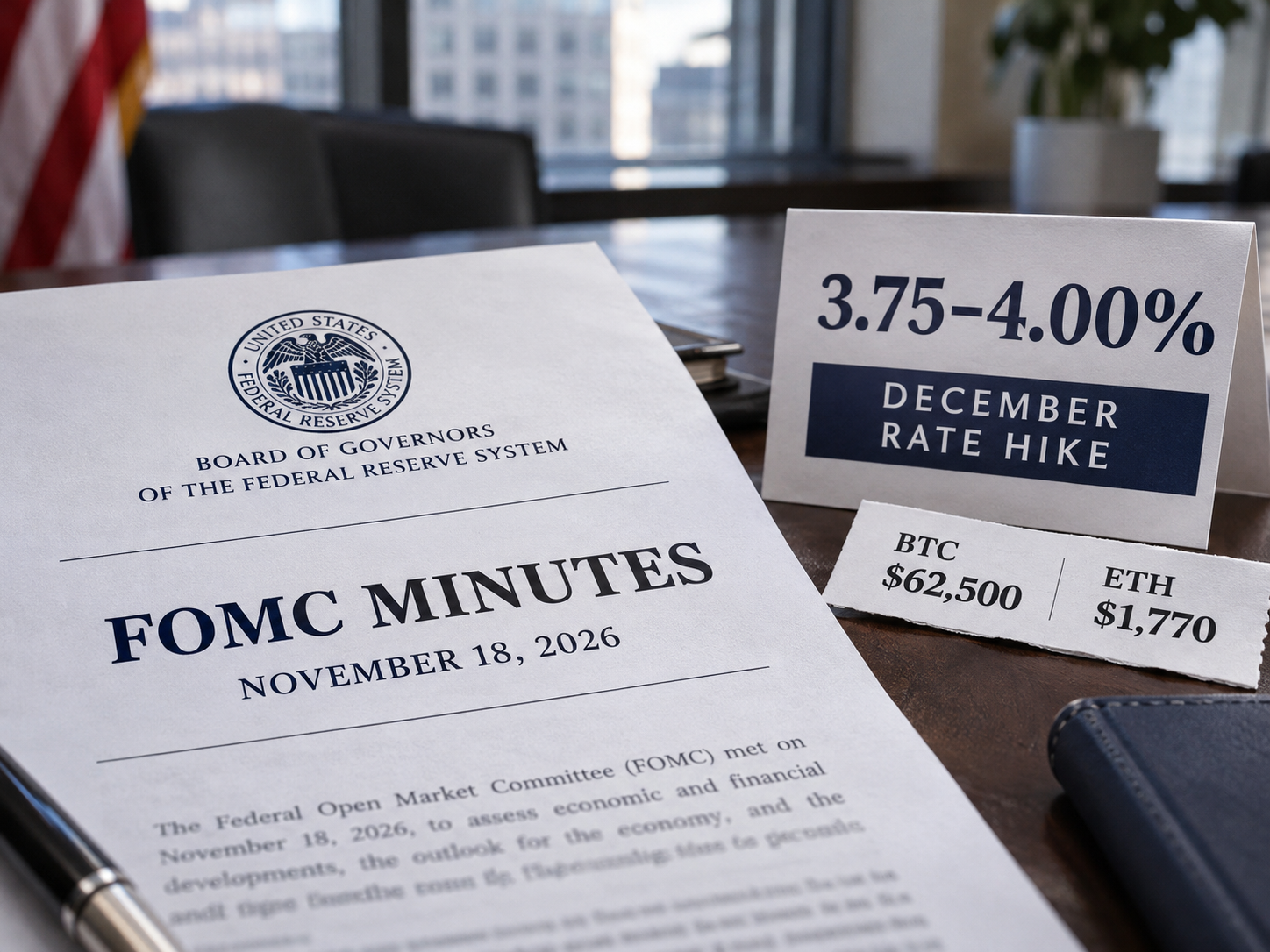
Bitcoin fell toward $62,000 after the Federal Reserve released its October meeting minutes on November 18, 2026, revealing broad support for additional interest-rate increases as US inflation remains stubbornly elevated.
The minutes showed that nearly all Fed officials expected further tightening, while two participants suggested that a larger 50-basis-point increase could be considered in December if incoming inflation data disappointed.
Ethereum also came under pressure, declining toward $1,770 as investors reassessed monetary policy expectations.
The hawkish message reinforced an already difficult environment for cryptocurrencies. Higher interest rates, a strong US dollar and elevated Treasury yields have increased competition for speculative assets.
However, with a December rate hike largely priced into financial markets, Bitcoin’s next significant move may depend more on the size of that increase and the Fed’s guidance for 2027.
FOMC Minutes November 2026: Key Takeaways
The Federal Reserve published the minutes of its October 27–28 meeting on November 18 at 2:00 PM Eastern Time.
At that meeting, policymakers voted 10–2 to maintain the federal funds target range at 3.75–4.00%.
Fed Governor Lisa Cook and Cleveland Fed President Beth Hammack opposed the decision, preferring an immediate 25-basis-point increase.
The detailed minutes revealed that support for tighter policy extended beyond those two dissenters.
November 2026 FOMC Minutes: Key Figures
| Indicator | November 2026 Update |
|---|---|
| Minutes released | November 18, 2026 |
| Meeting covered | October 27–28 |
| Federal funds target | 3.75–4.00% |
| October vote | 10–2 to hold rates |
| Main policy signal | Further hikes likely |
| Possible December increase | 25 or 50 basis points |
| Next Fed meeting | December 8–9, 2026 |
| Fed inflation target | 2% |
The most significant finding was that almost all participants considered further rate increases appropriate under their baseline economic projections.
Some officials who supported keeping rates unchanged in October described the decision as a close call.
That suggests the Committee may have been more hawkish than its official 10–2 vote initially indicated.
Why the Fed Is Still Worried About Inflation
Inflation dominated the October policy discussion.
Officials acknowledged that some temporary price pressures could eventually fade, including effects associated with tariffs and energy markets.
However, they also warned that inflation was becoming more widespread across the economy.
Several policymakers highlighted persistent price increases in core services, while others expressed concern about the impact of investment in artificial intelligence infrastructure.
Demand for data centers, advanced technology equipment and specialized workers has increased costs in certain industries.
Some participants worried that businesses could pass these costs on to consumers.
The Fed also discussed financial stability risks associated with highly leveraged AI-related investment.
Although the broader US economy remained resilient, officials were reluctant to assume inflation would return quickly to their 2% objective.
Hawkish vs Dovish Signals
| Hawkish Signals | Dovish Signals |
|---|---|
| Almost all officials expect additional hikes | Some inflation pressures may fade |
| Possible 50 bps December increase | Labor market remains relatively stable |
| Inflation is becoming broad-based | Higher borrowing costs are already affecting housing |
| Strong consumer and business spending | Financial conditions have tightened |
| Risks of persistent inflation | Future decisions remain data-dependent |
The overall balance was hawkish, although the minutes did not establish a guaranteed December decision.
December 2026 Fed Rate Decision: What Markets Expect
The next Federal Reserve meeting is scheduled for December 8–9, 2026.
Following the November minutes, futures markets continued to assign overwhelming probability to another rate increase.
CME FedWatch estimates reported on November 19 indicated approximately a 90% probability of a 25-basis-point hike and about a 10% probability of a 50-basis-point increase.
These probabilities are market-implied estimates, not official Federal Reserve commitments.
December Fed Rate Scenarios
| December Decision | New Target Range | Market Interpretation |
|---|---|---|
| Hold rates | 3.75–4.00% | Unexpectedly dovish |
| Raise 25 bps | 4.00–4.25% | Expected outcome |
| Raise 50 bps | 4.25–4.50% | Strongly hawkish |
A December Fed rate cut is not the market’s central expectation.
Instead, investors are debating how aggressively the central bank will tighten policy and whether additional increases will follow in early 2027.
A standard quarter-point hike may produce a limited crypto reaction if the decision is already reflected in prices.
A half-point increase, particularly if accompanied by hawkish guidance, could create greater volatility.
Bitcoin Price Reaction After the FOMC Minutes
Bitcoin extended its decline following the November 18 release, reaching a reported session low near $62,086.
During Wednesday’s trading, BTC lost approximately 3.3%, falling toward $62,500 amid broader risk aversion.
The cryptocurrency subsequently recovered some of those losses.
On November 19, Bitcoin traded around $63,400–$63,700 during parts of the session, showing that the initial selloff did not develop into an uninterrupted decline.
The reaction was influenced by several overlapping factors.
Hawkish Fed expectations contributed to pressure on speculative investments, while Bitcoin ETF outflows, leveraged-position liquidations and broader market sentiment also affected trading.
It would therefore be misleading to attribute Bitcoin’s entire daily decline to the minutes alone.
Bitcoin and Ethereum: Post-FOMC Market Snapshot
| Asset | Post-Release Low | Nov. 19 Recovery Snapshot |
|---|---|---|
| Bitcoin (BTC) | Around $62,086 | Around $63,442 |
| Ethereum (ETH) | Around $1,770 | Around $1,802 |
Approximate reported USD prices from November 18–19, 2026. Figures represent selected market observations rather than synchronized exchange quotes.
The recovery suggests that some investors were willing to buy after the initial decline, although it does not confirm that selling pressure has ended.
Ethereum Reaction: Why ETH Remains Sensitive to Fed Policy
Ethereum also weakened after the hawkish minutes, falling toward $1,770 before recovering to approximately $1,800 on November 19.
ETH is particularly sensitive to broader cryptocurrency liquidity conditions, leveraged trading and investor demand for risk assets.
Higher US interest rates can affect Ethereum through several channels.
First, higher Treasury yields increase the return available from traditional fixed-income investments.
Second, tighter financial conditions can reduce speculative investment across crypto markets.
Third, rising funding costs may encourage leveraged investors to reduce exposure.
Ethereum offers staking rewards, unlike Bitcoin, but those rewards do not eliminate its sensitivity to interest rates.
Investors still compare potential staking income against token-price volatility, custody risks and returns available elsewhere.
For ETH, a sustained recovery would likely require improved market sentiment and renewed demand for Ethereum-based assets, rather than merely a temporary bounce after the Fed minutes.
Treasury Yields and the US Dollar: What They Reveal
Bitcoin’s reaction to Federal Reserve policy becomes easier to interpret when examined alongside Treasury yields and the US Dollar Index.
On November 18, US government bond yields moved in different directions.
The two-year Treasury yield rose slightly, while the benchmark ten-year yield declined despite hawkish commentary from Fed officials.
The dollar strengthened, with DXY approaching its highest level in approximately 19 months.
Market Indicators After the Fed Minutes
| Indicator | November 18 Level | Daily Movement |
|---|---|---|
| US 2-year Treasury yield | 4.798% | +1.1 bps |
| US 10-year Treasury yield | 5.065% | -3.6 bps |
| US Dollar Index (DXY) | Around 103.78 | +0.2% |
| Bitcoin | Around $62,500 | Approximately -3.3% |
Approximate November 18 market observations. Bitcoin and DXY changes reflect the broader session, not an isolated minutes-release window.
The difference between two-year and ten-year yields is particularly important.
Short-term Treasury yields tend to react more directly to expectations about Federal Reserve policy.
Longer-term yields also reflect inflation expectations, economic growth, government borrowing and demand for safe assets.
The decline in ten-year yields shows that hawkish Fed communication does not automatically produce higher yields across every maturity.
Why a Stronger Dollar Can Pressure Crypto
Bitcoin trades predominantly against the US dollar.
When the dollar strengthens, global financial conditions can become more restrictive, particularly for investors and borrowers operating outside the United States.
A stronger DXY can therefore coincide with weaker demand for cryptocurrencies.
However, the relationship is not mechanically inverse.
Bitcoin can rise alongside the dollar when crypto-specific demand is sufficiently strong.
The most useful approach is to analyze the dollar alongside Treasury yields, ETF flows and broader risk appetite.
What Happens Next for Bitcoin and Ethereum?
The November minutes confirmed that the Federal Reserve remains focused on controlling inflation, even as higher borrowing costs affect parts of the economy.
The central question for cryptocurrency investors is now whether December brings a conventional quarter-point increase or a more aggressive policy response.
Three developments deserve particular attention.
1. December Rate-Hike Expectations
A shift toward higher odds of a 50-basis-point increase could pressure Bitcoin and Ethereum.
Conversely, weaker economic or inflation data could reduce expectations of aggressive tightening.
2. Treasury Yields and DXY
If short-term yields and the dollar continue rising, financial conditions may remain challenging for cryptocurrencies.
Stabilization in both indicators could help improve sentiment.
3. Institutional Crypto Demand
Bitcoin ETF flows and institutional positioning may determine whether macroeconomic pressure translates into sustained selling.
Persistent outflows could amplify declines, while renewed inflows may cushion the impact of restrictive Fed policy.
Potential Bitcoin Market Scenarios
| Scenario | Macro Conditions | Possible BTC Response |
|---|---|---|
| Bullish | Softer inflation, lower yields, ETF inflows | Recovery gains traction |
| Neutral | 25 bps hike already priced in | Range-bound volatility |
| Bearish | 50 bps hike expectations rise, stronger DXY | Renewed selling pressure |
These scenarios describe possible market reactions, not guaranteed price outcomes.
Frequently Asked Questions
When were the November 2026 FOMC minutes released?
The Federal Reserve released the October 27–28 meeting minutes on November 18, 2026, at 2:00 PM ET.
What did the November 2026 Fed minutes reveal?
The minutes showed that almost all policymakers expected further interest-rate increases, while two participants considered the possibility of a larger December hike if inflation remained elevated.
How did Bitcoin react to the Fed minutes?
Bitcoin declined toward $62,000 following the release and broader market selloff, before partially recovering on November 19.
How did Ethereum react?
Ethereum fell toward $1,770 and subsequently recovered to around $1,800 during November 19 trading.
Will the Fed cut rates in December 2026?
A December rate cut is not the central market expectation. Investors predominantly anticipate a 25-basis-point increase, with a smaller probability assigned to a 50-basis-point hike.
Why do higher interest rates affect Bitcoin?
Higher interest rates can increase Treasury yields, strengthen the dollar and reduce demand for speculative assets. However, Bitcoin’s performance also depends on institutional flows and crypto-specific market conditions.
When is the next FOMC meeting?
The next Federal Reserve policy meeting is scheduled for December 8–9, 2026.