
Sending Ethereum to a wallet address such as 0x742d35Cc6634C0532925a3b844Bc9e7595f0bEb isn’t particularly convenient. The address is difficult to remember, easy to mistype, and almost impossible to recognize at a glance.
Ethereum Name Service (ENS) solves this problem by replacing complicated blockchain addresses with readable names such as alice.eth.
Instead of copying 42 characters, users can enter a registered .eth name into a compatible wallet. The application looks up the associated blockchain address before sending cryptocurrency.
ENS is also used for Web3 profiles, decentralized websites, digital identities, and wallet recognition across supported applications.
However, .eth names aren’t permanently owned without conditions. They require registration, renewal, and careful security management.
What Is Ethereum Name Service?
Ethereum Name Service is a decentralized naming system built around Ethereum smart contracts.
Its primary purpose is to connect human-readable names with machine-readable blockchain information.
The easiest comparison is the Domain Name System (DNS), which translates website names into network addresses.
ENS performs a related function for cryptocurrency wallets and Web3 applications.
For example, an ENS name can point to an Ethereum address, a Bitcoin address, profile information, or decentralized website content.
ENS vs Traditional Internet Domains
| Feature | ENS .eth Domain | Traditional Domain |
|---|---|---|
| Example | alice.eth | alice.com |
| Main infrastructure | Ethereum smart contracts | DNS infrastructure |
| Primary purpose | Wallet naming and Web3 identity | Websites and internet services |
| Address records | Crypto addresses | IP addresses and related records |
| Registration | Blockchain-based | Domain registrar |
| Renewal required | Yes | Yes |
| Transferable | Yes | Yes |
| Works in ordinary browsers by default | No | Generally yes |
A .eth domain is not automatically equivalent to a conventional website address.
Opening a .eth name in a browser generally requires compatible software, a gateway, or another supported resolution method.
How Do .eth Domains Work?
ENS uses smart contracts and resolver records to connect names with blockchain addresses.
When someone registers alice.eth, the ENS system records the relevant name registration and ownership information.
A resolver then provides the data associated with that name.
Example: Sending ETH Using ENS
Suppose Alice registers alice.eth and configures it to point to her Ethereum wallet.
Another person wants to send her 0.1 ETH.
The process works as follows:
- The sender enters
alice.ethinto an ENS-compatible wallet. - The wallet requests the address associated with the name.
- The ENS resolver returns Alice’s configured Ethereum address.
- The wallet prepares the transaction to that address.
- The sender verifies the destination and confirms payment.
The blockchain ultimately receives an ordinary Ethereum transaction.
ENS makes identifying the recipient easier; it doesn’t change how the underlying blockchain processes transfers.
Main ENS Components
| Component | Function |
|---|---|
| Registry | Tracks ownership and resolver information |
| Registrar | Manages .eth registrations and expiry |
| Resolver | Returns addresses and other records |
| Address record | Connects a name to a wallet |
| Primary name | Associates a wallet address with its displayed ENS identity |
| Text records | Store profile and other metadata |
Users don’t need to understand every smart contract to register a domain, but knowing the difference between ownership and address records helps prevent mistakes.
What Is an ETH Domain Used For?
An .eth name can serve several practical purposes.
The most common is replacing a difficult-to-read wallet address with a recognizable identifier.
A freelancer might receive crypto payments through a personal name. A DAO member might use an ENS identity when interacting with governance applications.
Projects can also create subnames for different departments or contributors.
Common ENS Use Cases
| Use Case | Example |
|---|---|
| Receive cryptocurrency | alice.eth |
| Web3 profile | Public identity and avatar |
| DAO participation | Recognizable governance identity |
| Multi-chain addresses | Different receiving records by network |
| Decentralized website | Name linked to website content |
| Organization identity | team.project.eth |
| Wallet identification | Display ENS instead of hexadecimal address |
ENS names can hold records for multiple cryptocurrencies.
However, applications must explicitly support the relevant resolution method.
Not every wallet can send every cryptocurrency using the same .eth name.
How Much Does an ENS Domain Cost?
The registration fee depends primarily on the length of the name and registration duration.
Shorter names are more expensive because fewer combinations are available.
ENS Domain Registration Prices in 2026
| Name Length | Example | Base Annual Price |
|---|---|---|
| 5+ characters | crypto.eth | $8 |
| 4 characters | defi.eth | $160 |
| 3 characters | btc.eth | $640 |
Base one-year ENS registration rates, November 2026. Availability is not implied by the examples.
The minimum length for a standard registered .eth name is three characters.
ENS also offers discounts for longer registration periods under its updated pricing structure.
ENS Multi-Year Registration Costs
| Registration Term | 5+ Characters | 4 Characters | 3 Characters |
|---|---|---|---|
| 1 year | $8 | $160 | $640 |
| 2 years | $14 | $280 | $1,120 |
| 3 years | $16.50 | $330 | $1,320 |
| 5 years | $27.50 | $550 | $2,200 |
| 6 years | $27 | $540 | $2,160 |
These figures represent the published registration fees, excluding variable network costs.
Interestingly, the six-year registration can cost slightly less than five years because of the discount structure.
Additional charges may apply for certain recently expired names.
ENS Registration Fees vs Network Fees
The annual domain price isn’t necessarily the total amount paid.
Registering or updating an ENS name can require blockchain transactions.
These transactions may involve gas fees, payment approvals, or token conversions.
The official ENS App supports USDC payments on selected networks, including Ethereum, Base, Arbitrum, and Optimism.
It also supports an ETH payment route on Ethereum, with conversion handled during the payment process.
The final amount depends on the payment method, network conditions, and any additional required actions.
Before confirming registration, inspect the quoted total rather than relying only on the advertised annual domain price.
How to Buy an ENS Domain: Step by Step
Registering an .eth domain is relatively straightforward through the official ENS application.
Step 1: Open the Official ENS App
Visit:
Connect a compatible cryptocurrency wallet.
Make sure the address is correct and verify the website URL before authorizing any transaction.
Step 2: Search for a Domain
Enter your preferred name.
For example, search for mycryptoname.eth.
The application displays whether the name is available.
If another user already owns it, you generally cannot register it directly unless it becomes available again or the owner transfers it.
Step 3: Select Registration Duration
Choose how many years you want to register the domain.
Longer periods may offer lower annual costs.
Check the displayed expiration date.
Step 4: Review the Payment
Select an available payment method and review the total.
The application may request payment approval or other steps before registration.
Read the wallet prompts carefully.
Step 5: Complete Registration
Confirm the required wallet interactions.
Wait for the application to display successful registration.
Do not assume ownership until the process has completed.
Step 6: Configure Your Wallet Address
Open your registered name’s profile.
Find the address settings and verify the Ethereum receiving address.
Publish the records using the official application.
Your .eth name can now resolve to that wallet in compatible services.
How to Connect an ENS Domain to Your Wallet
ENS registration and wallet resolution are separate concepts.
Owning alice.eth doesn’t mean it automatically points to every address you control.
The most important record is the ETH Address.
That field determines where ETH sent to the name on Ethereum will go.
For supported EVM networks, ENS also provides chain-specific and default address-resolution options.
ENS Address Record Example
| Record | Example Purpose |
|---|---|
| ETH Address | Receive ETH on Ethereum |
| Base address | Receive assets on Base |
| Arbitrum address | Receive assets on Arbitrum |
| Bitcoin address | Receive native BTC in supported applications |
| Solana address | Receive SOL where supported |
Some interfaces reuse the Ethereum address across selected EVM networks.
Other configurations permit different addresses for each blockchain.
Always verify which address is returned for the network you intend to use.
A correctly configured Ethereum address doesn’t automatically establish a valid Bitcoin or Solana destination.
What Is an ENS Primary Name?
An ENS Primary Name associates a blockchain account with a readable identity.
For example, a wallet holding address 0x1234...abcd may display alice.eth in compatible applications.
This uses reverse resolution.
Ordinary ENS resolution finds an address from a name.
Reverse resolution attempts to identify the name associated with an address.
For a Primary Name to be valid, the relevant forward address record must also resolve back to the same account.
This verification helps prevent misleading identity displays.
Setting a Primary Name is useful for wallet interfaces, Web3 profiles, and applications that recognize ENS identities.
ENS Domain Renewal: What Happens When It Expires?
Standard .eth names are registered for a specified period.
They aren’t permanently owned without renewal.
When a registration expires, the name enters a grace period during which renewal remains possible.
ENSv1 and ENSv2 names currently have different grace-period rules.
ENS Domain Expiration Rules
| Stage | ENSv1 Name | ENSv2 Name |
|---|---|---|
| Active registration | Name remains controlled by registrant | Name remains controlled by registrant |
| Grace period | 90 days | 28 days |
| Name resolution during grace | May continue working | Stops until renewed |
| Renewal during grace | Allowed | Allowed |
| After grace | 21-day premium period | 21-day price cooldown |
| After cooldown | Available at ordinary price | Available at ordinary price |
During the post-grace cooldown period, anyone may register the name by paying the applicable price and temporary premium.
The premium declines over 21 days.
Once the grace period has ended, the previous owner no longer has priority.
Renewing before expiration is therefore important, especially for names used to receive payments or identify a business.
Is an ENS Domain an NFT?
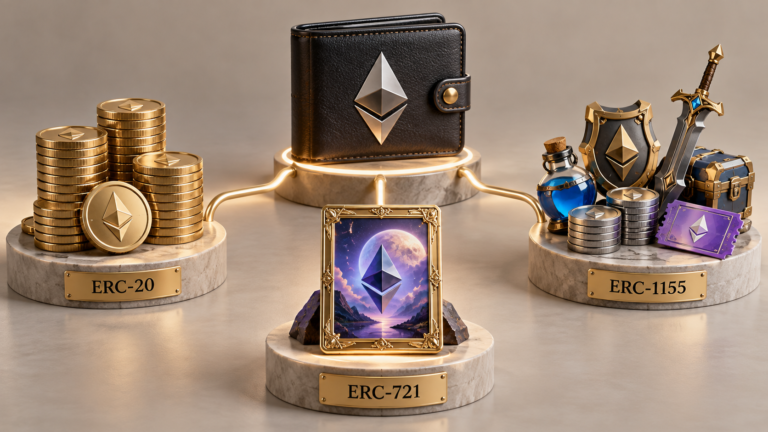
Standard .eth registrations have an NFT representation.
ENSv1’s .eth registrar uses ERC-721 tokens to represent registration ownership.
ENS also has name-wrapping mechanisms, while ENSv2 introduces a different underlying architecture.
This means ownership can be transferred through supported tools, subject to the name’s status and rules.
However, ENS domains shouldn’t be treated as interchangeable with ordinary collectible NFTs.
They have registration periods, expiration conditions, resolver configurations, and potential consequences when transferred.
A transfer of domain ownership also doesn’t necessarily update the wallet addresses stored in its records.
ENS Security Risks: What Users Should Know
ENS reduces the need to copy long wallet addresses, but it doesn’t eliminate payment risks.
Common ENS Security Risks
| Risk | Potential Consequence |
|---|---|
| Similar-looking .eth names | Payments to wrong recipient |
| Incorrect address record | Funds sent to unintended wallet |
| Compromised owner wallet | Unauthorized changes or transfer |
| Expired registration | Loss of control over the name |
| Fake ENS registration website | Phishing or malicious signatures |
| Outdated resolver records | Incorrect payment destinations |
| Public identity linkage | Reduced transaction privacy |
A common mistake is assuming that a familiar ENS name guarantees the identity of its owner.
Anyone may register available names, including names resembling brands or individuals.
Before sending a substantial payment, verify the recipient independently.
For high-value transfers, check the full resolved address and consider a small test transaction.
Never provide your seed phrase to an ENS registration website.
Does ENS Protect Your Privacy?
ENS names can make blockchain activity easier to associate with a recognizable identity.
If you publicly connect alice.eth to your personal identity, other people may be able to examine the transaction history of the associated public addresses.
The name itself doesn’t reveal your private keys.
However, public records can link wallet addresses, avatars, profiles, and additional information.
For privacy-conscious users, it may be better to separate publicly identifiable ENS accounts from wallets used for other purposes.
The convenience of a readable blockchain identity comes with additional visibility.
What Is the ENS Token?
ENS is also the ticker of the Ethereum Name Service governance token.
The ENS token is separate from an .eth domain registration.
Holding ENS tokens doesn’t automatically provide ownership of a particular name.
The token is associated with governance decisions through the ENS DAO.
By contrast, registered .eth names function as blockchain-based naming assets.
Users can register a domain without purchasing ENS governance tokens.
Frequently Asked Questions
What is Ethereum Name Service?
Ethereum Name Service is a decentralized naming system that connects readable names such as alice.eth with blockchain addresses and other records.
What is an .eth domain?
An .eth domain is a blockchain-based name registered through ENS. It can represent a wallet address, Web3 identity, or other supported records.
How much does an ENS domain cost?
The current base annual prices are $8 for names with five or more characters, $160 for four-character names, and $640 for three-character names. Network fees and special premiums may apply.
How do I buy an ENS domain?
Visit the official ENS App, connect your wallet, search for an available name, choose the registration duration, and complete the required payment.
Do ENS domains expire?
Yes. Registered .eth names require renewal. The applicable grace period depends on whether the name uses ENSv1 or ENSv2.
Can I use one ENS name for multiple cryptocurrencies?
Yes, ENS supports records for multiple networks, but the receiving wallet or application must support those records.
Is ENS the same as Ethereum?
No. ENS is a naming system built around Ethereum infrastructure. Ethereum is the underlying blockchain ecosystem.
Can someone steal my ENS domain?
If the account controlling the name is compromised, an attacker may be able to transfer it or change its records. Secure wallet management is essential.
Can I use an ENS domain as a website?
Yes, ENS can reference decentralized content, but ordinary browser access may require compatible software or gateways.
Do I need ENS tokens to register an .eth name?
No. ENS governance tokens are not required to register a standard .eth domain.