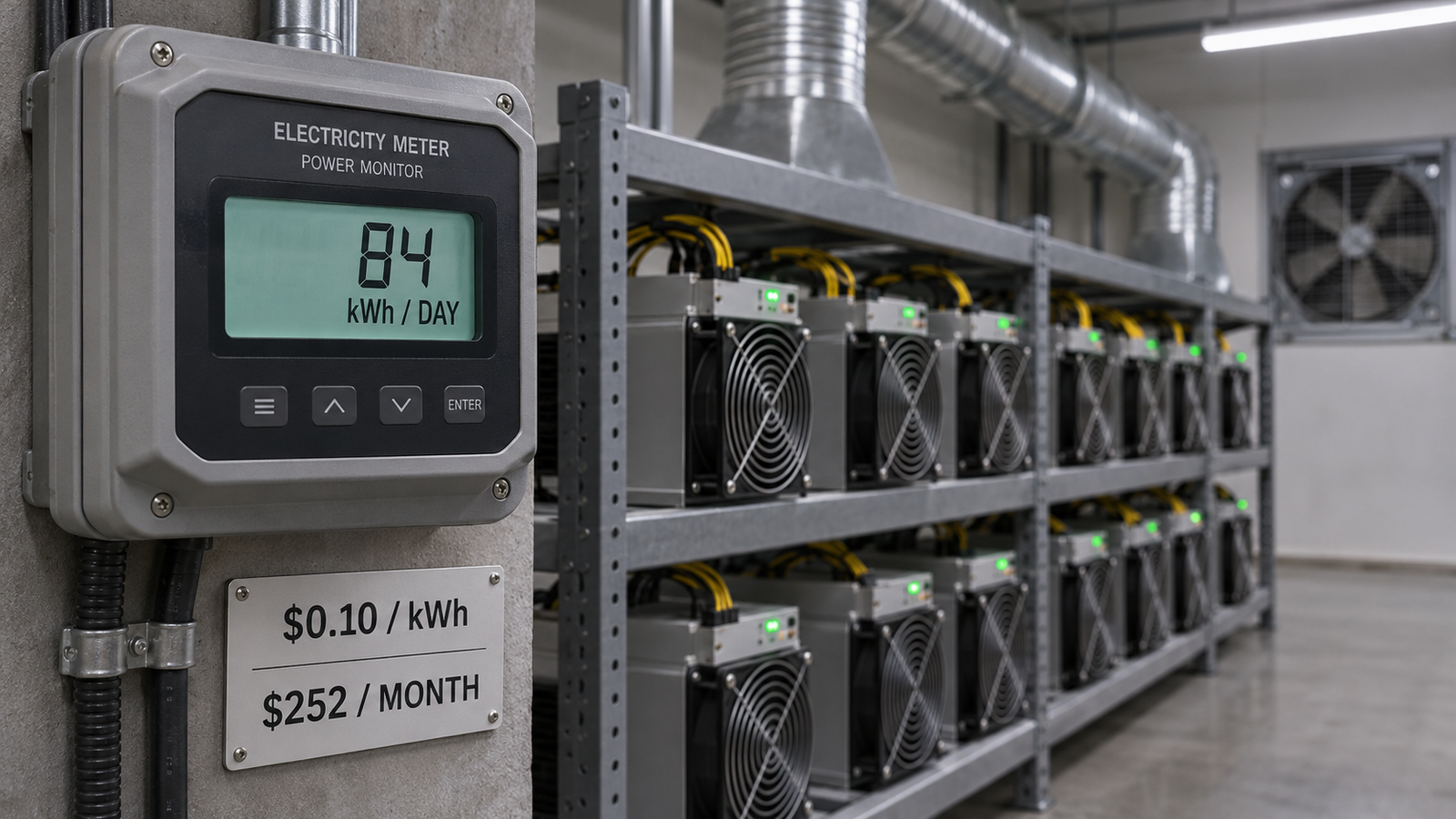
A Bitcoin miner consuming 3,500 watts uses 84 kilowatt-hours (kWh) of electricity every day. At $0.10 per kWh, that adds up to $252 over a 30-day month, before accounting for additional cooling.
A smaller 500-watt mining setup costs just $36 per month at the same rate. The difference becomes significant when electricity prices rise or mining revenue declines.
Power consumption is one of the few mining expenses that can be calculated with reasonable precision before purchasing hardware. The difficult part is determining whether the cryptocurrency earned will cover those costs.
Understanding how much electricity does crypto mining use requires distinguishing equipment wattage, actual energy consumption, cooling overhead, and the break-even electricity price.
How Much Electricity Does Crypto Mining Use per Day?
Mining equipment consumes electricity continuously while operating.
Its power rating, measured in watts (W), indicates the rate at which it uses energy. Electricity bills measure the total energy consumed in kilowatt-hours.
One kilowatt equals 1,000 watts.
To calculate daily electricity consumption:
Daily kWh = Power in Watts / 1,000 × Operating Hours
For a miner consuming 1,500 W and running continuously:
1,500 / 1,000 × 24 = 36 kWh per day
Over 30 days:
36 × 30 = 1,080 kWh
Crypto Mining Electricity Consumption by Power Rating
| Miner Power | Daily Usage | 30-Day Usage | Annual Usage |
|---|---|---|---|
| 500 W | 12 kWh | 360 kWh | 4,380 kWh |
| 1,500 W | 36 kWh | 1,080 kWh | 13,140 kWh |
| 3,500 W | 84 kWh | 2,520 kWh | 30,660 kWh |
Calculations assume uninterrupted 24/7 operation and constant measured power consumption. Monthly figures use 30 days; annual figures use 365 days.
A 3,500-watt miner consumes seven times more energy than a 500-watt device running for the same duration.
However, higher electricity consumption doesn’t automatically mean worse mining economics. A more powerful machine may generate substantially more hashes and potentially earn more cryptocurrency.
Crypto Mining Electricity Cost at Different kWh Rates
Electricity prices vary by country, region, utility provider, and customer tariff.
Some mining operations use low-cost industrial electricity contracts. Home miners usually pay residential rates, which can be considerably higher.
The calculation is:
Electricity Cost = Energy Consumption (kWh) × Electricity Rate ($/kWh)
Monthly Mining Electricity Cost Comparison
| Miner Power | $0.05/kWh | $0.10/kWh | $0.15/kWh | $0.20/kWh |
|---|---|---|---|---|
| 500 W | $18 | $36 | $54 | $72 |
| 1,500 W | $54 | $108 | $162 | $216 |
| 3,500 W | $126 | $252 | $378 | $504 |
Assumes 30 days of continuous operation. Cooling and other facility expenses are excluded.
The numbers demonstrate why electricity pricing can determine whether mining is financially viable.
At $0.05/kWh, a 3,500 W miner costs approximately $126 per month to operate.
At $0.20/kWh, the same machine consumes $504 in electricity.
That is a $378 difference every month, despite identical hardware performance.
Bitcoin Miner Power Consumption: Real ASIC Example
Modern Bitcoin mining uses specialized application-specific integrated circuits (ASICs).
These machines are designed to perform the SHA-256 hashing calculations required by Bitcoin’s Proof of Work system.
The Bitmain Antminer S21 provides a useful example.
Its published specifications include:
| Specification | Antminer S21 |
|---|---|
| Hash rate | 200 TH/s |
| Rated power consumption | 3,500 W |
| Energy efficiency | 17.5 J/TH |
| Daily electricity usage | 84 kWh |
| Monthly electricity usage | 2,520 kWh |
| Monthly cost at $0.10/kWh | $252 |
The rated consumption is measured at specified operating conditions. Actual electricity usage can change with temperature, power settings, firmware, and hardware performance.
Power efficiency, commonly expressed as joules per terahash (J/TH), is especially useful when comparing Bitcoin miners.
Lower J/TH generally indicates that a machine performs more mining calculations per unit of electricity.
A miner consuming more total power can still be more efficient if its hash rate increases proportionally more.
How to Measure Your Mining Rig’s Actual Electricity Use
Manufacturer specifications provide a starting point, but the most accurate calculation uses measured power consumption.
For a small home mining setup, an appropriately rated electricity meter can measure the power drawn from the wall.
This matters because the processor or GPU’s advertised power rating may exclude other components.
A CPU mining computer also consumes electricity through its motherboard, memory, storage, fans, and power supply.
Similarly, an ASIC’s real-world consumption may differ from its nominal specification.
For an accurate measurement, record average power draw during a sustained mining session rather than relying only on a momentary reading.
If the machine averages 620 W instead of the expected 500 W, its 30-day electricity consumption rises from 360 to 446.4 kWh.
At $0.15/kWh, that difference adds $12.96 per month.
Ensure measurement equipment is rated for the load and local electrical installation. High-power ASICs may require dedicated circuits and suitable wiring.
How Much Electricity Does Mining Cooling Use?
Mining hardware produces substantial heat.
Nearly all the electricity consumed by a mining computer ultimately becomes heat in the surrounding environment.
That heat needs to be managed to keep equipment within its operating temperature limits.
Cooling can involve ventilation fans, air conditioning, evaporative systems, or liquid cooling.
The extra electricity depends heavily on the room, climate, airflow, and cooling system.
A useful estimate is to express additional facility electricity as a percentage of the miner’s consumption.
Monthly Electricity With Cooling Overhead
| Miner Power | Mining Only | +10% Cooling | +20% Cooling |
|---|---|---|---|
| 500 W | $36.00 | $39.60 | $43.20 |
| 1,500 W | $108.00 | $118.80 | $129.60 |
| 3,500 W | $252.00 | $277.20 | $302.40 |
Assumes $0.10/kWh and 30 days. The 10% and 20% figures are hypothetical additional electricity loads, not universal cooling benchmarks.
For a 3,500 W miner, a 20% cooling overhead adds 504 kWh per month.
At $0.10/kWh, that’s an additional $50.40.
In a well-ventilated environment, cooling electricity could be lower. An air-conditioned room in a hot climate may require significantly more.
If the miner’s measured wall power already includes its internal fans, don’t count those fans twice.
How to Calculate Crypto Mining Profit After Electricity
Electricity cost alone does not determine mining profitability.
Mining revenue depends on the cryptocurrency, equipment hash rate, network difficulty, block rewards, transaction fees, and coin price.
For pooled mining, operator fees also reduce payouts.
A simplified calculation is:
Daily Operating Profit = Gross Mining Revenue − Pool Fees − Electricity Costs − Other Operating Expenses
Suppose a miner generates $12 in gross daily mining revenue.
Assume the following hypothetical conditions:
| Metric | Daily Value |
|---|---|
| Gross mining revenue | $12.00 |
| Pool fee (2%) | -$0.24 |
| Electricity, 3,500 W at $0.10/kWh | -$8.40 |
| Additional cooling (15%) | -$1.26 |
| Operating profit | $2.10 |
The example produces $2.10 per day before hardware depreciation, repairs, financing, and taxes.
Over 30 days, that equals $63.
However, mining revenue isn’t fixed. Rising network difficulty or a falling cryptocurrency price can turn a profitable operation into a loss without any change in electricity consumption.
What Is the Break-Even Electricity Price for Mining?
The break-even electricity rate is the maximum price per kWh a miner can pay before its operating profit reaches zero under specified assumptions.
The formula is:
Break-Even Electricity Rate = Daily Revenue After Pool Fees and Other Fixed Operating Costs / Total Daily kWh
Using the previous example:
- Daily revenue after pool fees: $11.76
- Miner consumption: 84 kWh
- Cooling overhead: 15%
- Total electricity consumption: 96.6 kWh
Break-even electricity price:
$11.76 / 96.6 = $0.1217 per kWh
At approximately 12.17 cents per kWh, the example miner would cover electricity and pool fees but generate no remaining operating profit.
Mining Profitability at Different Electricity Rates
| Electricity Rate | Daily Power Cost Including Cooling | Daily Operating Profit |
|---|---|---|
| $0.05/kWh | $4.83 | +$6.93 |
| $0.08/kWh | $7.73 | +$4.03 |
| $0.10/kWh | $9.66 | +$2.10 |
| $0.12/kWh | $11.59 | +$0.17 |
| $0.15/kWh | $14.49 | -$2.73 |
| $0.20/kWh | $19.32 | -$7.56 |
Assumes $12 daily gross mining revenue, a 2% pool fee, and 15% cooling overhead. All profits are illustrative.
The break-even threshold changes whenever mining revenue, electricity consumption, or operational expenses change.
It should be recalculated regularly, especially during periods of significant market volatility.
Electricity Break-Even vs Full Mining Profitability
A machine can cover its electricity bill without earning enough to repay its purchase price.
Suppose the previous ASIC costs $2,400.
If the miner generates $2.10 in daily operating profit, simple payback would require approximately 1,143 days.
That is more than three years, assuming profitability remains constant.
In reality, mining difficulty, hardware reliability, rewards, and coin prices change.
If the equipment must recover its $2,400 purchase cost over two years, the daily capital recovery requirement is approximately $3.29.
That would exceed the example’s $2.10 operating profit.
A useful distinction is:
- Operating break-even: mining revenue covers ongoing costs.
- Full economic break-even: mining revenue also covers equipment and other capital costs.
A positive daily electricity margin doesn’t guarantee that purchasing the equipment was financially worthwhile.
Does Mining Bitcoin Use More Electricity Than Mining Monero?
Bitcoin and Monero use different Proof of Work algorithms and hardware.
Bitcoin relies primarily on specialized SHA-256 ASICs.
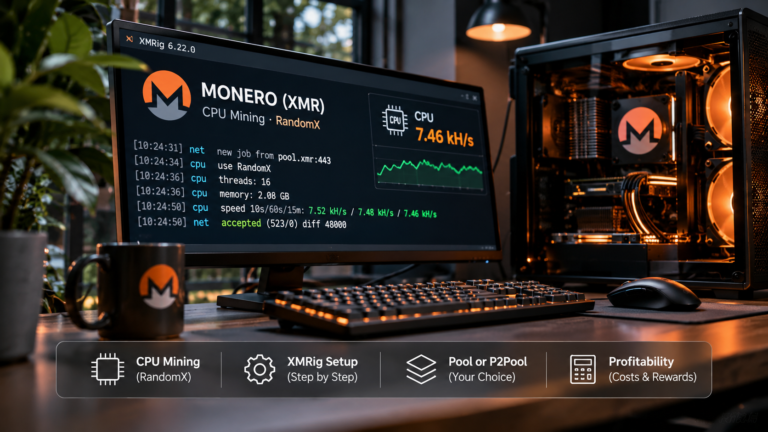
Monero uses RandomX, which is designed for general-purpose CPUs.
A Monero mining desktop may consume 100–200 W during operation, while a modern Bitcoin ASIC can consume several kilowatts.
However, comparing individual machines doesn’t reveal which cryptocurrency is more profitable.
Bitcoin vs Monero Mining Power Requirements
| Feature | Bitcoin Mining | Monero Mining |
|---|---|---|
| Typical hardware | ASIC | CPU |
| Example system power | 3,500 W | 150 W |
| Daily energy | 84 kWh | 3.6 kWh |
| Monthly energy | 2,520 kWh | 108 kWh |
| Monthly cost at $0.10/kWh | $252 | $10.80 |
The 150 W Monero setup is a hypothetical whole-system measurement; both examples assume continuous operation.
Mining a cryptocurrency with lower electricity consumption doesn’t necessarily produce a better return.
Profitability must be evaluated using the relevant network’s difficulty, payout structure, hardware efficiency, and market price.
How to Reduce Crypto Mining Electricity Costs
The most useful improvement isn’t always purchasing a machine with the lowest wattage.
It is reducing the amount of electricity consumed per unit of mining revenue.
Undervolting or using an efficient power mode can sometimes improve hash rate per watt, although results vary by hardware.
Maintaining adequate ventilation can reduce unnecessary cooling demand and help avoid thermal throttling.
Mining during lower-priced electricity periods may reduce expenses where time-of-use tariffs are available, but fewer operating hours also mean fewer expected rewards.
Older hardware can become uncompetitive when newer models offer substantially better energy efficiency.
Finally, monitor actual power consumption rather than relying exclusively on manufacturer specifications.
An efficient system with low electricity rates can outperform a higher-hash-rate machine operating under expensive electricity conditions.
Frequently Asked Questions
How much electricity does crypto mining use per day?
A 500 W miner uses 12 kWh per day, a 1,500 W miner uses 36 kWh, and a 3,500 W miner uses 84 kWh when running continuously.
How much does it cost to run a 3,500 W Bitcoin miner?
At $0.10/kWh, it costs $8.40 daily or $252 over 30 days, excluding additional cooling and facility expenses.
How do you calculate crypto mining electricity cost?
Divide watts by 1,000, multiply by operating hours, and multiply the resulting kWh by the electricity tariff.
Is crypto mining profitable at $0.15 per kWh?
It depends on mining revenue and energy efficiency. Some setups may cover costs, while others operate at a loss. Calculate the break-even rate for the specific device.
Does mining use more electricity than gaming?
Mining typically runs hardware at sustained load for longer periods. Total consumption depends on power draw and operating hours, not simply the activity.
Do ASIC miners use more electricity than GPUs?
Individual high-performance ASICs often draw more power than individual GPUs, but comparisons should also consider how much useful mining work each device performs.
How much does cooling add to mining costs?
It varies significantly. A hypothetical 10–20% additional electricity load provides a starting sensitivity calculation, but actual cooling requirements should be measured.
What is the cheapest electricity rate for profitable Bitcoin mining?
There is no universal threshold. The break-even tariff depends on hash rate, hardware efficiency, network difficulty, mining revenue, pool fees, and facility costs.