
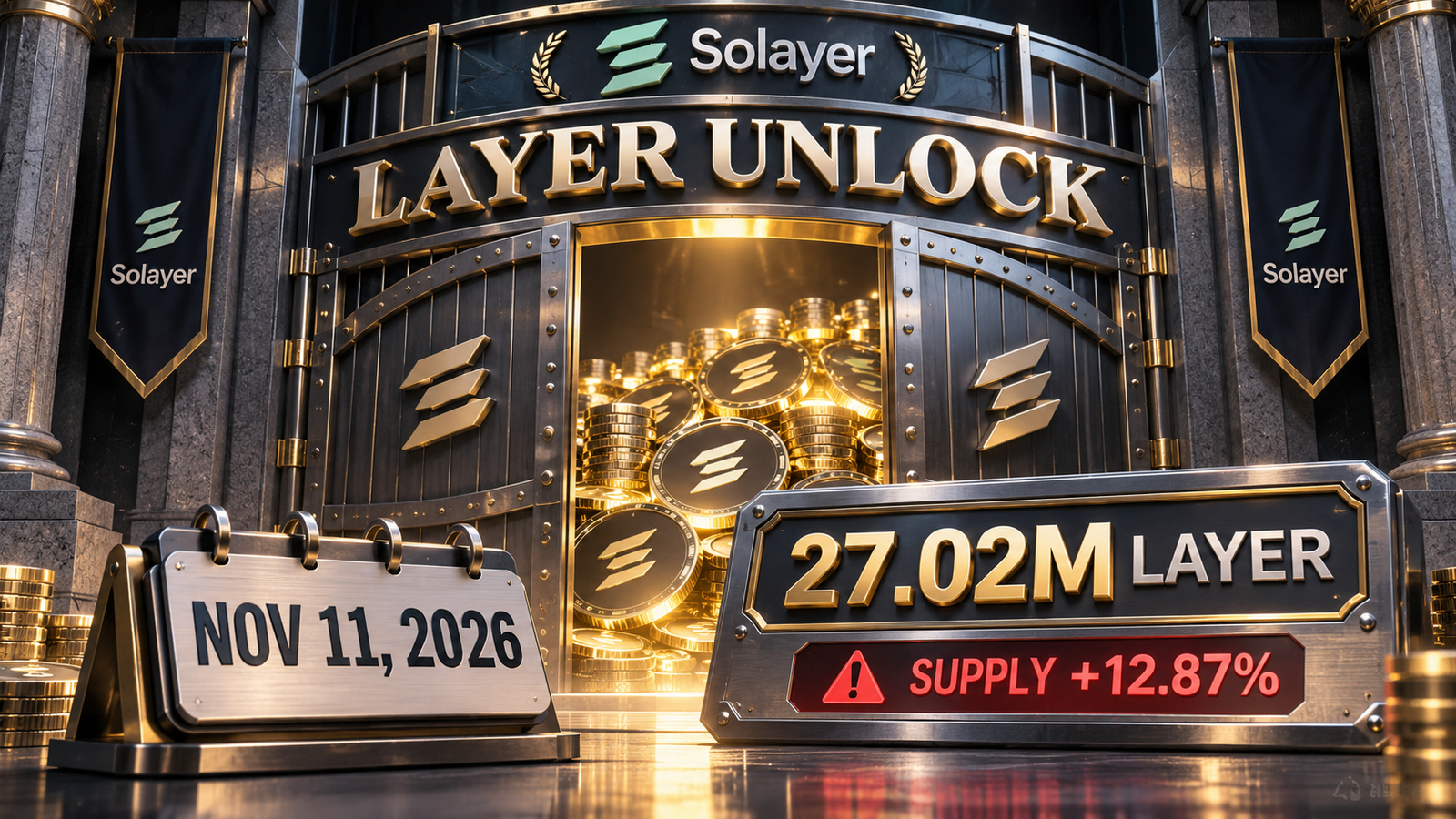
Solayer (LAYER) faces a scheduled token unlock on November 11, 2026, with approximately 27.02 million tokens expected to become available under one of the most widely tracked vesting schedules.
At a reference price near $0.057, the release would be worth roughly $1.54 million. More importantly, it represents approximately 12.87% of LAYER’s reported circulating supply of 210 million tokens.
That is a meaningful potential supply increase for a relatively small cryptocurrency.
However, tracking platforms disagree on the precise amount. Some include additional investor and contributor allocations, while others count only specific vesting releases.
The market impact will depend on which allocations become transferable, whether recipients sell, and how much liquidity is available to absorb additional supply.
Solayer Token Unlock: November 11, 2026
The upcoming LAYER unlock is part of Solayer’s token distribution schedule, which allocates supply to ecosystem development, the foundation, investors, and contributors.
Solayer launched its LAYER token in February 2025 with a maximum supply of 1 billion tokens.
Vesting arrangements gradually release tokens over time rather than making the entire allocation transferable immediately.
LAYER November 2026 Unlock: Key Figures
| Metric | Estimated Value |
|---|---|
| Scheduled unlock date | November 11, 2026 |
| Expected release, principal tracker estimate | 27.02M LAYER |
| Reference token price | ~$0.057 |
| Estimated unlock value | ~$1.54M |
| Reported circulating supply | 210M LAYER |
| Maximum supply | 1B LAYER |
| Unlock / circulating supply | 12.87% |
| Unlock / maximum supply | 2.70% |
| Reported market capitalization | ~$12M |
Data checked November 5, 2026. Figures are estimates based on published vesting trackers and market data, not confirmed exchange deposits or sales.
The distinction between total supply and circulating supply is important.
A 27.02 million token release represents only 2.7% of the maximum supply, but nearly 13% of the currently reported circulating amount.
The second percentage is generally more relevant when assessing potential short-term market pressure.
How Many LAYER Tokens Will Actually Unlock?
The November event appears across multiple token unlock calendars, but their estimates are not identical.
Solayer Unlock Estimates by Tracking Method
| Tracking Estimate | Tokens | % of Reported Circulating Supply |
|---|---|---|
| Narrower investor and insider schedule | 11.69M | 5.57% |
| Community and Foundation release | 27.02M | 12.87% |
| Broader multi-allocation schedule | 40.25M | 19.17% |
Different providers classify continuous vesting, cliff distributions, and circulating supply differently.
The 27.02 million figure is supported by several major tracking services, including those that separately identify community and foundation allocations.
Another schedule counts approximately 40.25 million tokens distributed across four allocation categories.
These estimates should not be added together. They may overlap or represent different accounting treatments of the same vesting program.
Until the actual release and corresponding wallet movements are verified, the final amount entering transferable circulation remains uncertain.
Who Receives the November LAYER Unlock?
The 27.02 million token estimate breaks down into two categories.
LAYER Unlock Allocation Breakdown
| Recipient | Tokens | Share of Scheduled Release |
|---|---|---|
| Community and Ecosystem | 17.64M | 65.3% |
| Solayer Foundation | 9.38M | 34.7% |
| Total | 27.02M | 100% |
Community and ecosystem allocations may support development incentives, partnerships, grants, or other activities.
Foundation allocations may be used for treasury operations, ecosystem development, and funding project-related activities.
These categories do not establish that every released token will immediately be sold.
However, they also should not be assumed to remain permanently inactive.
A foundation may distribute tokens to partners or service providers, while ecosystem recipients may eventually convert tokens into other assets.
Broader vesting estimates also include investors and core contributors, whose incentives and liquidity needs can differ from those of the foundation.
Monitoring recipient wallets is therefore more informative than relying solely on the headline unlock figure.
LAYER Circulating Supply: How Much Could It Increase?
The reported circulating supply currently stands near 210 million LAYER.
If all 27.02 million unlocked tokens were newly counted as circulating, the total could rise to approximately 237.02 million.
Potential Supply Change
| Metric | Before Unlock | After Full Inclusion |
|---|---|---|
| Circulating supply | 210.00M | 237.02M |
| Increase | — | 27.02M |
| Percentage increase | — | 12.87% |
| Share of 1B maximum supply | 21.00% | 23.70% |
This is a conditional calculation.
Tokens becoming unlocked do not necessarily enter circulating supply immediately. Some may remain in treasury wallets, be subject to operational restrictions, or be excluded by market-data providers.
For that reason, unlocked supply and reported circulating supply should not be treated as identical.
The current difference between vesting trackers’ unlocked totals and market-data estimates of circulating supply illustrates this problem.
Why the LAYER Unlock Could Create Selling Pressure
Token unlocks increase the amount of cryptocurrency that eligible recipients can potentially transfer.
They do not automatically create sell orders.
Selling pressure develops when recipients decide to convert tokens into USDT, USDC, SOL, or other assets and available buying demand cannot absorb the additional supply without price adjustments.
For LAYER, the estimated $1.54 million event is sizable relative to the token’s approximately $12 million market capitalization.
But market capitalization is not the same as trading liquidity.
A token can report millions of dollars in daily volume while maintaining relatively shallow order books.
Hypothetical LAYER Selling Scenarios
Assume 27.02 million LAYER unlock at a constant reference price of $0.057.
| Share Sold | Tokens Sold | Notional Value |
|---|---|---|
| 0% | 0 | $0 |
| 10% | 2.70M | ~$154K |
| 25% | 6.76M | ~$385K |
| 50% | 13.51M | ~$770K |
| 100% | 27.02M | ~$1.54M |
These scenarios measure hypothetical selling value, not predicted transactions.
They also assume a constant price. In reality, large sell orders may execute at progressively lower prices depending on market depth.
If recipients distribute sales over several days or execute negotiated OTC transactions, the immediate exchange-market effect may be different.
Trading Volume vs Unlock Size: Is LAYER Liquid Enough?
Recent reported 24-hour LAYER trading volume has been near $9 million, although the amount changes constantly.
At first glance, a $1.54 million unlock represents only about 17% of that volume.
That comparison provides context but can be misleading.
Exchange trading volume measures completed transactions across a period. It does not indicate how much additional selling can be absorbed at the current market price.
The more relevant measures include bid-side order-book depth, trading spreads, execution slippage, and the distribution of volume across exchanges.
A market reporting $9 million in daily volume may still struggle to absorb a $500,000 aggressive sell order without substantial price movement.
For this reason, the volume-to-unlock ratio should not be interpreted as a reliable prediction of price impact.
What Does LAYER’s Vesting Schedule Look Like After November?
Solayer’s distribution program extends into 2029.
The November 11 event is not the final supply release.
Under the broader vesting schedule, recurring investor and contributor releases continue alongside larger community and foundation distributions.
Upcoming LAYER Vesting Events
| Scheduled Date | Estimated Release | Main Allocations |
|---|---|---|
| November 11, 2026 | 27.02M–40.25M | Ecosystem, Foundation; additional categories in broader estimates |
| December 11, 2026 | ~11.29M | Investors and Contributors |
| January 11, 2027 | ~11.29M | Investors and Contributors |
| February 11, 2027 | ~40.25M | Multiple allocations |
Dates and amounts reflect selected published vesting models. Other trackers classify releases differently, and schedules may be revised.
This ongoing distribution matters because market participants evaluate future dilution, not just one unlock.
A relatively small release can still influence prices if investors expect significantly more supply to become available over subsequent months.
Conversely, a larger unlock may have a limited impact if recipients hold their allocations and market demand remains strong.
How Have Previous Solayer Unlocks Affected LAYER?
Historical vesting events provide context, although they cannot establish what caused past price movements.
One unlock tracker reports that LAYER experienced an approximately 18.8% maximum drawdown within eight days after its October 11, 2026 event.
The same dataset reports smaller drawdowns following the August and September unlocks.
Selected Historical Post-Unlock Drawdowns
| Unlock Date | Reported Maximum Subsequent Drawdown | Observation Window |
|---|---|---|
| August 11, 2026 | -2.9% | 3 days |
| September 11, 2026 | -3.3% | 6 days |
| October 11, 2026 | -18.8% | 8 days |
Provider-calculated post-unlock price movements, not causal estimates.
These figures don’t prove that token unlocks caused the declines.
Bitcoin’s direction, general altcoin liquidity, project announcements, and derivatives positioning may have influenced the market simultaneously.
A historical post-unlock drawdown is not equivalent to a forecast for November 11.
Three Market Scenarios Around November 11
The LAYER token unlock price impact will depend largely on the relationship between newly available supply and market demand.
Scenario 1: Selling Pressure Increases
Recipients transfer substantial amounts of LAYER to exchanges before or after the unlock.
If order-book liquidity is shallow and buying demand remains weak, the resulting sales could pressure the price.
A decline accompanied by rising spot selling volume would offer stronger evidence of active distribution.
Scenario 2: The Unlock Is Already Priced In
Token vesting schedules are generally public well before their execution dates.
Investors may reduce exposure in anticipation of a release.
If the event occurs without unexpectedly large sales, the market could stabilize or recover despite the increase in transferable supply.
Scenario 3: Tokens Remain in Treasury or Ecosystem Wallets
Recipients may retain their tokens, distribute them gradually, or use them for operational purposes.
Under those circumstances, the immediate market impact could remain limited.
However, the tokens may still represent potential future supply.
Scenario Comparison
| Scenario | On-Chain Evidence | Potential Market Effect |
|---|---|---|
| Active distribution | Increased exchange deposits | Higher selling pressure |
| Limited immediate selling | Few transfers to trading venues | Smaller short-term impact |
| Gradual distribution | Transfers spread over time | Extended rather than sudden pressure |
| Strong market demand | Selling absorbed by buyers | More resilient price action |
What Traders Should Monitor Before the Unlock
The most useful indicators are those that reveal whether additional LAYER is actually entering liquid markets.
First, compare vesting data across tracking platforms and look for official updates to the schedule.
Second, monitor wallets associated with the foundation, ecosystem allocations, investors, and contributors when their identities can be reliably established.
Third, watch transfers into centralized exchanges. Such deposits may precede selling, although they do not prove that recipients intend to liquidate.
Fourth, examine bid-side liquidity and spreads across major LAYER markets.
Finally, monitor Bitcoin’s broader market direction. Smaller altcoins can experience substantial price fluctuations even when their own tokenomics remain unchanged.
Frequently Asked Questions
When is the next Solayer token unlock?
The next widely reported LAYER unlock is scheduled for November 11, 2026.
How many LAYER tokens will unlock?
Several major trackers estimate 27.02 million LAYER. Other schedules report approximately 11.69 million or 40.25 million, reflecting differences in included allocations.
What percentage of circulating supply is the unlock?
A 27.02 million token release represents approximately 12.87% of the currently reported 210 million circulating LAYER supply.
Who receives the unlocked LAYER tokens?
Under the 27.02 million estimate, approximately 17.64 million tokens go to Community and Ecosystem allocations and 9.38 million to the Solayer Foundation.
Will the LAYER token price fall after November 11?
Not necessarily. Unlocks create potential selling capacity, but actual price movements depend on recipient behavior, liquidity, demand, and broader cryptocurrency conditions.
Is unlocked supply the same as circulating supply?
No. A token may be unlocked under its vesting schedule without immediately being counted as circulating by market-data providers.
How can investors track the Solayer unlock?
Compare published token vesting calendars with circulating supply data, identifiable on-chain recipient transfers, exchange deposits, and spot-market liquidity.