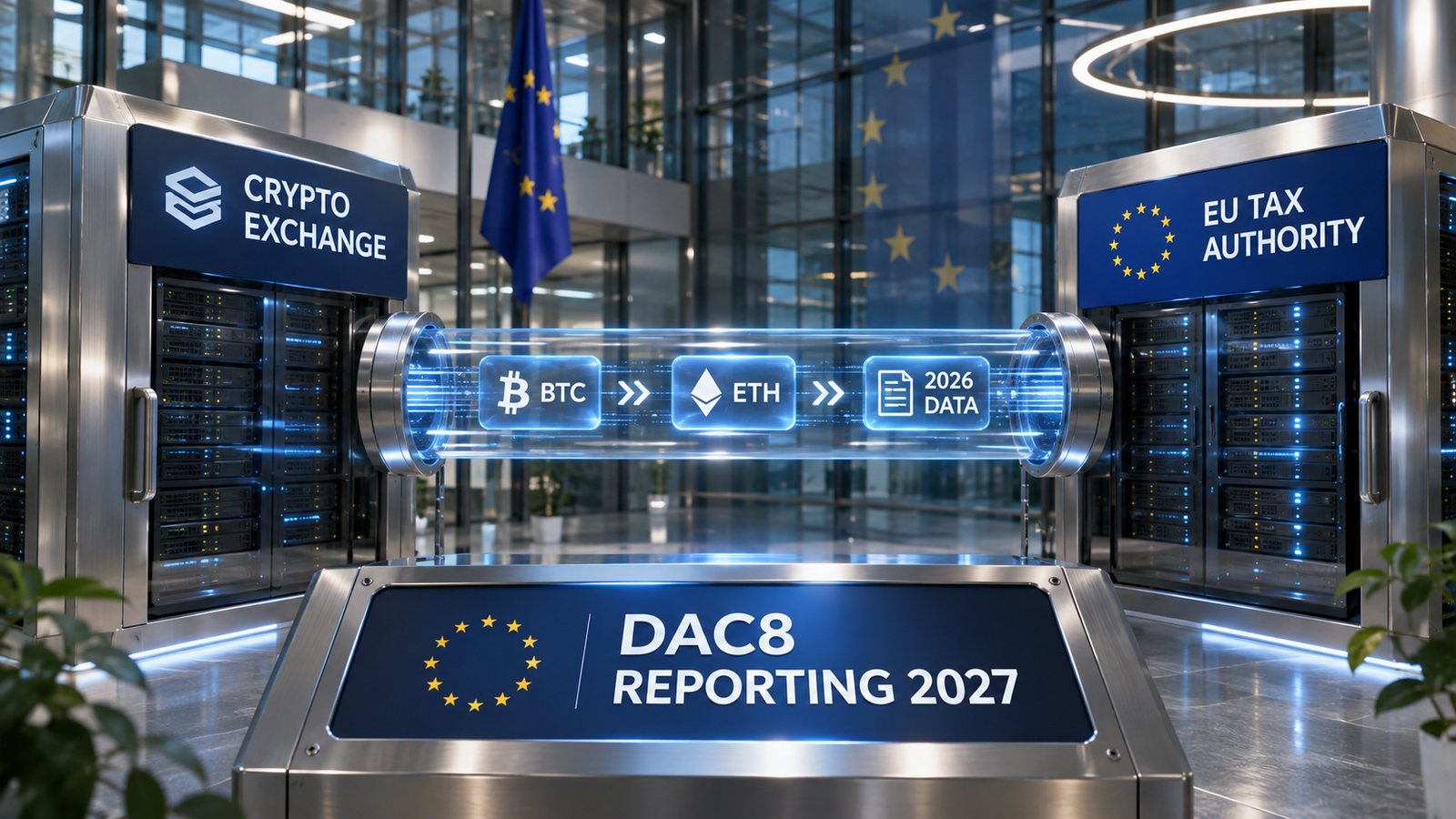
Crypto transactions made by EU tax residents in 2026 will become part of a new reporting system in 2027. Under the EU’s DAC8 directive, covered cryptocurrency exchanges and other crypto-asset service providers must collect customer information and report qualifying activity to tax authorities.
The rules apply from January 1, 2026, with the first reporting and cross-border information exchanges taking place in 2027.
This changes how European tax authorities can access crypto trading information. Rather than relying exclusively on individual disclosures or investigations, they will receive standardized reports from regulated service providers.
DAC8 does not introduce a new cryptocurrency tax rate. It creates a mechanism for identifying crypto transactions and sharing relevant information between EU tax administrations.
For investors, the practical implication is that activity on covered exchanges may become visible to tax authorities even when the exchange operates in another EU country.
What Is DAC8 Crypto Reporting?
DAC8 is the eighth amendment to the European Union’s Directive on Administrative Cooperation in taxation.
Adopted through Council Directive (EU) 2023/2226, it expands automatic tax information exchange to crypto-assets.
The system draws on the OECD’s Crypto-Asset Reporting Framework (CARF), an international standard designed to improve tax transparency.
Under DAC8, Reporting Crypto-Asset Service Providers (RCASPs) identify reportable customers, collect information about qualifying transactions and submit annual reports to the relevant tax authority.
That authority can then exchange information with other EU member states according to the customer’s tax residence.
The reporting system covers domestic as well as cross-border activity.
A German tax resident using a French crypto exchange, for example, may have reportable information transmitted from France to Germany.
DAC8 Timeline: 2026 Data Collection and 2027 Reporting
The most important distinction is between the year transactions occur and the year information is reported.
DAC8 applies to reportable activity beginning January 1, 2026.
The first reporting cycle covers the 2026 calendar year, with exchanges of information between EU tax authorities required by September 30, 2027.
DAC8 Reporting Timeline
| Date | Requirement |
|---|---|
| October 17, 2023 | DAC8 adopted by the EU Council |
| December 31, 2025 | Deadline for member states to transpose the directive |
| January 1, 2026 | DAC8 rules apply and first reporting period begins |
| Throughout 2026 | Providers collect transaction data and verify customers |
| December 31, 2026 | First calendar-year reporting period ends |
| During 2027 | Providers submit first reports under national deadlines |
| September 30, 2027 | Deadline for first EU cross-border information exchange |
The September 30 deadline applies to information exchange between tax authorities. It should not be confused with a universal filing deadline for every exchange.
National authorities may require providers to submit reports earlier in 2027.
What Information Must Crypto Exchanges Report?
DAC8 combines customer identification with transaction information.
The reporting requirements are designed to help authorities associate crypto activity with identifiable taxpayers.
Customer Identification Data
For reportable individual users, relevant information generally includes:
- Full name
- Residential address
- Country or countries of tax residence
- Tax Identification Number (TIN)
- Date of birth
- Place of birth, where required under applicable rules
For legal entities, additional information can include the entity’s name, address, TIN and relevant controlling persons.
Service providers must also report identifying information about themselves.
Crypto Transaction Data
The directive requires information to be categorized by reportable crypto-asset.
Depending on the activity, reportable data includes aggregate transaction values, quantities and transaction counts.
| Data Category | What May Be Reported |
|---|---|
| Fiat-to-crypto purchases | Aggregate fiat paid, units acquired and transaction count |
| Crypto-to-fiat sales | Aggregate fiat received, units disposed of and transaction count |
| Crypto-to-crypto exchanges | Aggregate fair market values, units and counts |
| Incoming transfers | Aggregate value and units received |
| Outgoing transfers | Aggregate value and units sent |
| Transfers to certain external addresses | Aggregate transfer value and units |
| Customer identification | Identity and tax residency details |
A crucial detail is that DAC8’s standardized report uses annual aggregates by asset and transaction category for many activities.
It does not mean every individual trade must automatically be transmitted as a separate line item in the annual DAC8 report.
Providers may nevertheless retain more granular transaction records for compliance and other legal obligations.
Example: How DAC8 Could Report Crypto Trading
Consider an EU resident using a centralized exchange throughout 2026.
The investor completes the following transactions:
Hypothetical 2026 Crypto Activity
| Transaction | Amount | Category |
|---|---|---|
| Buy Bitcoin with EUR | €10,000 | Fiat-to-crypto purchase |
| Buy Ethereum with EUR | €5,000 | Fiat-to-crypto purchase |
| Sell Bitcoin for EUR | €7,000 | Crypto-to-fiat sale |
| Exchange ETH for SOL | €3,000 | Crypto-to-crypto exchange |
| Withdraw SOL to personal wallet | €2,000 | Outgoing transfer |
Illustrative transaction values, not actual market data.
The investor has made €15,000 in fiat-funded purchases, €7,000 in fiat sales, a €3,000 crypto swap and a €2,000 transfer.
These categories contain different information and should not simply be added together to calculate taxable profit.
For example, the €7,000 Bitcoin sale may generate a gain or loss depending on the acquisition cost and the investor’s applicable national tax rules.
Likewise, transferring SOL to a wallet controlled by the same individual may not represent a taxable sale, even though the transfer could be reportable.
DAC8 reporting is primarily about transaction visibility, not automatic profit calculation.
Which Crypto Assets Are Covered by DAC8?
DAC8 has a broad scope intended to capture assets that can be used for payments or investment purposes.
It generally covers major cryptocurrencies and relevant tokens, including assets that may fall outside some traditional financial reporting frameworks.
Crypto Asset Coverage
| Asset Type | General DAC8 Treatment |
|---|---|
| Bitcoin (BTC) | Covered |
| Ethereum (ETH) | Covered |
| Other qualifying cryptocurrencies | Covered |
| Stablecoins | Generally covered, subject to exclusions |
| Relevant investment or payment tokens | Generally covered |
| Certain NFTs | Potentially covered |
| Central bank digital currencies | Excluded from the reportable crypto-asset category |
| Specified electronic money products | Excluded where legal criteria are met |
Not every token is automatically reportable.
Certain crypto-assets qualify for exclusions based on their characteristics, including whether they can be used for payment or investment purposes.
NFT treatment depends on the asset’s economic characteristics rather than simply whether it is labeled an NFT.
The same applies to stablecoins: classification and applicable exclusions matter.
Do Transfers to Self-Custody Wallets Get Reported?
Moving cryptocurrency from an exchange to a personal wallet does not automatically remove the transaction from DAC8 reporting.
The directive includes reporting requirements for relevant crypto transfers, including transfers to distributed ledger addresses not known to be associated with another crypto-asset service provider or financial institution.
This means withdrawals to self-hosted wallets may be reflected in the exchange’s reported aggregate transfer data.
However, DAC8 does not require every individual operating a self-custody wallet to register directly as a reporting service provider merely because they hold crypto.
The reporting obligation primarily concerns covered service providers facilitating relevant transactions.
A purely peer-to-peer transaction between self-custody wallets, without involvement from a reporting intermediary, does not automatically create a DAC8 provider report.
Other tax, recordkeeping and anti-money-laundering obligations may still apply.
Which Crypto Exchanges Must Comply?
DAC8 reporting requirements can apply to centralized cryptocurrency exchanges and other service providers facilitating reportable transactions.
The scope includes relevant providers authorized under the EU’s Markets in Crypto-Assets Regulation (MiCA), as well as certain operators that are not MiCA-authorized but fall within DAC8’s reporting rules.
Non-EU operators serving reportable EU customers can also face obligations.
Providers and DAC8 Exposure
| Provider Type | Potential DAC8 Obligation |
|---|---|
| EU centralized crypto exchange | Yes |
| MiCA-authorized crypto service provider | Yes, for covered activities |
| Non-EU exchange serving EU residents | Potentially yes |
| Custody-only provider without reportable transactions | Depends on activities |
| Non-custodial wallet software | Not automatically |
| DeFi service with an identifiable reporting operator | Depends on the operator’s role |
DAC8 is activity-based as well as provider-based.
A service’s decentralized branding does not, by itself, determine whether reporting requirements apply.
The relevant question is whether an identifiable person or entity falls within the definition of a Reporting Crypto-Asset Service Provider.
DAC8 vs MiCA: What’s the Difference?
DAC8 and MiCA are frequently confused, but they serve different purposes.
MiCA provides a regulatory framework for crypto-assets and crypto-asset service providers in the EU.
DAC8 focuses on the collection and exchange of information for tax administration.
DAC8 vs MiCA Comparison
| Feature | DAC8 | MiCA |
|---|---|---|
| Main purpose | Tax transparency | Crypto market regulation |
| Main authorities | Tax administrations | Financial regulators |
| Core obligations | Customer due diligence and transaction reporting | Authorization, conduct and operational requirements |
| Key data | Tax residence and crypto activity | Regulatory and compliance information |
| Investor protection | Indirect | Direct regulatory focus |
| Main crypto reporting period begins | January 2026 | Different phased implementation dates |
| First major reporting milestone | 2027 | Already applicable for major provisions |
A MiCA-authorized exchange may also have DAC8 obligations.
Obtaining a MiCA license does not eliminate the need to report qualifying crypto transactions for tax purposes.
Similarly, DAC8 compliance does not automatically authorize a business to provide regulated crypto services under MiCA.
Both regimes can operate simultaneously.
How Cross-Border Crypto Tax Reporting Works
DAC8 uses the EU’s existing administrative cooperation framework to exchange information automatically.
Consider a Spanish tax resident trading through a crypto exchange reporting in Ireland.
The process generally follows four stages.
- The exchange collects and verifies the customer’s tax residence and identification information.
- It records reportable crypto transactions during 2026.
- It submits the required annual report to the appropriate tax authority in 2027.
- Ireland’s tax administration exchanges relevant information with Spain’s tax authority.
The Spanish authority can then compare the reported activity with the taxpayer’s domestic tax filings.
This process does not automatically mean the investor owes additional taxes.
The existence and amount of any liability depend on Spanish tax rules and the investor’s actual transactions.
The system is designed to improve information availability, not harmonize cryptocurrency tax rates across the EU.
What Should EU Crypto Investors Do Before 2027?
Investors should prepare for exchanges to request additional tax-residency information and updated customer details.
For existing customers, DAC8 includes due-diligence transition rules, with tax-residency self-certification generally required by January 1, 2027.
Failure to provide required information may lead to service restrictions under applicable national rules.
Practical DAC8 Preparation Checklist
| Action | Why It Matters |
|---|---|
| Confirm tax residency | Determines the relevant tax authority |
| Provide accurate TIN | Supports customer identification |
| Export 2026 trade history | Helps reconcile reported activity |
| Track acquisition costs | Needed to calculate gains and losses |
| Record wallet transfers | Helps distinguish transfers from sales |
| Keep staking and DeFi records | Some activities require separate tax analysis |
| Review national tax rules | DAC8 does not standardize tax rates |
Investors using multiple exchanges should pay particular attention to transactions between their own accounts.
An exchange may report a withdrawal without knowing the acquisition history at another platform.
Maintaining records allows users to explain the transaction and establish relevant cost bases if required.
Does DAC8 Introduce a New Crypto Tax?
No. DAC8 establishes reporting and information-exchange obligations; it does not create a single EU-wide tax on cryptocurrency gains.
Each member state continues to determine how relevant crypto income, capital gains and other taxable events are treated under domestic law.
An investor who already complies with applicable tax obligations may not face a different tax calculation solely because DAC8 begins operating.
What changes is the quantity and consistency of information available to tax authorities.
Frequently Asked Questions
When does DAC8 crypto reporting start?
DAC8 applies from January 1, 2026. Providers collect information on qualifying transactions during 2026, with the first reports and information exchanges occurring in 2027.
What is the DAC8 reporting deadline in 2027?
The first cross-border exchanges between EU tax authorities must take place by September 30, 2027. National provider filing deadlines may be earlier.
Do crypto exchanges report every transaction under DAC8?
DAC8 requires reporting of specified transaction information, commonly using annual aggregate values, units and counts by crypto-asset and activity type. It does not necessarily require every trade to appear individually in the standardized annual report.
Does DAC8 apply to Bitcoin and Ethereum?
Yes. BTC and ETH fall within the scope of reportable crypto-assets.
Are crypto-to-crypto trades reported?
Yes. Qualifying exchanges between crypto-assets are included in DAC8 transaction reporting.
Does DAC8 apply to self-custody wallets?
Holding crypto in a self-custody wallet does not itself make the owner a reporting service provider. However, relevant transfers involving reporting exchanges may be reportable.
Is DAC8 the same as MiCA?
No. MiCA regulates crypto markets and service providers, while DAC8 establishes tax information collection and exchange requirements.
Does DAC8 mean all crypto transactions are taxable?
No. Reporting obligations and taxable events are different concepts. Tax liability depends on applicable national legislation and the nature of the activity.