US cryptocurrency investors began receiving a new tax document in 2026: Form 1099-DA, officially titled Digital Asset Proceeds From Broker Transactions.
The form gives the Internal Revenue Service more standardized information about cryptocurrency sales and other reportable digital asset dispositions handled by brokers.
But receiving a 1099-DA doesn’t mean the amount shown is taxable profit. A reported $20,000 in Bitcoin sales could represent a $5,000 gain, a $3,000 loss, or another result entirely, depending on what the investor originally paid.
The distinction matters because the first reporting year generally covered gross proceeds without requiring brokers to report acquisition costs. Beginning with certain assets acquired in 2026, additional cost basis reporting requirements apply.
Understanding what the form includes, what it leaves out, and how to reconcile it with your transaction history is essential for accurate cryptocurrency tax reporting.
What Is Crypto Form 1099-DA?
Form 1099-DA is an IRS information return used by covered digital asset brokers to report customers’ sales and other qualifying dispositions of cryptocurrency and related digital assets.
The form identifies the broker, taxpayer, asset involved, transaction quantity, proceeds, and certain additional information.
For transactions subject to cost basis reporting, it can also include the amount originally paid for the disposed assets.
Brokers provide the relevant information to the IRS and furnish a statement to the customer.
Form 1099-DA is not itself an investor’s income tax return. It supplies information that may be used to prepare a federal tax return.
Form 1099-DA Reporting Timeline
| Tax Year | Reporting Requirement | When Investors Receive Forms |
|---|---|---|
| 2024 | No general Form 1099-DA reporting | Not applicable |
| 2025 | Gross proceeds reporting begins | Early 2026 |
| 2026 | Gross proceeds plus basis for qualifying covered assets | Early 2027 |
| 2027 onward | Reporting continues under applicable rules | Following tax season |
For tax year 2025, brokers were generally required to furnish Form 1099-DA statements by February 17, 2026.
The 2026 tax-year reporting cycle introduces mandatory basis information for qualifying covered digital assets, with statements generally arriving in 2027.
Not every transaction or digital asset qualifies for identical reporting treatment.
Who Issues Form 1099-DA?
The reporting obligation generally applies to US digital asset brokers that facilitate covered transactions for customers.
These can include custodial cryptocurrency trading platforms and certain other intermediaries.
Who May Need to Report?
| Business Type | Form 1099-DA Treatment |
|---|---|
| US custodial crypto exchange | Generally required for reportable sales |
| Broker facilitating crypto transactions | Subject to applicable broker rules |
| Digital asset kiosk operator | May have reporting obligations |
| Qualifying payment processor | Subject to specific rules and exceptions |
| Foreign exchange | Not automatically subject to the same US broker requirements |
| Non-custodial wallet software alone | Generally not a reporting broker |
| Blockchain validator acting only as a validator | Generally not a reporting broker |
The reporting framework focuses on the intermediary’s activities, not simply whether it operates in cryptocurrency.
A software wallet that allows users to control their private keys does not become a reporting broker solely because it provides wallet functionality.
Similarly, an investor using a foreign exchange may not receive a Form 1099-DA from that platform.
The absence of a form does not eliminate the investor’s obligation to report taxable transactions.
Which Crypto Transactions Appear on Form 1099-DA?
The form generally reports sales and other qualifying dispositions facilitated by a covered broker.
These can include selling cryptocurrency for US dollars, exchanging one cryptocurrency for another, or disposing of digital assets to purchase goods or services through applicable reporting arrangements.
Crypto Transaction Reporting Examples
| Transaction | Generally Reportable on 1099-DA? | Potential Tax Treatment |
|---|---|---|
| Sell BTC for USD | Yes | Capital gain or loss if held as an investment |
| Swap ETH for SOL | Yes, if facilitated by a covered broker | Taxable disposition |
| Sell an NFT | Potentially, subject to specific rules | Depends on circumstances |
| Buy BTC with USD | No sale proceeds from the purchase alone | Establishes acquisition basis |
| Hold BTC without selling | No | Generally no realization event |
| Transfer BTC between your own wallets | Not a sale by itself | Generally not taxable |
| Receive staking rewards | Not ordinarily a sale reported solely on 1099-DA | May create ordinary income |
| Spend BTC through a covered payment processor | Potentially, subject to exceptions | May create gain or loss |
Special reporting methods and de minimis exceptions apply to certain qualifying stablecoins, specified NFTs, and payment processor transactions.
These exceptions should not be interpreted as general tax exemptions.
A transaction can remain taxable even when the broker is not required to issue a 1099-DA.
Proceeds vs Cost Basis: The Most Important Difference
One of the biggest misunderstandings surrounding Form 1099-DA is confusing sales proceeds with taxable profit.
Proceeds represent the value received when an asset is sold or otherwise disposed of, adjusted for applicable transaction costs.
Cost basis generally represents the investor’s adjusted acquisition cost.
The taxable capital gain or loss is calculated by subtracting adjusted basis from the amount realized.
Capital Gain or Loss = Amount Realized − Adjusted Cost Basis
Example: Selling Bitcoin for $15,000
Suppose an investor purchased 0.20 BTC for $10,000 and later sold it for $15,000.
Assume no transaction fees.
| Metric | Amount |
|---|---|
| Bitcoin purchased | 0.20 BTC |
| Original purchase cost | $10,000 |
| Gross sale proceeds | $15,000 |
| Adjusted cost basis | $10,000 |
| Capital gain | $5,000 |
The broker may report $15,000 in proceeds.
However, the investor’s capital gain is $5,000.
If a taxpayer mistakenly treats the entire $15,000 as taxable profit, the resulting calculation substantially overstates the gain.
This is why transaction histories and acquisition records remain necessary even when a broker provides tax forms.
How 1099-DA Cost Basis Reporting Changes in 2026
The 1099-DA cost basis reporting rules distinguish between covered and noncovered digital assets.
For this purpose, a covered digital asset generally must have been acquired after December 31, 2025, in an account where the broker provided custodial services and remained in that account until the broker facilitated its disposition.
For qualifying covered assets, brokers must generally report adjusted basis for sales occurring in 2026 and later.
Assets acquired before 2026 generally remain noncovered for this purpose.
The same issue arises with assets transferred into a broker’s custody from an external wallet.
Even if the investor knows the original purchase price, the receiving broker may not be permitted to treat that information as reportable basis.
Covered vs Noncovered Digital Assets
| Situation | Basis Reporting |
|---|---|
| BTC purchased and held with the same broker in 2026, then sold there | Generally required |
| BTC purchased with the broker in 2024, then sold in 2026 | Generally not required |
| BTC transferred from a self-custody wallet and sold | Generally noncovered |
| BTC purchased on another exchange and transferred in | Generally noncovered |
| Qualifying stablecoin under optional reporting method | Basis may be omitted |
A blank cost basis field does not mean that the asset had a zero acquisition cost.
It means the broker has not supplied the basis through that reporting field.
The investor must establish the correct basis using available records.
What Information Appears on Form 1099-DA?
The exact fields depend on the transaction and applicable reporting requirements.
Several boxes are especially useful for individual investors.
Important Form 1099-DA Fields
| Form Field | Information |
|---|---|
| Box 1b | Digital asset name |
| Box 1c | Number of units |
| Box 1d | Acquisition date, when reportable |
| Box 1e | Sale or disposition date |
| Box 1f | Proceeds |
| Box 1g | Cost or other basis |
| Box 2 | Whether basis was reported to the IRS |
| Box 6 | Short-term, long-term or ordinary classification |
| Box 9 | Noncovered security designation |
| Boxes 12a–12b | Transferred-in units and transfer date |
Investors should pay particular attention to Boxes 1f and 1g.
If proceeds are populated but basis is blank, additional calculations may be required.
For digital assets acquired through multiple purchases, the acquisition date and selected tax lots also affect the gain or loss calculation.
Form 1099-DA vs 1099-B: What’s the Difference?
Form 1099-B has traditionally been used by brokers to report sales of stocks, bonds, and certain other financial instruments.
Form 1099-DA is designed specifically for reportable digital asset transactions.
Both forms can provide information used to calculate taxable gains and losses.
1099-DA vs 1099-B Comparison
| Feature | Form 1099-DA | Form 1099-B |
|---|---|---|
| Primary purpose | Digital asset broker reporting | Traditional broker transaction reporting |
| Asset focus | Cryptocurrency and other digital assets | Stocks, bonds and other covered instruments |
| Reports proceeds | Yes | Yes |
| May report cost basis | Yes | Yes |
| Used in capital gains reporting | Yes | Yes |
| Broker submits information to IRS | Yes | Yes |
Some tokenized securities and other specialized instruments require additional classification and reporting analysis.
The forms should not be treated as interchangeable merely because both include proceeds and cost basis.
How to Reconcile Form 1099-DA With Your Exchange History
Investors should compare their tax forms against records from every relevant exchange and wallet.
A single exchange’s 1099-DA may not capture the entire acquisition history of assets transferred into that platform.
A practical reconciliation begins with downloading the full transaction history for the tax year and any earlier acquisition records needed to establish basis.
Step 1: Collect Your Records
Gather exchange exports, purchase confirmations, wallet transfers, transaction fees, and historical acquisition data.
Retain records of transfers between wallets you own so those movements are not mistaken for sales.
Step 2: Compare Reported Proceeds
Match each reported disposition with the corresponding transaction.
Check the asset, quantity, transaction date, and proceeds.
Small differences can arise from execution timing, conversion methods, or transaction fee treatment.
Step 3: Reconstruct Missing Basis
For noncovered assets, identify the relevant acquisition lots using the applicable identification and accounting rules.
If you purchased the same cryptocurrency at several prices, the cost basis depends on which units were disposed of.
Example: Reconciling Three Crypto Sales
| Transaction | Reported Proceeds | Verified Basis | Gain / Loss |
|---|---|---|---|
| BTC sale | $12,000 | $8,000 | +$4,000 |
| ETH sale | $4,500 | $5,200 | -$700 |
| SOL sale | $2,000 | $1,200 | +$800 |
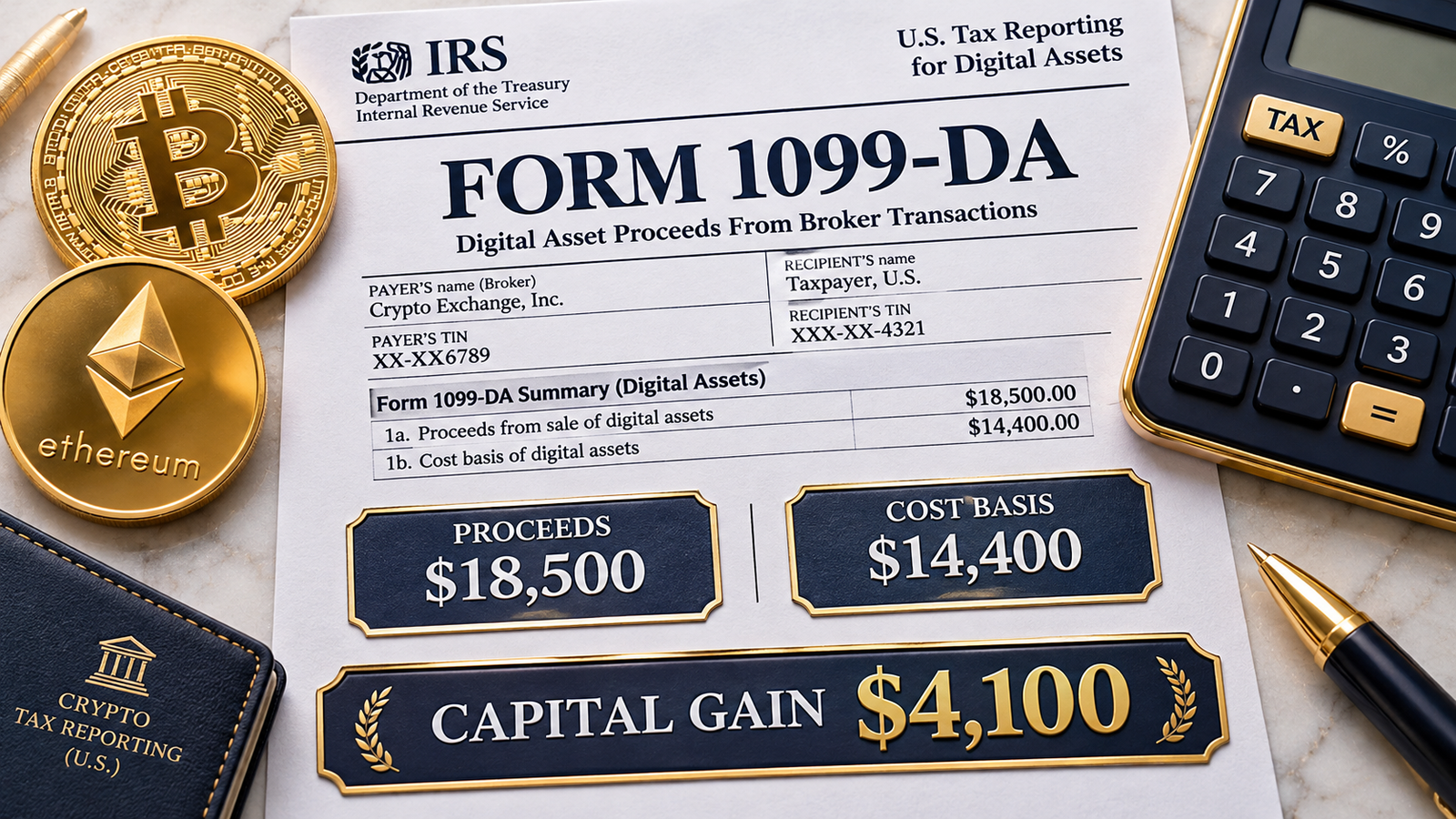
| Total | $18,500 | $14,400 | +$4,100 |
The investor has $18,500 in total proceeds but only $4,100 in net capital gains before considering holding-period classifications and any other tax adjustments.
This example assumes all transactions qualify for capital treatment, all basis figures are correct, and no additional adjustments apply.
Step 4: Review Transfers and Duplicates
Transfers between wallets owned by the same taxpayer are generally not taxable sales by themselves.
However, records can become complicated when assets move between exchanges.
A receiving broker may report a later sale without knowing the original acquisition cost.
Also check for duplicate imports, missing transactions, and incorrect classifications.
Step 5: Correct Errors Before Filing
If the broker reports incorrect quantities, dates, or proceeds, contact the broker and request a corrected statement.
Maintain documentation supporting any differences between the issued form and the amounts reported on your return.
Do not assume that changing a number in tax software will also correct the information already submitted to the IRS.
Does Form 1099-DA Calculate Your Crypto Taxes Automatically?
No.
The form provides information about certain transactions, but it does not necessarily calculate your full federal tax liability.
An investor may have activity across multiple exchanges, self-custody wallets, and decentralized applications.
Some income categories, including staking rewards and certain other crypto receipts, may require separate reporting.
Capital gains and losses generally involve Form 8949 and Schedule D, subject to applicable reporting exceptions.
Other digital asset income may need to be reported in different sections of the federal return.
Tax treatment also depends on the investor’s circumstances, including holding period, applicable adjustments, and whether assets were held for investment or business purposes.
A Form 1099-DA should therefore be treated as a reporting document, not a complete cryptocurrency tax calculation.
Common Form 1099-DA Mistakes to Avoid
The most frequent mistake is treating the total proceeds shown on the form as taxable income.
Another is assuming that a blank basis field means the original purchase price was zero.
Investors may also overlook crypto-to-crypto swaps, incorrectly classify transfers between their own wallets, or omit transactions because no tax form arrived.
A separate problem occurs when records from multiple exchanges are combined without preserving transaction dates and acquisition information.
For active traders, these errors can materially affect taxable gain calculations.
Keeping consistent records throughout the year is easier than reconstructing hundreds of transactions immediately before the filing deadline.
Frequently Asked Questions
What is Form 1099-DA used for?
It allows covered digital asset brokers to report proceeds from qualifying cryptocurrency transactions and, where required, cost basis information to taxpayers and the IRS.
Who receives Form 1099-DA in 2026?
Investors who completed reportable transactions through applicable brokers during 2025 generally received their first Forms 1099-DA in early 2026.
Does Form 1099-DA show my crypto profit?
Not necessarily. It reports proceeds and, for qualifying transactions, cost basis. Investors must determine the correct taxable gain or loss.
Why is my cost basis missing from Form 1099-DA?
Basis may be omitted because the transaction occurred in 2025, the assets are noncovered, they were transferred from another wallet, or an applicable optional reporting method permits omission.
Are transfers between my own wallets taxable?
Generally, transferring cryptocurrency between wallets you own does not create a taxable sale, although separately paid transaction fees can require additional analysis.
Do I need to report crypto transactions without Form 1099-DA?
Yes. Taxable digital asset transactions must be reported even when no broker issues a tax form.
Is Form 1099-DA replacing Form 1099-B?
Form 1099-DA provides specialized reporting for covered digital asset transactions. Form 1099-B continues to apply to other reportable broker transactions.
What should I do if my 1099-DA contains incorrect information?
Compare it with your transaction records, contact the issuing broker, request a corrected form when appropriate, and retain documentation supporting your tax calculations.