Withdrawing 100 USDT from a cryptocurrency exchange can cost less than one cent or several dollars, depending on the platform and blockchain network.
The difference isn’t always what traders expect. TRC20 has a reputation for inexpensive stablecoin transfers, yet several exchanges currently charge more for USDT withdrawals through Tron than through Ethereum, BNB Smart Chain, or Layer 2 networks.
In late October 2026, published withdrawal schedules showed fees as low as 0.01 USDT on BEP20 at several major exchanges. Meanwhile, certain ERC20 routes cost less than comparable TRC20 withdrawals.
Finding the cheapest exchange to withdraw USDT requires comparing three things: the exchange’s fee, the minimum withdrawal amount, and whether the destination supports the selected network.
USDT Withdrawal Fees by Exchange: November 2026 Comparison
Most centralized exchanges charge a network-specific withdrawal fee, commonly deducted from the amount sent.
These fees can differ substantially between platforms, even when the same cryptocurrency and blockchain are involved.
USDT Withdrawal Fees Across Major Exchanges
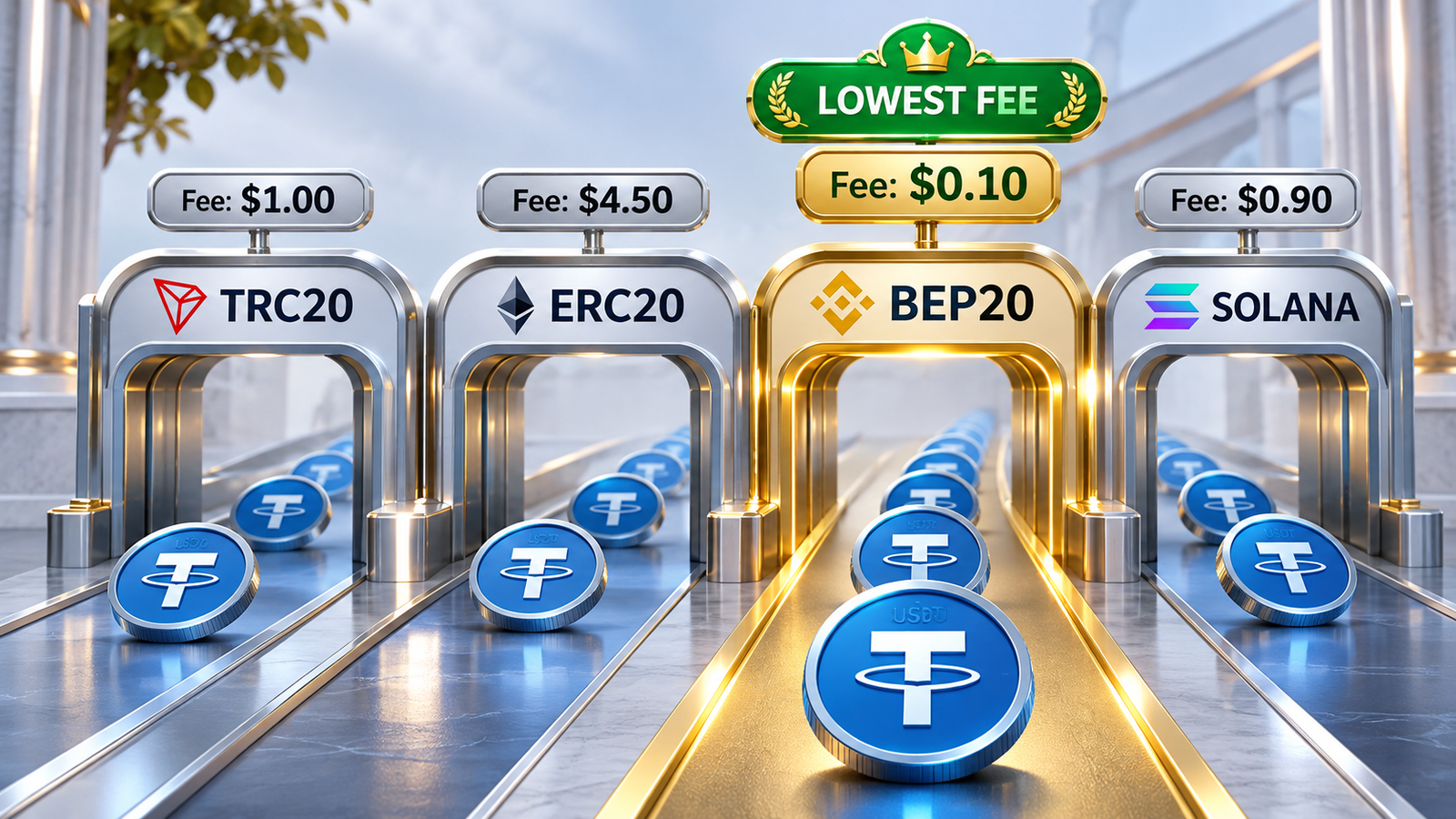
| Exchange | TRC20 | ERC20 | BEP20 | Solana |
|---|---|---|---|---|
| Binance | 1.50 | 0.60 | 0.01 | 0.30 |
| OKX | 1.50 | 0.29 | Not listed | 0.28 |
| Bybit | 1.30 | 0.80 | 0.15 | 0.50 |
| Bitget | 1.50 | 2.00 | 0.01 | 0.50 |
| MEXC | 0.50 | 0.094 | 0.01 | 0.18 |
| Gate | 1.50 | 1.00 | 0.50 | 0.50 |
| KuCoin | 1.99 | 5.50 | 1.00 | 1.50 |
Fees in USDT, based on a published cross-exchange comparison dated October 29, 2026. These are reference quotes, not guaranteed current rates or confirmation that withdrawals are enabled. Availability and pricing can differ by account and region.
Among the listed exchanges, MEXC had the lowest quoted TRC20 fee at 0.50 USDT.
For BEP20, Binance, Bitget, and MEXC each listed a 0.01 USDT withdrawal charge.
However, selecting the exchange with the lowest advertised fee does not automatically guarantee the cheapest completed transfer.
A network may be suspended, unavailable for certain customers, or unsupported by the receiving platform.
Which USDT Network Has the Lowest Withdrawal Fees?
The blockchain network often has a greater influence on withdrawal cost than the exchange itself.
USDT exists on multiple networks, but they aren’t interchangeable.
Sending USDT over Ethereum differs from sending USDT over Tron, BNB Smart Chain, or Solana.
USDT Networks Compared
| Network | Common Fee Range | Important Consideration |
|---|---|---|
| Tron (TRC20) | 0.50–1.99 USDT | Widely supported, but not always cheapest |
| Ethereum (ERC20) | 0.09–5.50 USDT | Broad compatibility; exchange fees vary |
| BNB Smart Chain (BEP20) | 0.01–1.00 USDT | Very low fees at some exchanges |
| Solana | 0.18–1.50 USDT | Low-cost transfers where supported |
| Arbitrum One | Often below 0.50 USDT | Check USDT versus USDT0 support |
| Polygon | Often below 0.10 USDT | Verify the exact supported token |
| TON | Often below 0.50 USDT | Some destinations require a memo |
Indicative exchange withdrawal charges observed in October 2026, not blockchain gas-fee forecasts.
The lowest-cost route is the cheapest network supported by both the sending exchange and receiving destination.
That compatibility requirement matters more than saving a few cents.
TRC20 vs ERC20: Is Tron Still Cheaper?
TRC20 became popular for stablecoin transfers because its blockchain typically offers faster and less expensive settlement than congested Ethereum Mainnet transactions.
However, the exchange withdrawal fee is not necessarily equal to the underlying blockchain transaction cost.
An exchange may charge a fixed fee, adjust fees periodically, or subsidize transfers on selected networks.
For example, Binance’s quoted October 29 schedule listed:
- TRC20: 1.50 USDT
- ERC20: 0.60 USDT
- BEP20: 0.01 USDT
Under that schedule, withdrawing USDT through Ethereum would cost less than withdrawing through Tron.
The difference is even more noticeable on BEP20.
A user sending 100 USDT would pay 1.50 USDT through TRC20 but only 0.01 USDT through BEP20, assuming those quoted fees remained available.
The network’s historical reputation is therefore a poor substitute for checking live prices.
Minimum USDT Withdrawal Amounts by Exchange
Withdrawal minimums determine whether a transfer can be completed at all.
A low fee is irrelevant if the exchange requires a larger withdrawal than the user’s available balance.
Minimum USDT Withdrawal Requirements
| Exchange | Network | Reported Minimum |
|---|---|---|
| Binance | BEP20 | 2 USDT |
| Binance | TRC20 | 5 USDT |
| Binance | ERC20 | 3 USDT |
| OKX | TRC20 | 10 USDT |
| OKX | Other selected networks | Generally 2 USDT |
| Bitget | Supported USDT networks | 5 USDT |
| KuCoin | TRC20 | 4 USDT |
| KuCoin | BEP20 | 10 USDT |
| KuCoin | ERC20 | 30 USDT |
Reference minimums from October 2026 published exchange data. Requirements may change without notice or differ by region. Some quoted values refer to total withdrawal amounts, including fees.
The minimum amount and network fee must be checked together.
For example, if an exchange requires at least 10 USDT for an ERC20 withdrawal, a user with only 8 USDT cannot complete that withdrawal even if the fee is relatively low.
Kraken illustrates another important distinction: its published minimums explicitly include the withdrawal fee.
In its fee schedule, a Tron USDT withdrawal carried a 1 USDT fee and a 6 USDT minimum including the fee. Its Arbitrum One route also listed a 1 USDT fee but a 4 USDT minimum.
Minimums should therefore never be assumed to represent the amount that will actually arrive.
Cheapest Exchanges for USDT Withdrawals
Different exchanges offer advantages depending on the receiving network.
Binance: Low-Cost BEP20 Transfers
Binance’s published schedule included a 0.01 USDT fee for withdrawals through BNB Smart Chain.
That makes it inexpensive when the destination accepts BEP20 USDT.
However, temporary withdrawal suspensions can make an otherwise cheap route unusable.
Availability must be verified in the account before initiating a transfer.
OKX: Competitive Layer 2 Routes
OKX supports several networks with low transaction costs, including selected Layer 2 routes.
Some reported Arbitrum-related USDT withdrawal fees were below 0.01 USDT during October.
However, certain routes use USDT0, an omnichain representation requiring explicit support from the receiving platform.
OKX withdrawal costs also vary by region and can change frequently.
MEXC: Low TRC20 and ERC20 Quotes
MEXC’s October 29 reference fees included 0.50 USDT on TRC20 and 0.094 USDT on ERC20.
It also listed 0.01 USDT on BEP20.
These quotes make it worth comparing for multiple supported networks, although withdrawal availability and the final displayed fee must be checked.
Bitget: Inexpensive BEP20 Withdrawals
Bitget listed a 0.01 USDT fee for BEP20 withdrawals.
Its published TRC20 and ERC20 charges were substantially higher at 1.50 and 2.00 USDT, respectively.
For users already holding USDT on Bitget, selecting a compatible low-cost network may save more than switching exchanges.
KuCoin: Network Choice Matters
KuCoin’s quoted TRC20 fee was 1.99 USDT, while ERC20 was significantly more expensive at 5.50 USDT.
Its TON route was reported around 0.50 USDT, with additional alternatives available.
The lowest fee should still be weighed against minimum withdrawals and destination compatibility.
How Much USDT Will You Actually Receive?
The simplest calculation is:
USDT Received = Withdrawal Amount − Withdrawal Fee
Assume an exchange charges either 0.01 USDT or 1.50 USDT per withdrawal.
USDT Withdrawal Cost Examples
| Withdrawal | Fee: 0.01 USDT | Fee: 1.50 USDT |
|---|---|---|
| 20 USDT | 19.99 received | 18.50 received |
| 100 USDT | 99.99 received | 98.50 received |
| 500 USDT | 499.99 received | 498.50 received |
| 1,000 USDT | 999.99 received | 998.50 received |
The difference is proportionally most significant for small transfers.
For a 20 USDT withdrawal, a 1.50 USDT fee consumes 7.5% of the amount.
On a 1,000 USDT withdrawal, the same fee represents just 0.15%.
This is why frequent small transfers can become expensive even when the absolute fee looks modest.
The example assumes fees are deducted from the withdrawal amount. Some interfaces allow users to enter the desired received amount and calculate a larger total debit instead.
How to Withdraw USDT With the Lowest Fee
The safest approach is to check the receiving destination before comparing exchange fees.
Step 1: Check the Receiving Network
Open the destination wallet or exchange and select the USDT deposit option.
Review the supported networks.
If the destination accepts only ERC20 USDT, selecting BEP20 because it is cheaper could result in lost or inaccessible funds.
Step 2: Compare Network Fees
Open the sending exchange’s withdrawal screen.
Select USDT and check the available networks.
Compare the displayed fee, minimum withdrawal, and amount expected to arrive.
Step 3: Verify the Token Version
Some networks support different representations of USDT.
Examples include native USDT and versions using omnichain infrastructure such as USDT0.
A familiar ticker or matching address format does not guarantee that the recipient supports the same asset.
This is especially important for EVM-compatible networks, where several blockchains use addresses beginning with 0x.
Step 4: Confirm the Destination Address
Copy the receiving address directly from the trusted destination.
Check whether a memo, tag, or other identifier is required.
Some exchange deposit systems use additional identifiers to credit funds correctly.
Step 5: Review the Final Withdrawal Amount
Before confirming, verify the selected network, withdrawal amount, fee, recipient address, and any additional requirements.
For a new destination, a small test transfer can reduce operational risk, provided it meets the minimum deposit and withdrawal requirements.
Hidden Costs Beyond the Withdrawal Fee
The quoted withdrawal fee is not always the complete economic cost.
Several additional expenses may apply.
Trading fees can arise if you exchange another asset for USDT before withdrawing.
A transfer to an unsupported network may require additional bridging or recovery steps, if recovery is possible at all.
The recipient may also impose a minimum deposit amount or reject particular token representations.
For example, saving 1 USDT on a withdrawal is not worthwhile if receiving the tokens requires an additional $5 bridge transaction.
The total cost should include every transaction necessary to reach the intended destination.
For users moving USDT into self-custody, future gas costs also matter. The cheapest network for receiving tokens may not be the cheapest network for using or transferring them afterward.
Why USDT Withdrawal Fees Change
Exchange withdrawal fees can change because of network congestion, blockchain transaction costs, operational policies, or temporary subsidies.
Exchanges may also suspend individual networks during maintenance or security reviews.
A fee displayed in October may therefore differ from the rate available in November.
This is particularly relevant for network comparisons where the difference between two platforms is only a few cents.
The final withdrawal confirmation screen is more authoritative than an older fee table.
Published fee comparisons are useful for identifying promising routes, but they should never be treated as guaranteed execution quotes.
Frequently Asked Questions
Which exchange has the lowest USDT withdrawal fee?
There is no permanent winner. October 2026 reference schedules included 0.01 USDT BEP20 withdrawal fees at Binance, Bitget, and MEXC. The cheapest available route depends on current fees, supported networks, and withdrawal status.
Is TRC20 cheaper than ERC20 for USDT withdrawals?
Not always. Some exchanges currently quote lower ERC20 fees than TRC20 fees. Compare both networks directly rather than relying on historical assumptions.
What is the minimum USDT withdrawal amount?
It varies by exchange and network. Published October schedules included minimums from approximately 2 USDT on some Binance routes to 30 USDT for KuCoin ERC20.
Is BEP20 safe for sending USDT?
BEP20 is a supported token standard on BNB Smart Chain, but the receiving wallet or exchange must support that exact network and asset. A low fee does not remove transfer or custody risks.
Why does the same USDT transfer cost more on one exchange?
Exchanges use different withdrawal pricing policies, operational arrangements, and network cost estimates. The fee charged to customers may differ from the actual blockchain transaction fee.
Can I withdraw USDT without paying a fee?
Some exchanges offer temporary zero-fee routes or highly subsidized transfers. Availability depends on the platform, network, and current conditions.
Does transferring USDT between accounts on the same exchange cost money?
Internal transfers may be free when both parties use a supported internal transfer feature. An external blockchain withdrawal normally follows the exchange’s published withdrawal fee schedule.
What happens if I choose the wrong USDT network?
The recipient may not be able to access or credit the tokens. Recovery can be expensive, technically difficult, or impossible. Always confirm the exact receiving network before sending.