Ethereum’s ETH and Uniswap’s UNI can both be stored in the same crypto wallet, traded on exchanges, and transferred between users. Yet they operate differently beneath the surface.
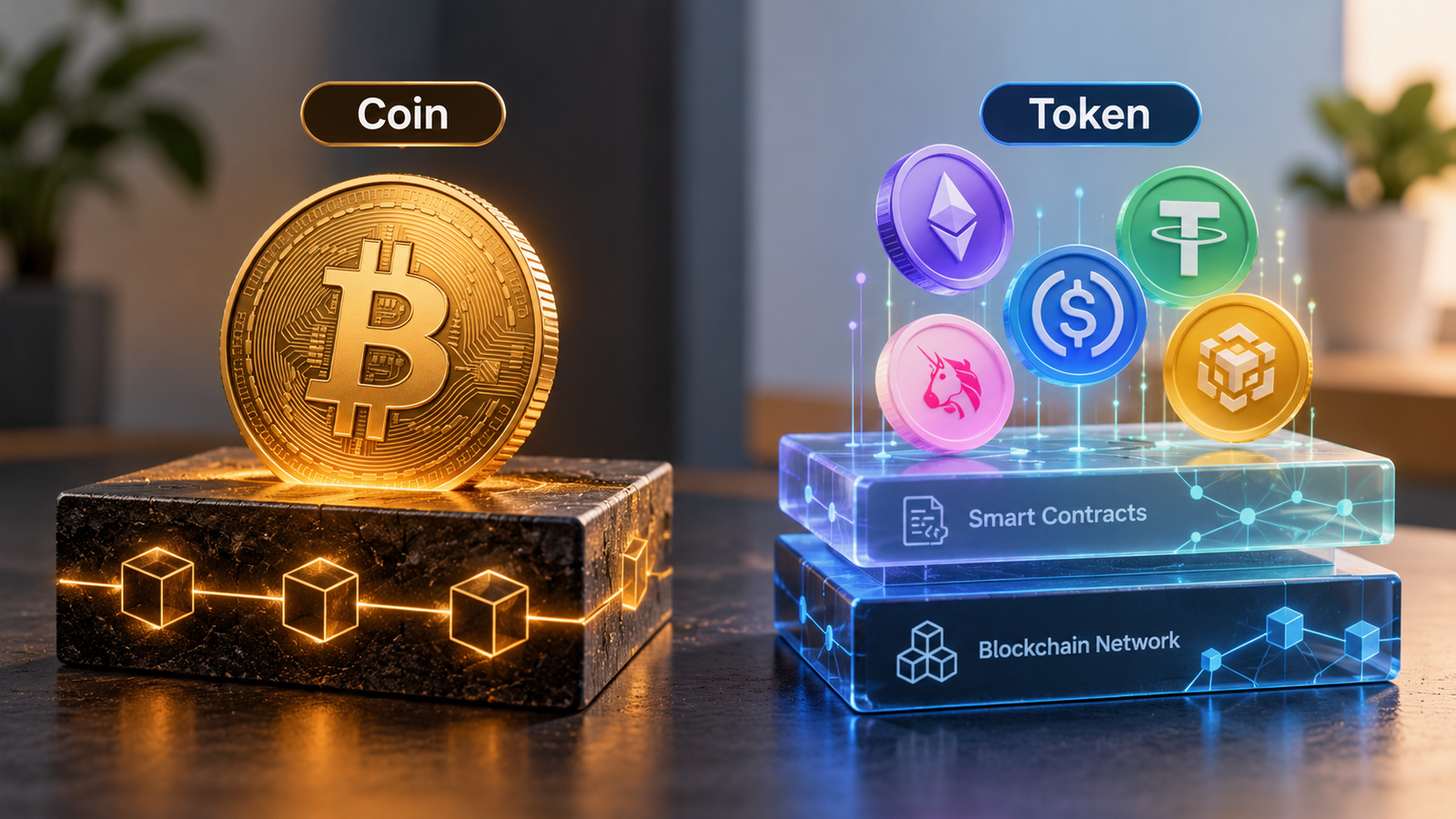
ETH is the native asset of the Ethereum blockchain. UNI is a token created through a smart contract deployed on Ethereum.
That distinction affects how transactions work, which asset pays network fees, how supply is managed, and what security risks holders face.
The terms coin and token are often used interchangeably in everyday crypto discussions. Technically, however, they describe two different ways of representing digital assets.
What Is a Coin in Cryptocurrency?
A crypto coin is the native cryptocurrency of a blockchain network.
Bitcoin has BTC, Ethereum has ETH, and Solana has SOL. These assets are built into their respective networks rather than issued as ordinary application-level tokens.
Native coins commonly serve several functions:
- Paying transaction fees.
- Compensating network participants.
- Supporting staking or other consensus mechanisms.
- Transferring value between accounts.
- Participating in applications built on the blockchain.
Their exact roles depend on the network.
For example, ETH pays for computation on Ethereum and serves as collateral in its proof-of-stake system. SOL covers transaction fees on Solana and can be staked to support network validation.
BTC operates differently. Bitcoin uses proof-of-work mining and doesn’t rely on staking for consensus.
A coin does not need every one of these functions to qualify as a native cryptocurrency.
What Is a Crypto Token?
A crypto token is a digital asset created using an existing blockchain’s infrastructure.
On Ethereum, developers commonly issue tokens through smart contracts following standards such as ERC-20, ERC-721, and ERC-1155.
Solana uses token programs, including the SPL Token and Token-2022 programs, to manage assets issued on its network.
Tokens can represent many different things:
- Stablecoins pegged to fiat currencies.
- Governance rights in decentralized protocols.
- Utility assets used within applications.
- NFTs and digital collectibles.
- Tokenized financial instruments.
- Gaming currencies and rewards.
Unlike native coins, tokens usually do not pay the underlying blockchain’s protocol fees directly.
For instance, transferring UNI on Ethereum normally requires ETH for gas. The UNI balance is managed by its token contract, while the Ethereum network processes the transaction.
This distinction becomes especially important when transferring assets or managing multiple blockchains in one wallet.
Coin vs Token: Main Differences
The difference between coin and token becomes clearer when comparing infrastructure, fees, supply, and ownership.
| Feature | Crypto Coin | Crypto Token |
|---|---|---|
| Blockchain | Native asset of a network | Issued on an existing blockchain |
| Examples | BTC, ETH, SOL | UNI, USDC, AAVE |
| Transaction fees | Often paid using the coin itself | Usually paid using the host network’s fee asset |
| Issuance rules | Defined by network protocol | Defined by token contracts or programs |
| Consensus role | May support mining or staking | Generally not the host network’s native consensus asset |
| Main uses | Payments, gas, staking | Stablecoins, DeFi, governance, NFTs |
| Security dependencies | Network consensus and implementation | Host network plus token contract or program |
| Deployment | Part of the blockchain architecture | Created using supported token infrastructure |
The important distinction is not whether an asset is valuable, widely traded, or decentralized.
It is whether the asset exists natively within the blockchain protocol or is issued through additional token infrastructure.
Crypto Coin vs Token Examples: ETH, SOL, UNI and USDC
Four well-known cryptocurrencies illustrate the differences.
| Asset | Symbol | Classification | Network | Main Function |
|---|---|---|---|---|
| Ethereum | ETH | Native coin | Ethereum | Gas, staking, network utility |
| Solana | SOL | Native coin | Solana | Transaction fees, staking |
| Uniswap | UNI | Governance token | Ethereum and supported deployments | Governance of the Uniswap ecosystem |
| USD Coin | USDC | Stablecoin token | Multiple blockchains | Dollar-denominated payments and transfers |
ETH: Ethereum’s Native Cryptocurrency
ETH is the native asset of Ethereum.
Every ordinary transaction on Ethereum Mainnet requires a network fee denominated in ETH, although applications can sometimes abstract this cost for their users.
ETH also supports Ethereum’s proof-of-stake consensus through validator staking.
An important technical distinction is that native ETH is not itself an ERC-20 token.
Wrapped Ether, or WETH, is an ERC-20 representation of ETH used by many decentralized applications. WETH and native ETH have related economic value but different technical interfaces.
SOL: The Native Coin of Solana
SOL plays a comparable network-level role on Solana, although the two blockchains use different architectures.
SOL is used for transaction fees, staking, and account-related requirements.
Tokens issued through Solana token programs rely on the network for execution and settlement.
Holding an SPL token does not automatically provide the SOL needed to pay a standard network transaction fee, although some applications support sponsored transactions.
UNI: A Governance Token
UNI represents a different asset model.
It is an ERC-20 governance token associated with the Uniswap ecosystem rather than the native cryptocurrency of Ethereum.
UNI holders can participate in governance according to the protocol’s rules.
The token doesn’t replace ETH as Ethereum’s gas asset.
Owning UNI also does not automatically confer equity ownership in a company or a direct contractual claim on every trading fee generated by Uniswap.
USDC: A Stablecoin Across Multiple Networks
USDC is a dollar-pegged stablecoin issued by Circle.
It exists on multiple blockchains, including Ethereum and Solana, through their respective token infrastructure.
A user holding USDC on Ethereum generally needs ETH for an ordinary transfer. On Solana, standard transaction fees are paid in SOL.
USDC issued on one network is not automatically the same on-chain asset as USDC issued on another. Moving between networks requires compatible transfer infrastructure, such as supported cross-chain protocols, exchanges, or bridges.
The network and token version matter just as much as the ticker.
How Do Coins and Tokens Work Technically?
Native coins are integrated into the blockchain’s transaction and accounting rules.
When you transfer ETH, Ethereum processes a native-value transfer between accounts. The balance change and gas fee are handled according to Ethereum’s protocol rules.
An ERC-20 transfer works differently.
Your wallet submits a transaction that calls a token contract. That contract checks the applicable rules and updates its internal token balances.
Ethereum executes the contract interaction and charges the sender a gas fee.
The token does not operate its own separate consensus network.
On Solana, token balances are tracked through accounts managed by token programs. Although the accounting model differs from Ethereum’s, the distinction between SOL and assets issued through token programs remains.
Why Token Transfers Can Cost More Than Coin Transfers
A native ETH transfer between ordinary Ethereum accounts typically uses 21,000 gas units.
An ERC-20 transfer often consumes more gas because it requires executing smart contract code and updating contract storage.
Consider a simplified Ethereum example using a gas price of 10 gwei.
| Transaction | Illustrative Gas Used | Gas Price | Network Fee |
|---|---|---|---|
| Native ETH transfer | 21,000 | 10 gwei | 0.00021 ETH |
| ERC-20 token transfer | 65,000 | 10 gwei | 0.00065 ETH |
Under these assumptions, the ERC-20 transfer requires approximately 3.1 times as much gas.
The calculation uses:
Transaction fee = Gas used × Gas price
At a hypothetical ETH price of $3,000, the fees would equal approximately $0.63 and $1.95, respectively.
These are illustrative calculations, not current market fee quotes. Actual gas consumption and fee rates vary.
Also, this comparison applies to Ethereum Mainnet. Other networks have different fee models, and application-level fee sponsorship can change the cost experienced by the user.
Are Tokens Less Secure Than Coins?
Tokens introduce additional technical dependencies, but that doesn’t mean every token is less secure than every native cryptocurrency.
A native coin depends primarily on its blockchain’s consensus rules, network security, software implementation, and custody arrangements.
A token also depends on the correctness and administration of its smart contract or token program.
For ERC-20 tokens, potential risks include:
- Smart contract vulnerabilities.
- Unauthorized minting or privileged supply changes.
- Malicious spending approvals.
- Administrative freezes or restrictions.
- Upgradeable contract risks.
- Bridge vulnerabilities for wrapped or bridged assets.
Some token contracts contain administrative controls that allow issuers to freeze addresses or modify certain operations.
These features may serve legitimate compliance or operational purposes, but they change the asset’s trust assumptions.
Native coins have their own risks, including protocol vulnerabilities, governance disputes, validator concentration, and network disruptions.
Security should be evaluated by the individual asset and its infrastructure, not by the coin-versus-token label alone.
Can a Coin Become a Token?
Yes, in certain circumstances.
A native cryptocurrency can be represented as a token on another blockchain through wrapping or bridging mechanisms.
Wrapped Bitcoin (WBTC), for example, represents exposure to BTC through a token issued on Ethereum and other supported networks.
The token is not native Bitcoin. Its redemption and backing depend on the relevant custody, issuance, and infrastructure arrangements.
The reverse can also happen during a project’s development.
A cryptocurrency project may initially issue a token on an existing blockchain and later launch its own network.
If the project migrates to a new mainnet with a native asset, its token may be exchanged for the new coin under a defined migration process.
Such migrations are project-specific and should never be assumed automatic.
Coin vs Token: What Matters When Investing?
Being a native coin doesn’t automatically make an asset a better investment than a token.
Both categories can experience substantial price volatility, supply dilution, and liquidity risks.
For native coins, investors should examine network adoption, transaction fees, issuance policies, staking economics, and competitive positioning.
For tokens, additional questions become important.
Does the token have a genuine economic function? Is its supply controlled by a small group? Are large allocations scheduled to unlock? Does protocol growth create measurable demand for the asset?
Consider two hypothetical assets trading at $1.
| Metric | Native Coin A | Token B |
|---|---|---|
| Price | $1 | $1 |
| Circulating supply | 500 million | 500 million |
| Market capitalization | $500 million | $500 million |
| Maximum supply | 1 billion | 5 billion |
| Fully diluted valuation | $1 billion | $5 billion |
Both have identical circulating market capitalizations, but Token B has a much larger fully diluted valuation.
This creates a different potential dilution profile, although actual future supply depends on issuance rules, vesting, and other tokenomics.
The example isn’t proof that the coin is a better investment. It shows why asset classification alone tells investors very little about valuation.
Common Mistakes When Sending Coins and Tokens
Many crypto transfer problems arise because users identify an asset by its ticker without checking its network.
USDC, for example, may exist on Ethereum, Solana, Base, and other blockchains.
The receiving service must support the exact asset and network used for the transfer.
Before sending, verify the destination address, blockchain network, token contract when applicable, and any additional deposit requirements.
Do not assume that two assets with the same ticker are interchangeable or that a wallet displaying a token means an exchange can accept deposits of that token.
A small test transfer can reduce operational risk when using an unfamiliar destination, but it does not replace verification of the network and asset.
Frequently Asked Questions
What is the main difference between a coin and a token?
A coin is native to its blockchain, while a token is issued using the infrastructure of an existing blockchain. ETH and SOL are native coins, whereas UNI and USDC are tokens.
Is Ethereum a coin or a token?
ETH is Ethereum’s native coin. ERC-20 tokens run on Ethereum through smart contracts and use ETH for ordinary network gas payments.
Is USDC a coin or a token?
USDC is a stablecoin token issued on multiple blockchain networks. It is not the native gas asset of Ethereum or Solana.
Is Solana a coin or a token?
SOL is Solana’s native cryptocurrency. Other assets issued on Solana use token programs and are separate from native SOL.
Can a token have its own blockchain?
An asset that becomes the native cryptocurrency of its own blockchain is generally classified as a coin. Some projects begin with tokens and later migrate to native blockchain assets.
Are coins more valuable than tokens?
No. Market value depends on supply, demand, utility, liquidity, and economic rights, not simply whether an asset is classified as a coin or a token.
Do you need ETH to send ERC-20 tokens?
For ordinary Ethereum Mainnet transactions, yes. ETH pays the gas fee. Some wallets and applications can sponsor or abstract fees, but the underlying Ethereum transaction still requires gas payment.
Is Bitcoin considered a token?
BTC is the native cryptocurrency of the Bitcoin network and is conventionally classified as a coin. Wrapped representations of BTC on other blockchains are tokens.