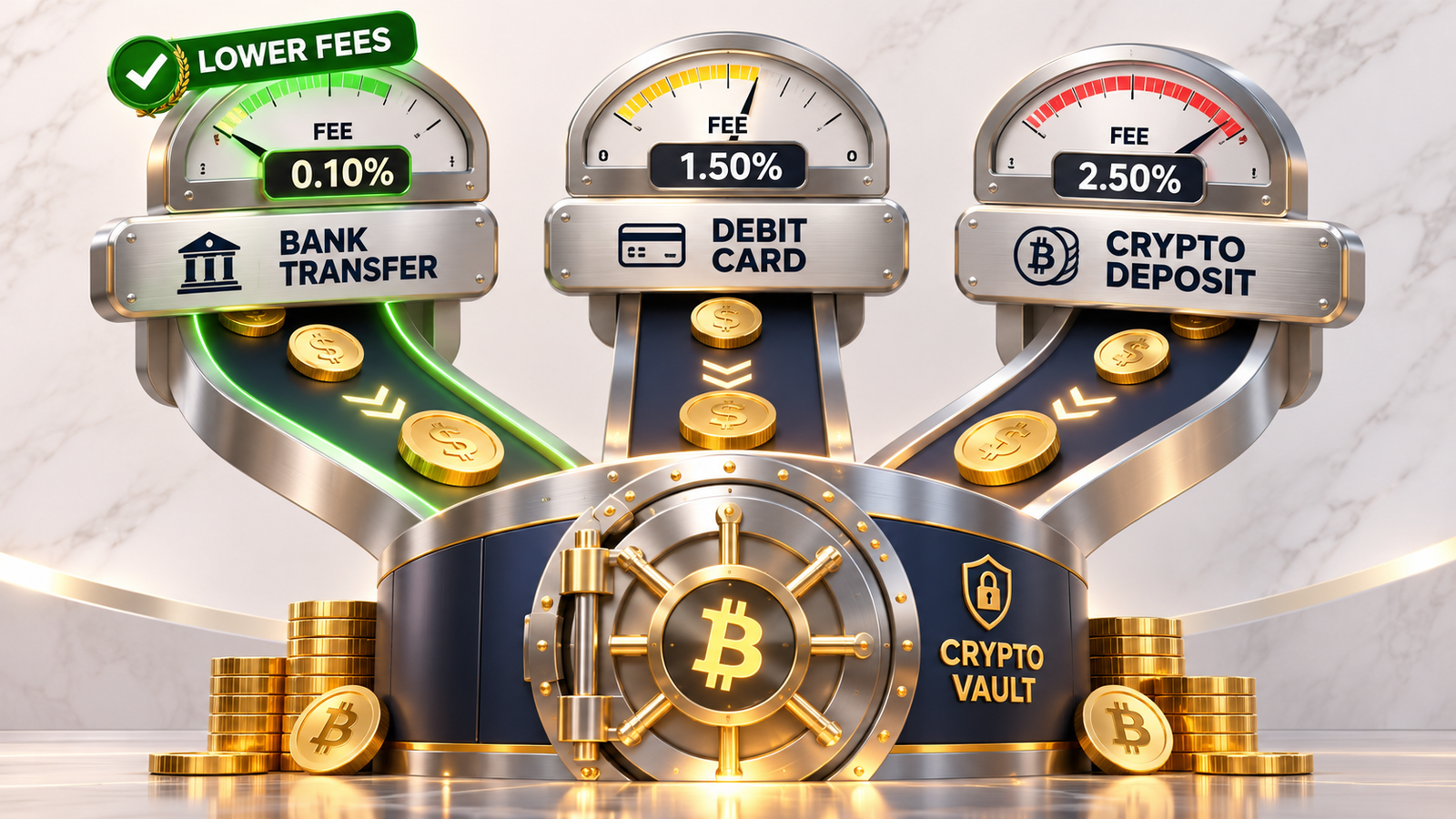
Depositing $1,000 into a cryptocurrency exchange may cost nothing through a bank transfer or nearly $40 through a debit card. And even when a platform advertises zero deposit fees, buying Bitcoin afterward can introduce trading commissions and a spread between the quoted and market prices.
The cheapest payment method depends on the exchange, country, currency, and whether you’re depositing money or purchasing cryptocurrency directly.
Bank transfers often have lower funding costs, while debit cards offer faster access at a premium. Crypto deposits generally don’t carry an exchange deposit fee, but transferring assets from another wallet can still cost money.
This guide compares crypto exchange deposit fees using published November 2026 pricing and explains how to calculate the total cost before committing funds.
Crypto Exchange Deposit Fees Compared
Most exchanges support multiple funding methods, but they charge for them differently.
A bank transfer typically credits fiat currency to the customer’s exchange balance. A card transaction may either fund a fiat wallet or initiate an immediate cryptocurrency purchase.
Those two card operations shouldn’t be treated as identical.
Bank Transfer vs Debit Card vs Crypto Deposit
| Deposit Method | Typical Exchange Fee | Processing Time | Main Additional Cost |
|---|---|---|---|
| ACH bank transfer | Often free | Same day to several business days | Possible withdrawal hold |
| SEPA bank transfer | Often free | Instant to 3 business days | Bank charges or currency conversion |
| Domestic wire | Free or fixed fee | Usually 0–1 business days | Sending bank fee |
| SWIFT transfer | Free or fixed fee | 1–5 business days | Intermediary bank charges |
| Debit card | Often 1%–4% | Usually near-instant | Processing fees and possible FX |
| Third-party card purchase | Provider-specific | Usually near-instant | Spread, processing and trading fees |
| Crypto deposit | Usually free at receiving exchange | Depends on blockchain | Sender’s network withdrawal fee |
These are indicative ranges rather than universal tariffs.
A fee-free bank deposit is often inexpensive, but that doesn’t mean the entire process of acquiring cryptocurrency will be free.
Trading fees must be included when comparing the final amount of BTC, ETH or USDT received.
Deposit Fees on Major Crypto Exchanges
Several established exchanges publish detailed deposit schedules, although availability varies by customer location and account type.
The table below uses specific published funding methods rather than assigning one universal fee to each exchange.
Crypto Exchange Funding Fees: November 2026
| Exchange | Funding Method | Published Fee |
|---|---|---|
| Kraken | USD ACH via Plaid | Free |
| Kraken | EUR SEPA | Free on listed routes |
| Kraken | Debit card USD/EUR | 3.75% + 0.25 currency units |
| Kraken | USD SWIFT via Bank Frick | $3 |
| Coinbase Exchange | USD ACH | Free |
| Coinbase Exchange | USD Fedwire | $10 |
| Crypto.com | Supported bank transfer | 0% platform deposit fee |
| Crypto.com | USD debit card deposit, eligible region | 1.49% |
| Crypto.com | EUR debit/credit card deposit, eligible region | 3.99% |
Published fee examples checked November 4, 2026. Product, region and account eligibility matter. Card deposits and instant crypto purchases may have different pricing.
These figures demonstrate why exchange comparisons require more detail than a single percentage.
Kraken’s USD ACH funding is free, but its debit card option carries a substantial processing charge.
Coinbase Exchange also offers free ACH funding, while its Fedwire deposit method has a fixed $10 charge.
Crypto.com publishes bank deposit fees of 0% for supported arrangements, while card fees depend on currency and jurisdiction.
For any exchange, the final funding screen should be treated as the applicable transaction quote.
Bank Transfer Fees: ACH, SEPA, Wire and SWIFT
Bank transfers are often the cheapest way to deposit money on a crypto exchange, particularly when the platform supports a local payment system.
However, different bank rails have different cost structures.
ACH Deposits in the United States
ACH is commonly used for transfers between US bank accounts.
Some exchanges charge nothing for deposits made using this system.
For example, Kraken lists free ACH funding with a $1 minimum.
However, the funds may be subject to a seven-day withdrawal hold even when credited for trading.
Coinbase Exchange also lists free ACH deposits.
The processing time may extend over several business days, although some platforms make the deposited amount available for trading earlier.
SEPA Transfers in Europe
SEPA supports euro transfers between participating financial institutions.
Kraken lists several free SEPA and SEPA Instant funding methods.
Crypto.com also publishes zero platform fees for supported bank deposits.
A bank may still impose its own charges, especially when foreign exchange conversion is involved.
Domestic Wire and SWIFT
Wire transfers can be useful for larger amounts or situations where ACH or SEPA is unavailable.
But fixed fees make them less attractive for small deposits.
Coinbase Exchange lists a $10 charge for USD Fedwire deposits.
Kraken offers certain free wire routes, alongside international options with fixed charges.
SWIFT transfers may also involve intermediary banks that deduct fees before the deposit reaches the exchange.
A transfer advertised as free by the receiving exchange can therefore still result in a smaller credited balance.
Debit Card Crypto Deposit Fees: The Cost of Convenience
Debit cards are popular because they allow customers to fund accounts or buy cryptocurrencies quickly.
That convenience often comes at a higher price.
Card transactions involve payment networks, processing services, fraud controls and potentially currency conversion.
Some exchanges charge a percentage of the transaction value plus a fixed fee.
Others use third-party payment providers with their own pricing.
Example: Kraken Debit Card Funding
Kraken’s published debit card deposit fee is 3.75% plus $0.25 for eligible USD transactions.
| Deposit Amount | Processing Fee | Total Fee |
|---|---|---|
| $100 | $3.75 + $0.25 | $4.00 |
| $500 | $18.75 + $0.25 | $19.00 |
| $1,000 | $37.50 + $0.25 | $37.75 |
| $5,000 | $187.50 + $0.25 | $187.75 |
The table calculates the fee on the stated transaction amount. Actual debit and credited balances depend on the payment interface.
The percentage component becomes significant as deposits increase.
For a $5,000 transaction, the $187.75 processing charge is substantially larger than many fixed bank transfer fees.
Debit Card Deposit vs Instant Crypto Purchase
A debit card deposit adds money to an exchange balance.
An instant purchase uses the card to acquire cryptocurrency directly.
The second operation may combine payment processing costs with a trading fee and an embedded spread.
Kraken, for example, describes a 1% trading fee for its Instant Buy service, with an additional spread where applicable.
Coinbase also includes a spread in simple buy and sell quotes.
By contrast, Coinbase Advanced uses an order-book-based trading model with separately calculated fees rather than an embedded simple-trade spread.
A user choosing an instant purchase should therefore compare the final crypto quantity received, not merely the advertised card processing percentage.
Hidden Crypto Exchange Fees: Why Zero Deposit Fees Can Mislead
A free deposit doesn’t necessarily result in the lowest total cost.
Several charges can occur before the investor receives cryptocurrency.
Common Hidden or Overlooked Costs
| Cost | Where It Appears |
|---|---|
| Bank transfer fee | Sending bank |
| Card processing fee | Exchange or payment provider |
| Foreign exchange markup | Bank or card issuer |
| Trading commission | Crypto purchase or conversion |
| Spread | Difference between quoted and reference market price |
| Network fee | Sending crypto from another wallet |
| Third-party on-ramp charge | External crypto purchase provider |
| Withdrawal fee | Moving funds out after purchase |
The spread deserves particular attention because it may not appear as a separate line item.
Suppose Bitcoin’s reference market price is $80,000.
An instant purchase interface quotes $80,800.
The difference is $800, representing a 1% markup relative to the reference price.
Even if the displayed trading commission is zero, the investor receives less BTC for the same amount of money.
A trading interface with transparent maker/taker fees may sometimes produce a lower overall execution cost, although that depends on liquidity, order size and market conditions.
How to Calculate the Real Cost of Depositing $1,000
To compare funding routes, calculate every charge required to convert the original funds into the desired cryptocurrency.
A simplified formula is:
Total Cost = Funding Fees + FX Costs + Trading Fees + Spread Cost + Network Fees
Consider three hypothetical methods for acquiring BTC with $1,000.
Bank Transfer vs Debit Card: Real Cost Example
| Cost Component | Bank Transfer | Debit Card Funding | Instant Card Purchase |
|---|---|---|---|
| Initial amount | $1,000 | $1,000 | $1,000 |
| Funding / processing fee | $0 | $37.75 | $20 |
| Trading fee | $2 | $2 | $10 |
| Estimated spread cost | $1 | $1 | $8 |
| Total estimated cost | $3 | $40.75 | $38 |
| Effective cost | 0.30% | 4.08% | 3.80% |
Illustrative all-in costs. The debit funding example uses a published 3.75% + $0.25 fee; all trading, spread and instant-card figures are hypothetical and are not current quotes from a specific exchange.
The example shows how payment method selection can outweigh small differences in exchange trading fees.
A free bank transfer followed by a competitively priced spot order may be considerably cheaper than an instant card purchase.
However, banks can impose their own charges, and the cheapest route is not always the fastest.
Crypto Deposits: Are They Really Free?
When transferring existing cryptocurrency to an exchange, most platforms do not charge a separate fee to receive supported deposits.
For example, Crypto.com and Kraken generally provide free crypto deposits, subject to asset-specific exceptions or minimums.
But the sending platform or blockchain may charge for the transfer.
Suppose a customer sends 500 USDT from one exchange to another.
The receiving exchange charges no deposit fee.
The sending exchange charges 1 USDT for withdrawal.
The effective cost of moving the funds is 1 USDT, even though the destination advertises free deposits.
The blockchain network also matters.
Transferring USDT through Ethereum, Tron, BNB Smart Chain or another supported chain can involve substantially different costs.
Before sending funds, verify the exact token contract, blockchain network, deposit minimum and any required memo.
A wrong-network transfer may create losses far greater than the fee savings.
Bank Transfer vs Debit Card: Which Is Cheaper?
For users who can wait for funds to settle, local bank transfers are often the most economical funding method.
Debit cards are generally more attractive when immediate access is necessary and the additional cost is acceptable.
Funding Method Comparison
| Priority | Method Worth Checking First |
|---|---|
| Lowest fees on larger deposits | Local bank transfer |
| Fast access to funds | Eligible instant bank transfer or debit card |
| Funding an account with existing crypto | On-chain crypto deposit |
| International fiat transfer | Compare SWIFT and local alternatives |
| Small recurring purchases | Compare payment fees and order execution |
| Moving stablecoins between exchanges | Compare network withdrawal charges |
Speed should not be confused with unrestricted availability.
Kraken’s ACH deposits, for example, can be available quickly for trading but remain subject to a seven-day withdrawal hold.
Certain card purchases may also trigger a 72-hour withdrawal restriction.
If the investor intends to move purchased Bitcoin immediately into self-custody, these holding periods can matter more than the deposit processing time.
How to Avoid Unnecessary Deposit Fees
The most reliable way to reduce funding costs is to compare the entire transaction before confirming it.
First, check whether the exchange offers a local bank transfer method in your currency.
Next, verify whether you’re adding fiat funds or directly purchasing cryptocurrency.
If buying with a card, inspect the provider fee, trading charge, exchange rate and estimated crypto received.
For bank transfers, review both the exchange’s published fee and any charges imposed by your bank.
Avoid unnecessary currency conversions when a direct funding method in your local currency is available.
For crypto transfers, verify blockchain compatibility and the sender’s withdrawal fee.
Finally, check whether deposit restrictions will prevent immediate withdrawals.
The cheapest route should be evaluated alongside settlement times, liquidity, counterparty risk and the intended use of the funds.
Frequently Asked Questions
What is the cheapest way to deposit money on a crypto exchange?
A free local bank transfer such as ACH or SEPA is often among the cheapest options. However, any later trading fees, spreads and bank charges still need to be considered.
Are crypto exchange deposits free?
Many exchanges offer free bank transfers and cryptocurrency deposits. Other methods, including debit cards and international wires, may have additional fees.
Why are debit card crypto deposits expensive?
Card payments involve processing costs and fraud controls. Depending on the platform, an instant crypto purchase may also include trading commissions and a spread.
Is ACH cheaper than a debit card for buying Bitcoin?
Often, yes. Several US exchanges offer free ACH deposits, while card funding can carry percentage-based charges. The final cost also depends on the subsequent Bitcoin purchase.
Do crypto exchanges charge a fee to receive USDT?
Many don’t, but the sending wallet or exchange may charge a network withdrawal fee. Asset-specific minimums and exceptions can also apply.
What is the difference between deposit fees and trading fees?
Deposit fees cover funding an account. Trading fees apply when exchanging fiat or crypto for another asset. Some purchase interfaces combine both costs.
Can a zero-fee crypto purchase still have a spread?
Yes. A quoted purchase price may include a markup relative to the reference market price, even if the displayed commission is zero.
Which funding method is best for large crypto deposits?
Local bank transfers are often more cost-effective for large amounts because they may avoid percentage-based card fees. Availability, transfer limits, bank charges and settlement times should still be checked.