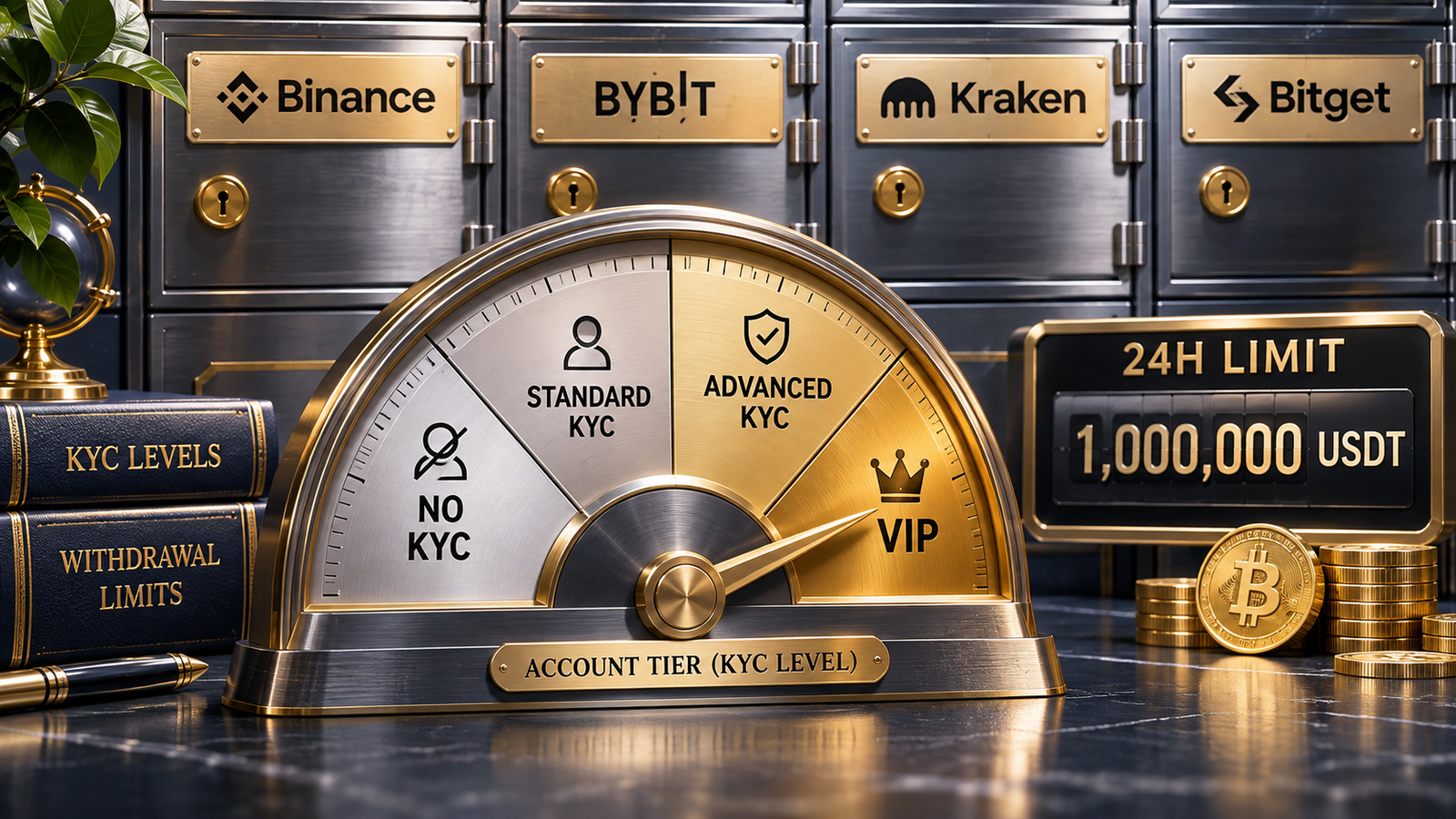
A cryptocurrency exchange may advertise a $1 million daily withdrawal limit, yet a verified customer could still be unable to transfer $50,000 immediately.
Withdrawal limits depend on more than account verification. Exchanges also consider account location, VIP status, security settings, recent transactions, and whether funds are being withdrawn as cryptocurrency or fiat.
The time window creates another complication. Some platforms reset daily allowances at midnight UTC, while others calculate withdrawals over the preceding 24 hours.
Understanding these differences matters when moving large balances between exchanges, transferring funds into self-custody, or preparing a time-sensitive withdrawal.
This comparison examines crypto exchange withdrawal limits across major platforms, with particular attention to KYC levels, daily caps, and monthly restrictions.
Crypto Exchange Withdrawal Limits: 2026 Comparison
Most centralized cryptocurrency exchanges apply withdrawal limits based on the value of assets transferred rather than the number of coins.
For example, an exchange may set a 24-hour allowance equivalent to 1 million USDT.
That limit generally applies across supported cryptocurrencies, using the exchange’s valuation method.
Crypto Withdrawal Limits by Exchange
| Exchange | Verification Level | Published Crypto Withdrawal Limit |
|---|---|---|
| Binance | Verified / Verified Plus | Account and region-specific |
| Bybit | Standard KYC, non-VIP | 1 million USDT daily |
| Bybit | Advanced KYC, non-VIP | 2 million USDT daily |
| Bitget | Verified VIP 0 | 3 million USDT per 24 hours |
| Bitget | Verified VIP 1 | 4 million USDT per 24 hours |
| KuCoin | Completed identity verification | 999,999 USDT per 24 hours |
| Kraken | Verified individual | Dynamic, account-specific |
| OKX | Verified | Depends on account, service and region |
Published reference limits checked November 2, 2026. Actual withdrawal capacity may differ by country, account status, and security controls.
The figures are not directly comparable in every respect.
Bybit uses a calendar-day reset, while KuCoin describes a 24-hour allowance. Kraken applies rolling limits, and Binance displays jurisdiction-specific values directly in the verification interface.
The maximum published amount should therefore be treated as a ceiling, not a guaranteed withdrawal entitlement.
How KYC Levels Affect Crypto Withdrawal Limits
Know Your Customer (KYC) verification allows exchanges to establish a customer’s identity and assess regulatory and financial crime risks.
Verification typically involves government-issued identification, personal details, and sometimes proof of address or additional documentation.
Higher verification levels may unlock larger withdrawals, but their names and requirements vary between platforms.
Withdrawal Limits by KYC Level
| Exchange | Lower / Unverified Tier | Standard Verified | Higher Verification or VIP |
|---|---|---|---|
| Binance | New users generally require KYC | Region-specific | Verified Plus or business limits vary |
| Bybit | Up to 20K USDT daily for eligible legacy cases | 1M USDT daily | 2M USDT Advanced; higher VIP caps |
| Bitget | KYC required for normal withdrawals | 3M USDT / 24h at VIP 0 | Up to 20M USDT / 24h at VIP 7 |
| KuCoin | 0–30K USDT / 24h according to account eligibility | 999,999 USDT / 24h | Additional conditions may apply |
| Kraken | Verification required | Dynamic crypto limits | Higher limits subject to account review |
| OKX | KYC required for supported services | Account-specific | Additional controls and account review |
Legacy non-KYC allowances should not be interpreted as general access for newly registered customers.
A higher verification level may increase the withdrawal ceiling, but it does not override temporary security restrictions, sanctions requirements, or local regulations.
Binance Withdrawal Limits: Why They Vary by Region
Binance uses verification levels including Verified, Verified Plus, and Enterprise Verification.
The exchange’s current guidance directs users to their Personal Identification page to view the applicable limits.
Those values can differ according to country of residence and account type.
Historically, Binance published standardized limits for different VIP tiers. However, older announcements should not be used as authoritative figures for every account in November 2026.
How to Check Your Binance Limit
Open the account menu and navigate to Identification or the verification section.
Confirm the account’s residential country and current verification level.
Review the withdrawal allowance displayed for that account.
For substantial transactions, also check the withdrawal screen for any additional restrictions.
A customer with sufficient cryptocurrency and completed KYC may still encounter a withdrawal hold after a password reset, security change, or other risk-control event.
Bybit Withdrawal Limits: Standard vs Advanced KYC
Bybit publishes one of the clearer withdrawal-limit schedules.
For non-VIP users, Standard Identity Verification provides a daily crypto withdrawal allowance of up to 1 million USDT.
Advanced Verification increases the maximum to 2 million USDT.
Eligible business accounts can have a higher base limit.
Bybit Daily Withdrawal Limits
| Account Level | Daily Crypto Limit |
|---|---|
| Eligible non-KYC account | 20,000 USDT |
| Standard KYC | 1,000,000 USDT |
| Advanced KYC | 2,000,000 USDT |
| Business verification | 4,000,000 USDT |
| VIP 1–3 | Up to 8,000,000 USDT |
| VIP 4 | Up to 16,000,000 USDT |
| VIP 5 | Up to 24,000,000 USDT |
Certain higher Pro tiers have larger published limits.
For eligible non-KYC accounts, Bybit also publishes a monthly withdrawal cap of 100,000 USDT.
However, current verification requirements generally require customers to complete KYC for normal account services. The non-KYC figures should not be read as permission for every new user to withdraw without verification.
For verified individual accounts, Bybit states that no separate monthly crypto withdrawal ceiling applies under its standard schedule.
Daily limits reset at 00:00 UTC.
VIP customers may also need to increase their configured withdrawal setting manually before using their higher entitlement.
Bitget Withdrawal Limits by VIP Level
Bitget links withdrawal capacity to verified account status and VIP level.
Its published standard crypto withdrawal allowance begins at 3 million USDT over 24 hours for verified VIP 0 users.
Higher VIP levels receive progressively larger limits.
Bitget Verified Account Limits
| VIP Level | 24-Hour Limit |
|---|---|
| VIP 0 | 3,000,000 USDT |
| VIP 1 | 4,000,000 USDT |
| VIP 2 | 6,000,000 USDT |
| VIP 3 | 8,000,000 USDT |
| VIP 4 | 10,000,000 USDT |
| VIP 5 | 12,000,000 USDT |
| VIP 6 | 15,000,000 USDT |
| VIP 7 | 20,000,000 USDT |
These allowances apply to eligible verified accounts.
Bitget may impose additional withdrawal restrictions if KYC is pending, account security requires review, or the selected asset has network-specific limitations.
A large published daily allowance doesn’t eliminate minimum withdrawal amounts or transaction fees.
Kraken Withdrawal Limits: Dynamic Account-Based Caps
Kraken differs from platforms that advertise one standard cryptocurrency withdrawal limit for every verified customer.
Its crypto withdrawal limits are dynamic and depend on factors including residence, verification status, transaction activity, account history, and asset type.
Customers can check their current limits in the Limits section of Account Settings.
Kraken also distinguishes cryptocurrency withdrawals from cash withdrawals.
For standard verified individual accounts, its published reference cash withdrawal limits include:
| Cash Withdrawal Window | Reference Limit |
|---|---|
| 24 hours | $100,000 |
| Rolling 30 days | $500,000 |
These figures apply to cash funding limits, not a universal cryptocurrency withdrawal cap.
An investor should not assume that a $100,000 daily cash withdrawal allowance means the same amount can be withdrawn through every cryptocurrency network or banking method.
KuCoin Withdrawal Limits After KYC
KuCoin publishes a 24-hour cryptocurrency withdrawal allowance of 999,999 USDT for users with completed identity verification.
Its verification documentation also describes a range of 0–30,000 USDT for accounts without completed verification, depending on eligibility and previously supplied identity information.
That range is not a universal allowance for newly created unverified accounts.
KuCoin has tightened verification requirements over time, and available functions can depend on when the account was created and the applicable local rules.
Customers should inspect their account’s current limit rather than assume that an older registration automatically qualifies for the maximum historical allowance.
OKX Withdrawal Limits and Additional Security Controls
OKX determines withdrawal allowances according to factors including customer verification, location, transaction type, and account-specific restrictions.
The platform also introduced Large Withdrawal Protection in 2026.
This feature allows eligible verified users to configure a personal 24-hour cumulative withdrawal threshold between $10,000 and $10 million.
Once that threshold is reached, additional verification is required before the affected withdrawal can proceed.
The protection covers several channels, including on-chain withdrawals and certain internal transfer-related services.
This configurable safety threshold is not the same as the exchange’s regulatory maximum withdrawal allowance.
A customer may have sufficient KYC authorization to withdraw a particular amount while still triggering an additional security check.
Daily vs Rolling 24-Hour Withdrawal Limits
The phrase “daily withdrawal limit” can describe two different systems.
A calendar-day limit resets at a specified time each day.
A rolling 24-hour limit measures activity over the preceding 24 hours.
The difference becomes significant when withdrawals occur near midnight.
Calendar Day vs Rolling 24 Hours
Assume an exchange has a $10,000 withdrawal limit.
A customer withdraws $8,000 on November 2 at 23:30 UTC.
| Time | Calendar-Day Reset | Rolling 24-Hour Window |
|---|---|---|
| Nov 2, 23:30 UTC | $8,000 withdrawn | $8,000 withdrawn |
| Nov 2, 23:45 UTC | $2,000 remaining | $2,000 remaining |
| Nov 3, 00:05 UTC | New $10,000 allowance | $2,000 remaining |
| Nov 3, 23:31 UTC | Subject to current day’s usage | Earlier $8,000 exits the window |
Under a calendar-day system, capacity can reset shortly after a withdrawal.
Under a rolling system, the transaction continues counting until it falls outside the measurement window.
Bybit explicitly uses a midnight UTC reset for its daily crypto limits.
Kraken uses rolling periods for its funding limits.
Other exchanges may apply different calculations depending on the product.
Monthly Limits: Calendar Month vs Rolling 30 Days
Monthly withdrawal limits also require careful interpretation.
A calendar-month cap resets on a specified day, commonly the first day of the next month.
A rolling 30-day cap continuously measures withdrawals made during the preceding 30 days.
Monthly Withdrawal Example
Suppose the monthly cap is $50,000 and the customer withdraws $40,000 on October 28.
| Date | Calendar-Month System | Rolling 30-Day System |
|---|---|---|
| October 28 | $10,000 remaining | $10,000 remaining |
| November 1 | New $50,000 allowance | $10,000 remaining |
| November 27 | Depends on November usage | October withdrawal begins leaving the window after 30 days |
The reset method affects how quickly someone can make a second large transfer.
Kraken uses rolling 30-day limits. Bybit’s applicable monthly cryptocurrency limits reset at midnight UTC on the first day of the month.
Traders should also check whether weekly restrictions, transaction-count limits, or per-order caps apply.
How to Calculate Your Remaining Withdrawal Limit
The simplified calculation is:
Remaining Allowance = Maximum Withdrawal Limit − Counted Withdrawals
Consider an account with a 24-hour limit of $100,000.
The customer has already withdrawn:
- $25,000 in BTC.
- $30,000 in USDT.
- $15,000 in ETH.
Total withdrawals equal $70,000.
The remaining allowance is $30,000, assuming all three transfers fall within the relevant measurement window and no additional restrictions apply.
Different cryptocurrencies are typically converted into a reference currency to calculate aggregate usage.
That means changing from BTC to USDT generally does not bypass the account’s total withdrawal ceiling.
Why an Exchange May Block a Withdrawal Below Your Limit
A failed withdrawal doesn’t necessarily indicate that the customer has exceeded the KYC allowance.
Several other restrictions may apply.
| Reason | Possible Effect |
|---|---|
| Recent password change | Temporary withdrawal hold |
| New withdrawal address | Additional verification or delay |
| Pending KYC review | Withdrawals may be restricted |
| Network maintenance | Withdrawals temporarily unavailable |
| Deposit confirmation requirements | Funds not yet eligible for withdrawal |
| Fiat payment hold | Recently purchased crypto temporarily restricted |
| Compliance review | Additional account checks |
| Personal security threshold | Extra authentication required |
These controls operate independently of the published daily cap.
For example, a customer with a $1 million allowance may still be unable to withdraw $10,000 while a security hold is active.
Crypto vs Fiat Withdrawal Limits
Crypto withdrawal limits and fiat withdrawal limits should not be treated as interchangeable.
Cryptocurrency withdrawals involve transfers to external blockchain addresses.
Fiat withdrawals involve payment rails such as bank transfers or supported card arrangements.
The latter may introduce additional banking rules, processing times, country restrictions, and separate account limits.
For example, Kraken’s published standard cash limits are different from its dynamically assigned crypto withdrawal allowances.
Bybit likewise publishes separate schedules for fiat withdrawals, with individual transaction limits and daily, weekly, and monthly restrictions.
When comparing exchanges, first decide whether the intended transfer involves cryptocurrency or conventional currency.
How to Check Your Actual Withdrawal Limit
Before initiating a large transfer, open the official exchange website or mobile application.
Navigate to the account verification, withdrawal, or account limits section.
Check the applicable crypto withdrawal allowance, remaining capacity, reset time, and any separate account restrictions.
For larger balances, confirm whether the limit applies to a calendar day, rolling 24 hours, or another interval.
Also review the withdrawal fee and minimum amount for the selected asset.
If a higher limit is needed for a legitimate large transfer, use the exchange’s official verification or account-upgrade procedure.
Do not rely on third parties claiming they can remove KYC limits or accelerate withdrawals in exchange for account credentials.
Frequently Asked Questions
Which crypto exchange has the highest daily withdrawal limit?
There is no universal leader for every customer. Bybit and Bitget publish high limits for eligible VIP accounts, while other exchanges use region-specific or dynamic allowances.
How much can I withdraw from Bybit after standard KYC?
Bybit publishes a daily crypto withdrawal limit of up to 1 million USDT for non-VIP users with Standard Identity Verification, subject to account-specific restrictions.
What is Bitget’s daily withdrawal limit?
Bitget publishes a 3 million USDT 24-hour limit for verified VIP 0 users, with higher allowances available at eligible VIP levels.
Does completing KYC remove all withdrawal limits?
No. Verified accounts remain subject to applicable daily caps, security restrictions, compliance reviews, and network-specific requirements.
Does a 24-hour withdrawal limit reset at midnight?
Not necessarily. Some exchanges reset at midnight, while others use a rolling window based on previous transactions.
Is a monthly withdrawal limit always based on a calendar month?
No. Some platforms use calendar months, while others use rolling 30-day periods.
Can I withdraw more by switching cryptocurrencies?
Usually not. Account-level limits generally aggregate withdrawals across supported cryptocurrencies using a common value calculation.
Why is my withdrawal restricted even though I have completed KYC?
Possible causes include security holds, pending compliance checks, deposit restrictions, insufficient available balance, network maintenance, or an additional personal withdrawal threshold.