A cryptocurrency exchange may display a European address, accept euro deposits, and claim to be regulated without holding the authorization required to provide crypto services under the EU’s Markets in Crypto-Assets Regulation (MiCA).
The exchange’s brand name is not enough to verify its regulatory status. A platform may operate through several companies, with different entities serving customers in different countries.
Before depositing funds, EU users should identify the company responsible for their account and check its authorization in the European Securities and Markets Authority (ESMA) register.
The process is free and usually requires only the exchange’s legal name, website, and regulatory details.
What Is a MiCA License for a Crypto Exchange?
MiCA establishes a common regulatory framework for cryptocurrency service providers operating in the European Union.
Companies authorized to provide regulated crypto services are generally known as crypto-asset service providers, or CASPs.
Under MiCA, authorization can cover activities including cryptocurrency custody, trading platform operation, exchange services, execution of orders, and crypto-asset transfers.
A CASP authorized in one EU member state can generally provide its authorized services across other member states through the applicable passporting procedures.
However, an authorization does not necessarily cover every financial product offered under the same brand.
For example, permission to provide spot cryptocurrency exchange services does not automatically authorize a company to offer derivatives or other investment products governed by separate legislation.
What Does a CASP Authorization Cover?
| Crypto Service | MiCA Authorization Category |
|---|---|
| Holding customers’ crypto | Custody and administration |
| Operating a crypto exchange | Operation of a trading platform |
| Buying or selling crypto for fiat | Exchange for funds |
| Exchanging BTC for ETH | Exchange for other crypto-assets |
| Executing customer trades | Execution of orders |
| Transferring crypto for customers | Transfer services |
| Managing crypto portfolios | Portfolio management |
| Providing crypto investment advice | Advice on crypto-assets |
An exchange might be authorized for several categories but not all of them.
Checking the exact services is therefore just as important as confirming the company’s name.
How to Check a MiCA License Using the ESMA Register
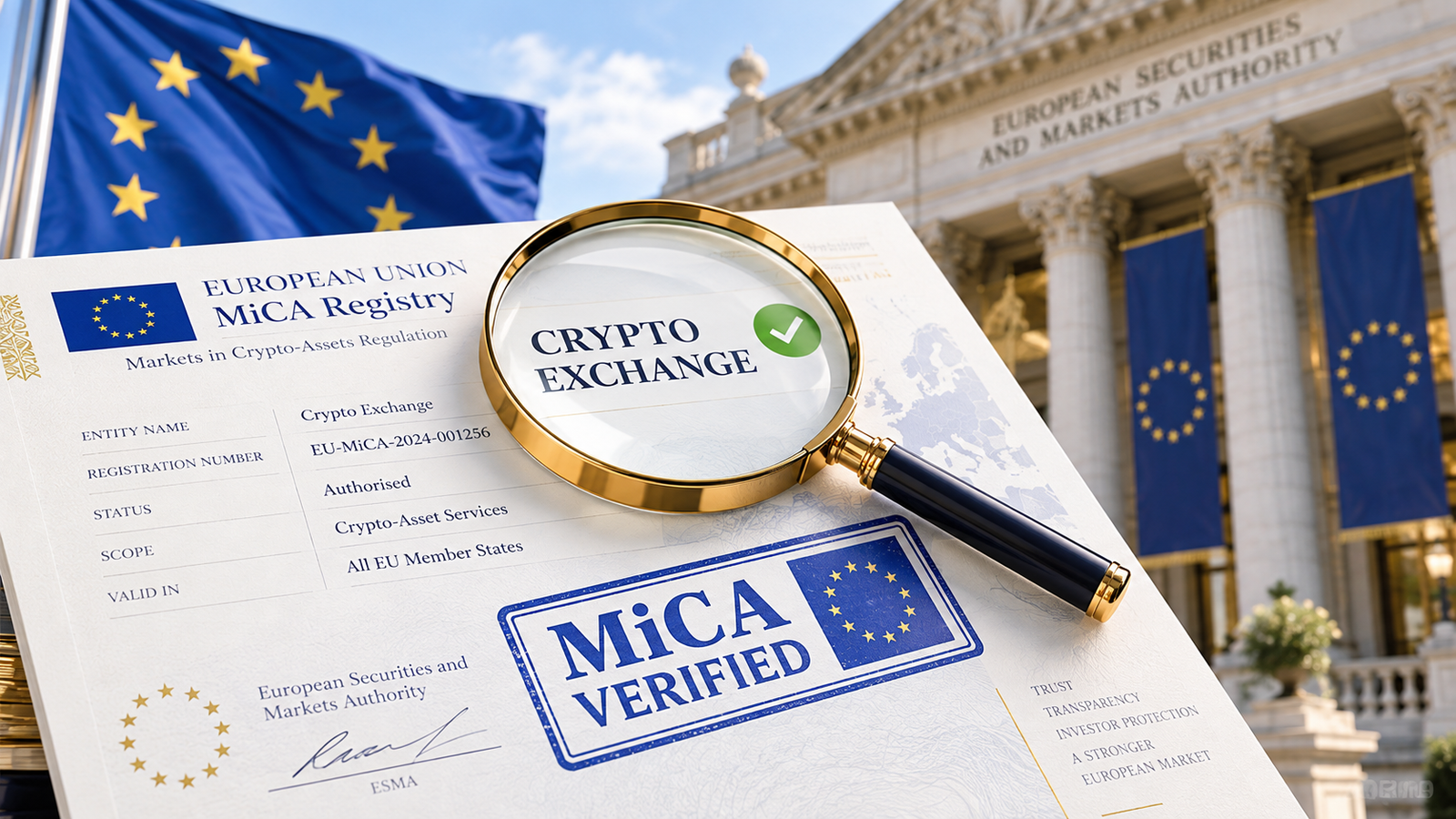
ESMA maintains a centralized register containing information about authorized crypto-asset service providers and other regulated crypto entities.
This is the main starting point for verifying an exchange’s MiCA status.
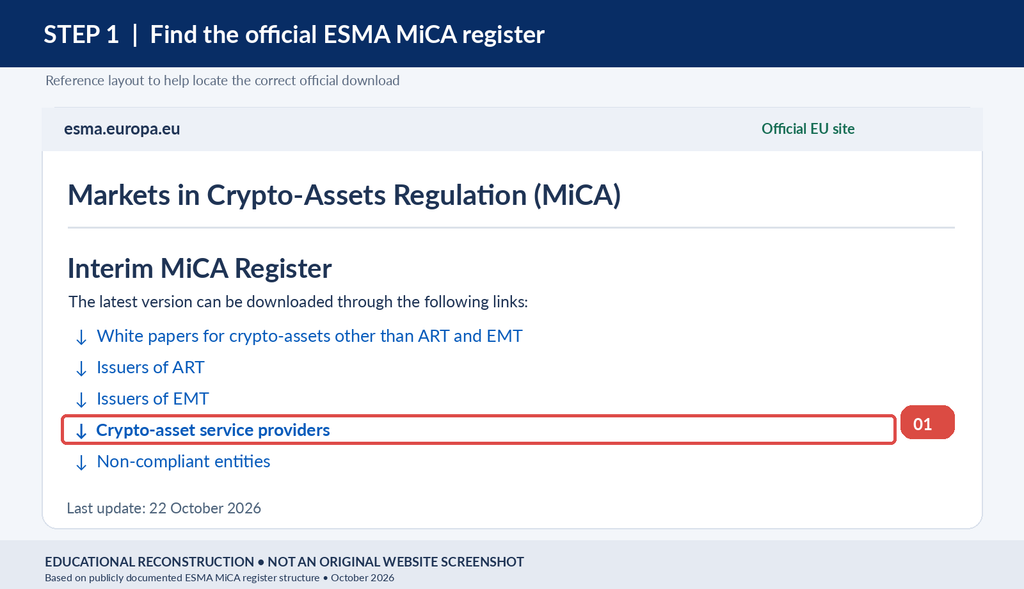
Step 1: Open the Official ESMA Website
Visit:
Find the section labeled “Interim MiCA Register.”
The page provides downloadable register files covering different categories of businesses and crypto assets.
Select the file named “Crypto-asset service providers.”
Do not confuse it with the separate registers for stablecoin issuers, crypto-asset white papers, or non-compliant entities.
As of October 30, 2026, the latest published ESMA register update was dated October 22.
Step 2: Download the CASP Register
ESMA provides its interim register in CSV format.
The file can be opened using Excel, Google Sheets, or another spreadsheet application.
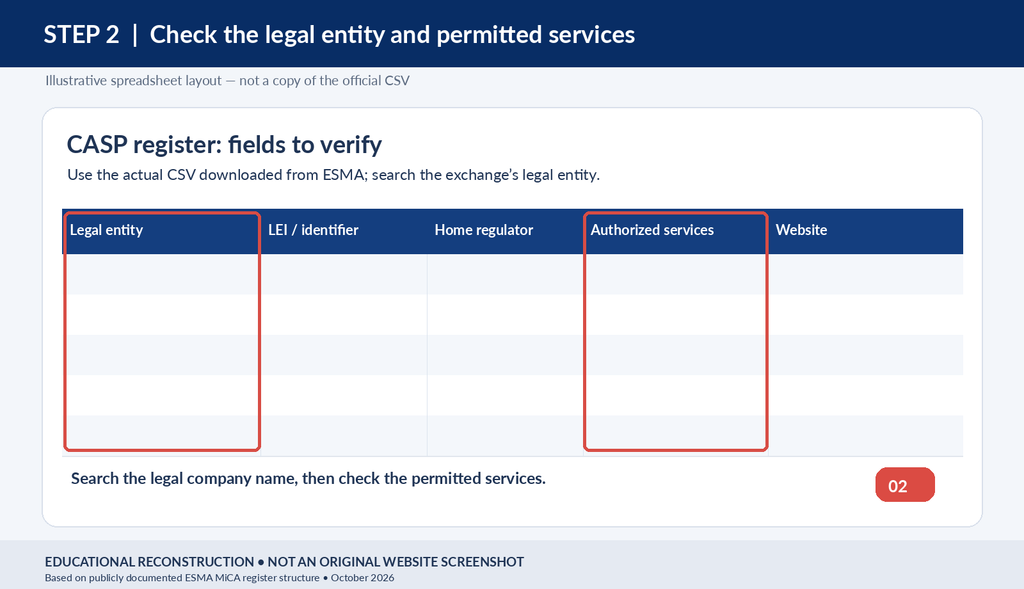
Look for the exchange’s legal company name rather than relying exclusively on its marketing brand.
For example, a cryptocurrency platform might advertise itself as “CryptoGlobal” while its European operating company is legally registered as “CryptoGlobal Europe GmbH.”
Searching only for the brand could produce an incomplete result.
Step 3: Find the Exchange’s Legal Entity
Visit the exchange’s official website and locate its legal documentation.
Useful pages include:
- Terms of Service
- Legal Notice
- Regulatory Information
- Privacy Policy
- Customer Agreement
Find the name of the company providing services to customers in your country.
Then search that exact name in the ESMA register.
Also check whether the exchange publishes a Legal Entity Identifier (LEI), a standardized identifier used to distinguish legal entities in financial markets.
If an LEI is available, compare it with the register entry.
Step 4: Verify the Competent Authority
CASP authorizations are granted or handled by the relevant national competent authority.
For example, depending on the member state, this could be a financial regulator in Germany, France, Austria, Malta, or another EU jurisdiction.
The ESMA entry should identify the relevant supervisory authority.
Check the regulator’s own website and authorization register to confirm that the company appears there.
This second verification is especially useful because ESMA explains that its published information may not immediately reflect the most recent updates from national regulators.
Step 5: Check Authorized Services and Countries
Finding a company in the register is not the end of the verification process.
Review the services it is permitted to provide and the countries covered by its cross-border activities.
If an exchange offers custody, spot trading, and portfolio management, verify the relevant authorizations rather than assuming one approval covers everything.
Also compare the official website listed in the register with the domain you intend to use.
A genuine license belonging to one company does not authorize another website to impersonate it.
What Information Should Match in the ESMA Register?
The ESMA crypto exchange register contains identifying and regulatory information intended to help users distinguish authorized providers from unrelated businesses.
MiCA License Verification Checklist
| Field | What You Should Verify |
|---|---|
| Legal entity name | Matches the company serving your account |
| Commercial name | Corresponds to the exchange brand |
| Legal Entity Identifier | Matches the company’s published LEI |
| Registered country | Consistent with corporate documentation |
| Competent authority | Recognized national financial regulator |
| Authorized services | Covers the products you intend to use |
| Official website | Matches the genuine exchange domain |
| Authorization status | Currently valid and applicable |
| Cross-border scope | Includes the relevant EU service arrangements |
A mismatch doesn’t automatically prove fraud.
Large cryptocurrency businesses may operate through multiple subsidiaries.
However, unexplained differences should be resolved before depositing funds.
Example: How to Verify a Crypto Exchange’s EU License
Consider a hypothetical exchange called EuroCrypto.
Its website states that it is “fully licensed in Europe.”
A customer in Spain wants to use the platform for BTC trading and crypto custody.
The customer identifies the following information.
| Verification Item | Example Result |
|---|---|
| Trading brand | EuroCrypto |
| Legal entity | EuroCrypto Europe Ltd. |
| Claimed licensing country | Malta |
| Claimed regulator | MFSA |
| ESMA register entry | Legal entity found |
| Authorized services | Trading platform and custody |
| Official website | Matches exchange domain |
| EU service coverage | Spain included |
This is a fictional example illustrating the verification process, not a real licensing record.
The exchange’s claim is supported only after the legal entity, regulator, services, and relevant cross-border arrangements have been checked.
Now consider a different outcome.
The legal entity exists in the register, but the website directs customers to a separate offshore company not covered by that authorization.
In that situation, the authorized European company may not be the entity responsible for the customer’s account.
A MiCA authorization held by one subsidiary should not be treated as blanket authorization for an entire corporate group.
MiCA License vs National Crypto Registration
One of the most common mistakes is confusing an older national cryptocurrency registration with full MiCA authorization.
Before MiCA, several EU countries maintained national registration systems for virtual asset service providers.
These registrations often focused on anti-money laundering requirements rather than the complete range of operational and investor protection rules introduced by MiCA.
Some existing businesses were allowed to continue operating temporarily while applying for MiCA authorization.
That transitional arrangement has now ended.
Regulatory Status Comparison
| Status | What It Means in October 2026 |
|---|---|
| MiCA CASP authorization | Authorization to provide specified regulated crypto services |
| Eligible Article 60 financial institution | May provide notified services under a separate MiCA route |
| Historical national VASP registration | Does not independently replace MiCA authorization |
| MiCA application submitted | Application is not approval |
| Company incorporation | Confirms company registration, not regulatory permission |
| Offshore crypto license | Does not automatically authorize EU crypto services |
The EU-wide transitional deadline expired on July 1, 2026.
An exchange that was previously permitted to operate under a national transitional regime cannot continue relying solely on that arrangement after the applicable deadline.
There is one additional distinction: certain already-regulated financial institutions can provide specified crypto services under MiCA Article 60, subject to its conditions and notification requirements, rather than obtaining the same authorization as an ordinary CASP.
For these entities, verify the relevant regulatory permissions and notification status rather than assuming that absence from one CASP list proves they are unauthorized.
What If an Exchange Is Missing From the ESMA Register?
An exchange’s absence from the register is an important warning sign, but it needs investigation.
ESMA receives authorization information from national authorities and updates the central register periodically.
A recently authorized company may not immediately appear in the published file.
There can also be differences between commercial names and registered company names.
Before reaching a conclusion:
- Search the company’s full legal name.
- Check alternative corporate names and its LEI.
- Verify the national regulator’s authorization records.
- Review whether the provider is an eligible financial institution using the Article 60 route.
- Ask the exchange for the exact entity and authorization details.
If the company cannot provide verifiable information, avoid relying on its claims of regulatory approval.
As of October 2026, simply saying that a MiCA application is pending is not sufficient evidence of authorization to provide services that require it.
How to Identify Fake MiCA Licenses and Exchange Scams
Fraudulent crypto businesses may copy genuine registration details to appear legitimate.
A common tactic is claiming to operate under the authorization of a real financial company.
Another involves displaying a fabricated license certificate or referencing an unrelated corporate registration.
Warning Signs of a Fake MiCA License
| Warning Sign | Why It Matters |
|---|---|
| License number cannot be verified | Authorization claim may be fabricated |
| Legal entity differs from account agreement | Another company may control customer funds |
| Website differs from official register | Possible impersonation or clone |
| Company claims an application is a license | Pending applications do not constitute approval |
| Only an offshore license is displayed | EU service authorization remains unverified |
| Guaranteed crypto returns are advertised | Potential investment fraud indicator |
| Withdrawals require an extra release fee | Common scam pattern |
A legitimate regulator does not require a user to share a wallet recovery phrase to verify an exchange’s license.
Likewise, a claim that funds cannot be withdrawn until an additional “MiCA verification tax” is paid should be treated with extreme caution.
If an exchange’s authorization details appear suspicious, contact the identified national regulator using contact information from its official website.
Does a MiCA License Mean an Exchange Is Safe?
MiCA authorization is an important regulatory distinction, but it is not a guarantee against financial loss.
Authorized CASPs must comply with applicable requirements involving governance, client assets, operational controls, and other obligations.
However, cryptocurrency investments remain volatile, and operational failures, cyberattacks, and market disruptions can still occur.
A MiCA-authorized exchange is not equivalent to an insured bank deposit account.
Crypto assets held through an exchange do not automatically benefit from conventional EU deposit guarantee protection.
Investors should also examine custody arrangements, withdrawal procedures, fee disclosures, cybersecurity controls, and the products offered.
Regulatory authorization is one component of due diligence, not a substitute for it.
What to Do Before Depositing Crypto on an EU Exchange
The final check should connect regulatory information with the actual service you intend to use.
Confirm that the company named in your customer agreement is the company whose authorization you verified.
Review which custody entity will hold your crypto assets and whether the intended service is covered.
Make sure you are using the official website and not a similarly named domain.
For a first transfer, a small test transaction can reduce the risk of an addressing mistake, although it doesn’t protect against exchange insolvency, fraud, or regulatory problems.
The main rule is simple: verify the legal entity and its authorization before sending funds, not after encountering a withdrawal problem.
Frequently Asked Questions
How can I check if a crypto exchange is MiCA licensed?
Open the official ESMA MiCA register, download the authorized CASP list, and search for the exchange’s legal entity. Verify its status, services, and regulator.
Is the ESMA crypto exchange register free?
Yes. ESMA provides public access to its regulatory register without a paid subscription.
Can a crypto exchange operate in the EU without a MiCA CASP license?
Certain regulated financial institutions can provide specified services through the Article 60 route. Otherwise, businesses providing services requiring CASP authorization generally need that authorization or another applicable legal basis.
Is a VASP registration the same as a MiCA license?
No. An older national VASP registration does not independently establish MiCA CASP authorization. The EU-wide transitional period ended on July 1, 2026.
Does MiCA authorization apply across the European Union?
CASPs can generally provide their authorized services across EU member states using the applicable cross-border notification arrangements.
Why can’t I find my exchange in the ESMA register?
Possible reasons include searching by brand rather than legal name, reporting delays, an applicable Article 60 notification route, or lack of authorization. Verify the details with the national regulator.
Does a MiCA license guarantee my crypto deposits?
No. Authorization provides a regulatory framework and associated safeguards but does not guarantee investment returns, eliminate custody risk, or automatically provide bank-style deposit insurance.
Can a fake exchange use a real MiCA license number?
Yes. Fraudsters can copy genuine authorization details. Always compare the legal entity, official website, regulator, and customer agreement.