Bitcoin, Ethereum, and tokenized company shares may all exist on blockchain networks, but that doesn’t make them the same type of financial asset under US law.
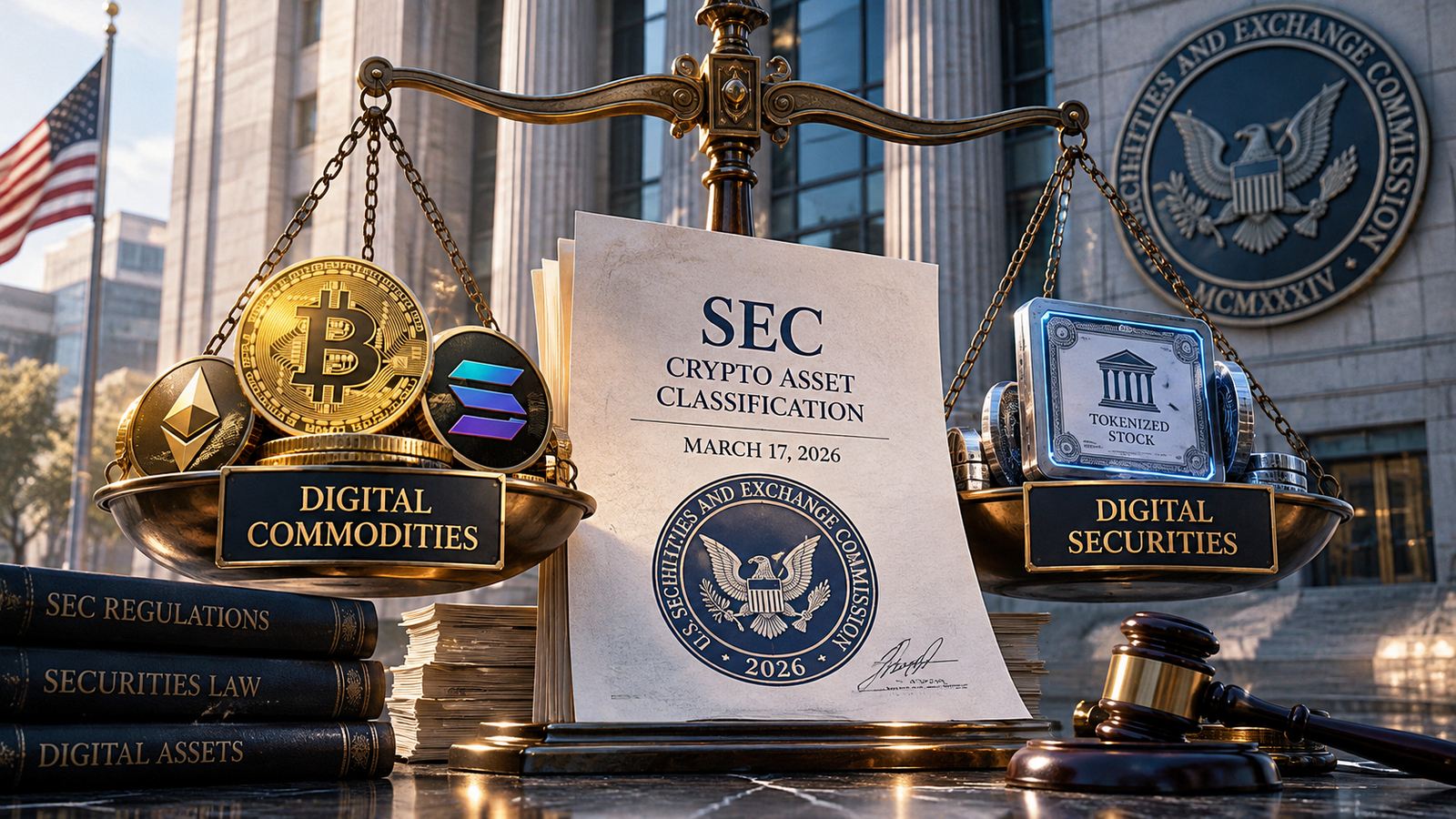
On March 17, 2026, the Securities and Exchange Commission (SEC) issued a major interpretation clarifying how federal securities laws apply to cryptocurrencies and transactions involving them.
The interpretation establishes five categories of crypto assets: digital commodities, digital collectibles, digital tools, stablecoins, and digital securities.
The Commodity Futures Trading Commission (CFTC) also provided guidance consistent with the SEC’s interpretation.
One distinction stands at the center of the new framework: a cryptocurrency may not itself be a security, even when its original sale involved an investment contract subject to securities regulation.
For token issuers, exchanges, and investors, understanding that difference is more useful than simply asking whether a particular cryptocurrency is a security.
What Changed in the SEC’s March 2026 Crypto Interpretation?
The SEC issued its interpretation on March 17, 2026, under Release No. 33-11412 and 34-105020. It became effective on March 23.
The guidance addresses which crypto assets fall within the federal definition of a security and when transactions involving otherwise non-security tokens can be regulated as securities transactions.
It also discusses airdrops, protocol staking, mining, and wrapping activities.
The interpretation doesn’t replace the Supreme Court’s Howey Test or eliminate the application of federal securities laws to token-related investments.
Instead, it explains how existing legal standards apply to different asset structures and transactions.
SEC Crypto Classification: Key Facts
| Regulatory Detail | March 2026 Interpretation |
|---|---|
| SEC issuance date | March 17, 2026 |
| Effective date | March 23, 2026 |
| Release numbers | 33-11412 / 34-105020 |
| Crypto asset categories | Five |
| Digital commodities | Generally not securities themselves |
| Digital collectibles | Generally not securities themselves |
| Digital tools | Generally not securities themselves |
| Stablecoins | Status depends on characteristics |
| Digital securities | Securities |
| Investment contracts | Evaluated under existing securities law |
This is a Commission-level interpretation rather than a new statute passed by Congress.
It provides regulatory guidance but does not prevent courts from independently applying federal securities laws.
SEC Crypto Token Taxonomy: Five Categories Explained
The SEC’s framework classifies crypto assets according to their characteristics, economic functions, and associated rights.
Not every token fits neatly into one category. Some may have overlapping features or require additional legal analysis.
SEC Crypto Asset Classification Table
| Category | Typical Examples | Securities Treatment |
|---|---|---|
| Digital commodities | BTC, ETH, SOL, XRP | Not themselves securities under the interpretation |
| Digital collectibles | Certain NFTs, digital artwork, collectibles | Generally not securities themselves |
| Digital tools | Membership tokens, tickets, credentials | Generally not securities themselves |
| Stablecoins | Dollar-pegged payment tokens | Depends on structure and applicable rules |
| Digital securities | Tokenized stocks, bonds, investment interests | Securities |
The classification concerns the characteristics of the underlying asset.
The terms of a transaction involving that asset may lead to a different regulatory result.
Digital Commodities: Bitcoin, Ethereum and Other Cryptocurrencies
Digital commodities are crypto assets associated with functional blockchain systems whose value derives from network operation and market supply and demand rather than an expectation of profits from essential managerial efforts by others.
The SEC explicitly identified several established cryptocurrencies as digital commodities in its March interpretation.
Examples include:
- Bitcoin (BTC)
- Ethereum (ETH)
- Solana (SOL)
- XRP
- Cardano (ADA)
- Avalanche (AVAX)
- Chainlink (LINK)
- Litecoin (LTC)
These examples are not an exhaustive list.
The classification reflects the SEC’s assessment of the assets’ characteristics and associated systems at the time of its interpretation.
Digital Commodity vs Security
A digital commodity may be valuable because people use, transfer, trade, or otherwise participate in the underlying crypto network.
A digital security, by contrast, represents an instrument that falls within the legal definition of a security.
For example, BTC operates as Bitcoin’s native cryptocurrency. It doesn’t represent shares in a company or provide holders with a contractual entitlement to corporate profits.
A tokenized corporate bond may provide contractual interest and repayment rights. Recording those rights on a blockchain doesn’t change their underlying financial nature.
This is why the presence of a blockchain is not enough to determine regulatory classification.
Which Crypto Assets Are Securities?
The clearest category is digital securities.
These are financial instruments that qualify as securities under existing law and are represented or recorded through blockchain technology.
Common examples include tokenized shares, bonds, and certain investment fund interests.
Examples of Digital Securities
| Tokenized Asset | Underlying Economic Right | Likely Treatment |
|---|---|---|
| Company shares | Equity ownership | Security |
| Corporate bond | Debt repayment and interest | Security |
| Tokenized fund interest | Rights in an investment fund | Security |
| Profit-sharing investment token | Contractual participation in profits | May be a security |
| Ordinary network utility token | Access to network functionality | Depends on asset and transaction characteristics |
A tokenized share remains a security even if it can be transferred between crypto wallets.
However, not every token referencing a company’s share price necessarily grants ownership of that share.
Synthetic products, derivatives, and other representations require examination of the actual legal and economic rights.
For investors, the central question is what the token legally represents, not whether its interface resembles a conventional cryptocurrency.
Why a Token Can Be Sold Through an Investment Contract
One of the most important aspects of the SEC crypto asset classification 2026 interpretation is the distinction between a token and the transaction through which it is distributed.
An asset that is not itself a security may still be offered or sold as part of an investment contract.
An investment contract is a type of security.
The SEC applies the Howey Test, established by the US Supreme Court, to determine whether a particular arrangement constitutes an investment contract.
The Four Elements of the Howey Test
| Element | Question |
|---|---|
| Investment of money | Did purchasers commit money or other consideration? |
| Common enterprise | Were their fortunes linked through a common arrangement? |
| Expectation of profits | Did purchasers reasonably expect financial returns? |
| Efforts of others | Were expected profits dependent on essential managerial efforts by others? |
Consider a hypothetical blockchain startup selling 100 million tokens.
The project tells buyers that its development team will build a trading platform, negotiate commercial partnerships, and create demand expected to increase the token’s market value.
Purchasers contribute funds based on those promises.
Even if the token itself doesn’t represent stock or a contractual share of profits, the initial sale may involve an investment contract.
The arrangement, including the issuer’s representations and commitments, matters.
Simply calling a token a utility token does not automatically exclude the offering from securities regulation.
Can a Crypto Token Stop Being Subject to an Investment Contract?
Yes. The March 2026 interpretation expressly addresses circumstances in which a non-security crypto asset separates from an investment contract under which it was previously sold.
This can occur when the issuer has fulfilled the relevant promises or when it becomes clear that the promised managerial efforts have been abandoned or cannot be fulfilled.
Suppose a project originally sold tokens to finance a network that had not yet launched.
Early buyers expected the development team to create the functioning system.
Several years later, the promised work has been completed, the network operates as intended, and the relevant managerial commitments have been fulfilled.
Under the SEC’s framework, the token may no longer be subject to the original investment contract.
The analysis depends on the facts, not merely the amount of time that has passed.
A token doesn’t automatically become exempt from securities laws because it trades on exchanges or because its issuer describes the network as decentralized.
Token vs Investment Contract: Practical Comparison
| Situation | Potential Securities Implication |
|---|---|
| Token sold with significant promises of future managerial work | Sale may involve an investment contract |
| Issuer still has essential unfulfilled promises | Investment contract obligations may continue |
| Relevant promised efforts fulfilled | Token may separate from investment contract |
| Token independently traded without a qualifying investment arrangement | Transaction may fall outside securities law |
| Token itself represents equity or debt | Underlying asset remains a security |
This distinction is particularly important for secondary-market trading.
The regulatory treatment of an early fundraising transaction isn’t automatically identical to every later exchange transaction involving the same asset.
How Are Stablecoins Classified Under SEC Rules?
Stablecoins receive separate treatment because their structures and associated rights can vary considerably.
The SEC doesn’t classify every stablecoin as a security or every stablecoin as a non-security.
Payment stablecoins meeting applicable requirements under the GENIUS Act generally fall outside securities classification under the relevant framework.
Other stablecoins may require additional analysis.
The legal treatment can depend on redemption rights, asset backing, promised returns, and the economic obligations of the issuer.
Stablecoin Classification Examples
| Stablecoin Structure | Regulatory Consideration |
|---|---|
| Qualifying payment stablecoin | Generally treated as a non-security |
| Token promising investment returns | Potential securities implications |
| Token representing an investment fund interest | May constitute a security |
| Algorithmic value-stabilization token | Requires examination of its actual characteristics |
| Yield-bearing stablecoin arrangement | Underlying rights and transaction terms matter |
The presence of a dollar peg doesn’t independently settle the question.
A token designed for payments and a token representing a claim on an investment portfolio can have different regulatory characteristics despite both targeting a $1 market value.
Are NFTs and Utility Tokens Securities?
The SEC distinguishes digital collectibles and digital tools from conventional investment securities.
Digital collectibles may include unique artwork, trading cards, and other assets intended for collection or use.
Digital tools can serve practical purposes such as tickets, credentials, membership access, or identity verification.
Under the March interpretation, these assets generally aren’t securities themselves.
However, specific arrangements can still raise securities issues.
For instance, fractionalized ownership interests in a collectible or an NFT program marketed around promised investment profits may require separate legal analysis.
A digital ticket providing admission to an event has a different economic purpose from a token sold through a scheme promising returns from the issuer’s future management.
The technology used to issue the token is less important than its actual rights and distribution structure.
What About Staking, Mining and Airdrops?
The SEC’s March interpretation also addresses common cryptocurrency distribution and network activities.
It discusses protocol mining, protocol staking, wrapping of non-security crypto assets, and certain airdrops.
These activities don’t automatically become securities transactions merely because crypto assets are received or distributed.
However, the details matter.
Ordinary protocol staking under the interpretation is different from a separate investment arrangement where an intermediary promises returns based on discretionary managerial activities.
Likewise, an airdrop must be evaluated based on its structure, consideration, and applicable investment-contract factors.
A broad statement that every staking product or token airdrop is exempt would go beyond the SEC’s interpretation.
What Does the SEC Classification Mean for Crypto Exchanges?
The framework gives exchanges and other market participants a clearer basis for identifying regulatory obligations.
Platforms handling digital securities may need to comply with the federal rules applicable to securities intermediaries.
Trading non-security digital commodities raises different regulatory questions, including the potential relevance of CFTC oversight.
However, classification alone doesn’t establish that an exchange may legally offer every asset or trading product.
Other laws may still apply, including anti-fraud requirements, sanctions, financial crime controls, and relevant derivatives regulations.
Regulatory Implications by Asset Type
| Asset Category | Main Compliance Question |
|---|---|
| Digital commodity | Which commodity and trading regulations apply? |
| Digital security | What securities registration or exemption rules apply? |
| Payment stablecoin | Does issuance meet applicable stablecoin regulation? |
| Digital collectible | Does the arrangement involve investment-contract features? |
| Digital tool | Is the token genuinely functional or sold through an investment scheme? |
The SEC’s interpretation does not automatically legalize every token offering or remove the need for transaction-specific legal analysis.
What Investors Should Check Before Buying a Token
Regulatory classification can influence where an asset trades, which disclosures are required, and what legal rights holders possess.
Before purchasing a token, investors should examine its actual economic structure.
Does it represent equity, debt, or another contractual claim? Is its value tied to an operating blockchain network? Does the issuer promise future managerial work intended to generate investment returns?
The issuer’s documentation and marketing materials may be as important as the token’s technical design.
Investors should also distinguish legal classification from investment quality.
A digital commodity can lose substantial value. A registered security can also be risky.
The absence of securities classification is not a guarantee of safety, legitimacy, or future price performance.
Frequently Asked Questions
Which crypto assets are securities under the SEC’s 2026 framework?
Digital securities, such as tokenized stocks, bonds, and qualifying investment interests, are securities. Other crypto assets may also be offered or sold through investment contracts subject to securities laws.
Is Bitcoin classified as a security in 2026?
No. The SEC’s March 2026 interpretation identifies Bitcoin as a digital commodity rather than a security itself.
Is Ethereum considered a security?
The SEC identifies ETH as a digital commodity under its March 2026 interpretation. Particular arrangements involving ETH may still require separate securities-law analysis.
Are all altcoins securities?
No. The SEC identifies several altcoins, including SOL, XRP, ADA, and AVAX, as digital commodities. Other tokens require examination of their characteristics and transaction structures.
What is the difference between a digital commodity and a digital security?
A digital commodity derives value from a functional crypto system and market demand. A digital security represents an instrument that meets the legal definition of a security, such as equity or debt.
Can a utility token be an investment contract?
Yes. A utility token that isn’t itself a security may be sold through an arrangement satisfying the Howey Test, particularly when purchasers rely on promised essential managerial efforts to generate profits.
Does the SEC’s 2026 interpretation replace the Howey Test?
No. The interpretation explains how existing federal securities laws and the Howey Test apply to crypto assets and related transactions.
Are stablecoins securities under US law?
Not necessarily. Qualifying payment stablecoins generally are not securities under the applicable framework, while other stablecoin structures may require additional legal analysis.