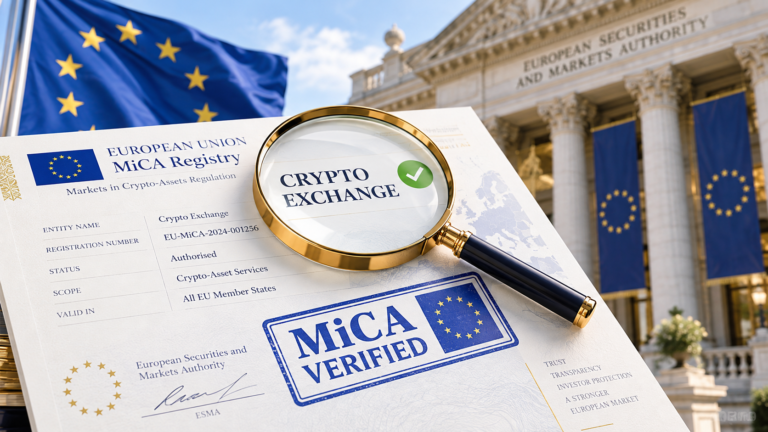

European cryptocurrency platforms face tighter restrictions on stablecoins that do not comply with the EU’s Markets in Crypto-Assets Regulation (MiCA).
On October 8, 2026, the European Securities and Markets Authority (ESMA) published a new opinion clarifying that authorized crypto-asset service providers should stop offering services involving non-compliant stablecoins to EU clients.
The restrictions extend beyond exchange listings. They cover trading, order execution, custody, transfers, and other regulated crypto services.
National regulators must ensure that remaining customer exposures are resolved as soon as possible, with January 8, 2027, serving as the outer deadline under ESMA’s three-month supervisory timetable.
For cryptocurrency holders, this creates an important distinction: a token becoming unavailable through an EU-regulated platform does not necessarily mean that holding it in a self-custody wallet is illegal.
What Changed Under MiCA in October 2026?
ESMA’s October 8 opinion strengthens the supervisory approach to stablecoins that do not satisfy MiCA requirements.
The regulation already established legal standards for stablecoin issuers. However, questions remained about how broadly restrictions should apply to services provided by exchanges, custodians, and other crypto businesses.
ESMA has now clarified that MiCA-authorized crypto-asset service providers (CASPs) should not facilitate access to non-compliant asset-referenced tokens (ARTs) or e-money tokens (EMTs).
The opinion covers services whether they are offered individually or combined with other cryptocurrency products.
MiCA Stablecoin Rules: Key Dates
| Date | Regulatory Development |
|---|---|
| June 30, 2024 | MiCA stablecoin issuer provisions begin applying |
| December 30, 2024 | Broader MiCA crypto service framework begins applying |
| January 17, 2025 | ESMA issues initial guidance on non-compliant stablecoins |
| July 1, 2026 | Final EU-wide CASP transitional period expires |
| October 8, 2026 | ESMA publishes expanded supervisory opinion |
| January 8, 2027 | Outer deadline for remediation of remaining exposures |
The January deadline does not represent the introduction of an entirely new stablecoin law.
MiCA’s underlying issuer requirements have been applicable since 2024. The October opinion explains how national regulators should enforce restrictions involving non-compliant tokens and existing customer holdings.
Which Stablecoins Are Covered by MiCA?
MiCA distinguishes between two main categories of regulated stablecoins.
E-money tokens reference the value of a single official currency, such as the US dollar or euro.
Asset-referenced tokens aim to maintain a stable value by referencing other values or rights, potentially including combinations of currencies or other assets.
EMT vs ART: Main Differences
| Feature | E-Money Token (EMT) | Asset-Referenced Token (ART) |
|---|---|---|
| Reference asset | One official currency | Other assets, rights or combinations |
| Example structure | USD-pegged stablecoin | Basket-backed stablecoin |
| Eligible issuer | Generally credit or electronic money institution | Authorized ART issuer or eligible credit institution |
| Reserve requirements | Applicable MiCA safeguarding and reserve rules | Dedicated reserve and asset-management requirements |
| Interest payments | Restricted | Restricted |
| Regulatory oversight | Applicable national and EU authorities | Applicable national and EU authorities |
Not every cryptocurrency described as a stablecoin automatically falls within the same category.
Its legal classification depends on how the token is designed and which value it intends to reference.
For dollar-pegged EMTs, compliant issuance generally requires an eligible authorized institution and the relevant documentation and disclosures.
A stablecoin’s popularity, liquidity, or history of maintaining its peg does not establish regulatory compliance.
What Happens to Non-MiCA-Compliant Stablecoins?
The most direct consequence is restricted access through regulated cryptocurrency platforms serving EU customers.
Under ESMA’s October opinion, authorized CASPs should not maintain, introduce, or facilitate access to non-compliant stablecoins as part of their normal services.
National authorities are expected to require technical, contractual, and organizational controls preventing customers from acquiring or increasing exposure to affected tokens.
How Different Crypto Services Are Affected
| Crypto Service | Expected Treatment |
|---|---|
| Spot trading | Normal trading access should cease |
| Crypto-to-crypto exchange | Acquiring affected tokens should be restricted |
| Order execution | Services involving affected assets should cease |
| Investment advice | Affected tokens should not be offered through normal advisory services |
| Portfolio management | Continuing exposure must be addressed |
| Custody | General ongoing services restricted; temporary safekeeping may support remediation |
| Transfers | Normal services restricted; limited transfers may support orderly withdrawal |
| Existing balances | Subject to supervised remediation |
This approach is broader than simply removing a trading pair from an exchange.
A platform cannot necessarily maintain access to a non-compliant stablecoin by transferring the activity into another regulated service category.
However, ESMA also recognizes the need to avoid disorderly customer losses.
Certain limited activities may continue temporarily when necessary to close, convert, withdraw, transfer, or safeguard existing positions.
Can EU Users Still Hold Non-Compliant Stablecoins?
The distinction between ownership and regulated services is particularly important.
ESMA’s October opinion addresses the conduct of authorized CASPs, rather than imposing a blanket prohibition on individuals possessing affected tokens.
A person holding a stablecoin in a self-custody wallet is not automatically required by this opinion to destroy or surrender the asset.
However, practical access can become more limited.
If regulated European exchanges stop supporting a particular stablecoin, the holder may find fewer options for converting it into euros, trading it against Bitcoin, or transferring it through custodial platforms.
A self-custody wallet may still technically support the token on its underlying blockchain.
That technical capability does not mean every exchange, payment provider, or regulated service must accept it.
Users should distinguish three separate questions:
- Can the token still exist and move on its blockchain?
- Can a regulated EU platform legally provide services involving it?
- Does a particular provider currently support deposits, withdrawals, or conversions?
The answers may differ.
What Happens to Existing Stablecoin Balances on Exchanges?
ESMA has instructed national regulators to ensure that remaining pre-existing exposures are addressed as quickly as possible.
The maximum supervisory remediation period is three months from the October 8 opinion, making January 8, 2027, the relevant outer deadline.
During this period, certain services may remain available strictly for dealing with existing holdings.
These can include liquidation, conversion, withdrawal, transfer, and temporary safekeeping.
Such arrangements must be time-limited, risk-based, and supervised.
Example: Holding 5,000 Non-Compliant Stablecoins
Suppose an EU customer holds 5,000 units of a dollar-pegged stablecoin on a regulated exchange.
The exchange determines that the token does not comply with MiCA and announces restrictions.
| Action | Potential Availability |
|---|---|
| Buy another 1,000 tokens | Expected to be blocked |
| Open a new trading position | Expected to be restricted |
| Convert existing tokens to a supported asset | May be allowed for remediation |
| Withdraw to a supported external wallet | May be allowed during wind-down |
| Continue holding indefinitely on the exchange | Not guaranteed |
| Transfer through the platform after the deadline | May be unavailable |
The available choices depend on the exchange’s implementation and supervisory requirements.
An exchange might impose an earlier deadline than January 8.
Customers should therefore consult their provider’s official notices rather than assume every service will remain available until the final date.
Are USDT and Other Dollar Stablecoins Banned in Europe?
No general statement that all dollar stablecoins are banned in Europe would accurately describe MiCA.
The regulation establishes compliance requirements rather than prohibiting stablecoins solely because they reference the US dollar.
An issuer meeting the applicable requirements can offer qualifying stablecoin products under the EU framework.
Tether’s USDT is a prominent example of a dollar-pegged token that has faced restrictions on MiCA-regulated European platforms because its issuance has not obtained the relevant MiCA authorization.
However, the October 8 ESMA opinion does not provide an exhaustive blacklist naming every affected stablecoin.
Compliance must be evaluated through the issuer’s legal status, token classification, and applicable regulatory requirements.
The same caution applies when comparing different versions or representations of a stablecoin across blockchains.
A wrapped or bridged token with a familiar ticker should not automatically be assumed to have the same legal or operational status as an authorized issuer’s native token.
What Must Crypto Exchanges and CASPs Do?
For regulated platforms, the ESMA opinion creates several operational priorities.
CASPs must identify non-compliant ARTs and EMTs available through their services and prevent customers from acquiring or increasing exposure.
They should also establish procedures for resolving existing holdings.
Depending on the platform, compliance measures may involve changes to trading systems, order routing, custody arrangements, transfer controls, and customer communications.
CASP Compliance Checklist
| Requirement | Practical Implementation |
|---|---|
| Identify affected tokens | Verify issuer authorization and token classification |
| Restrict new exposure | Disable relevant purchase and acquisition functions |
| Review trading services | Remove non-compliant access |
| Address custody | Establish supervised wind-down procedures |
| Manage existing balances | Provide permitted remediation routes |
| Notify customers | Explain restrictions and applicable deadlines |
| Maintain controls | Prevent indirect access through integrated services |
These are operational interpretations of ESMA’s expectations, not a universal software checklist prescribed for every exchange.
National competent authorities remain responsible for supervising implementation within their jurisdictions.
The objective is to prevent non-compliant stablecoins from continuing to reach EU customers through regulated service channels.
Why ESMA Expanded the Restrictions
The October 2026 opinion addresses concerns that limiting restrictions to new token listings or direct sales might leave other methods of accessing non-compliant stablecoins available.
An exchange might stop offering a stablecoin for spot purchases while still supporting it through transfers, custody, or other integrated services.
ESMA’s position is that the same underlying compliance concern applies across the regulated service categories.
The broader approach aims to prevent inconsistent enforcement and regulatory circumvention.
It also reinforces MiCA’s underlying issuer requirements involving governance, asset backing, redemption rights, and consumer protection.
For stablecoin issuers, maintaining access to the EU market increasingly depends on having an appropriate regulatory structure rather than relying solely on exchange distribution partnerships.
Could MiCA Stablecoin Restrictions Affect Crypto Liquidity?
Removing access to major stablecoin trading pairs can change market structure on European cryptocurrency platforms.
Stablecoins frequently act as settlement assets and quote currencies for Bitcoin, Ethereum, and other cryptocurrencies.
If an exchange replaces a non-compliant stablecoin pair with an authorized alternative, liquidity may shift between instruments.
Some traders may incur conversion expenses or experience wider bid-ask spreads during the transition.
Consider a hypothetical exchange where a stablecoin trading pair generates $200 million in daily volume.
If that pair is discontinued, the $200 million does not necessarily disappear from the market.
Some activity may migrate to other stablecoin pairs, euro pairs, or alternative trading venues.
The actual impact depends on available liquidity, customer demand, trading fees, and the restrictions applicable to each platform.
It would therefore be misleading to equate the removal of a trading pair with an equivalent loss of cryptocurrency market capitalization.
What EU Stablecoin Holders Should Check Before January 2027
Users holding affected assets through custodial platforms should review their provider’s published instructions.
Important details include the final supported trading date, available conversion methods, withdrawal deadlines, supported blockchain networks, and transaction costs.
Before transferring tokens, verify that the destination supports the exact asset and network.
A wallet displaying a token does not guarantee that an exchange can accept deposits of that token.
Customers should also beware of phishing messages claiming that MiCA requires them to connect a wallet or share a recovery phrase to unlock funds.
Legitimate regulatory remediation does not require revealing private keys or seed phrases.
The main practical concern is preserving access to existing holdings while regulated providers complete their compliance procedures.
Frequently Asked Questions
Are stablecoins banned under MiCA in 2026?
No. MiCA regulates stablecoin issuance and related crypto services. Stablecoins that satisfy applicable requirements can continue operating within the EU framework.
What did ESMA announce on October 8, 2026?
ESMA clarified that MiCA-authorized crypto service providers should cease services involving non-compliant asset-referenced and e-money tokens, including trading, transfers, and custody, subject to limited remediation activities.
What is the deadline for non-compliant stablecoins?
ESMA expects remaining pre-existing exposures to be resolved as soon as possible and no later than three months after October 8, 2026, establishing January 8, 2027, as the outer supervisory deadline.
Can I keep non-compliant stablecoins in a private wallet?
The ESMA opinion does not impose a blanket prohibition on individual self-custody holdings. However, access to regulated trading, custody, conversion, and transfer services may be restricted.
Does MiCA prohibit USDT everywhere in Europe?
No. The regulatory issue concerns compliance and access through regulated EU services, not an automatic technical prohibition on the token’s existence or blockchain transfers.
Can exchanges still allow withdrawals of affected stablecoins?
Limited withdrawals and transfers may be permitted during a supervised remediation period. Availability depends on the platform and applicable regulatory requirements.
Will non-compliant stablecoins lose their dollar peg?
Regulatory restrictions do not automatically cause depegging. However, reduced access to trading or redemption services could affect liquidity and market pricing under certain conditions.
Are all EU crypto exchanges subject to these restrictions?
The October opinion specifically addresses MiCA-authorized CASPs and national regulatory supervision. The broader MiCA framework determines which service providers may legally serve EU clients.