
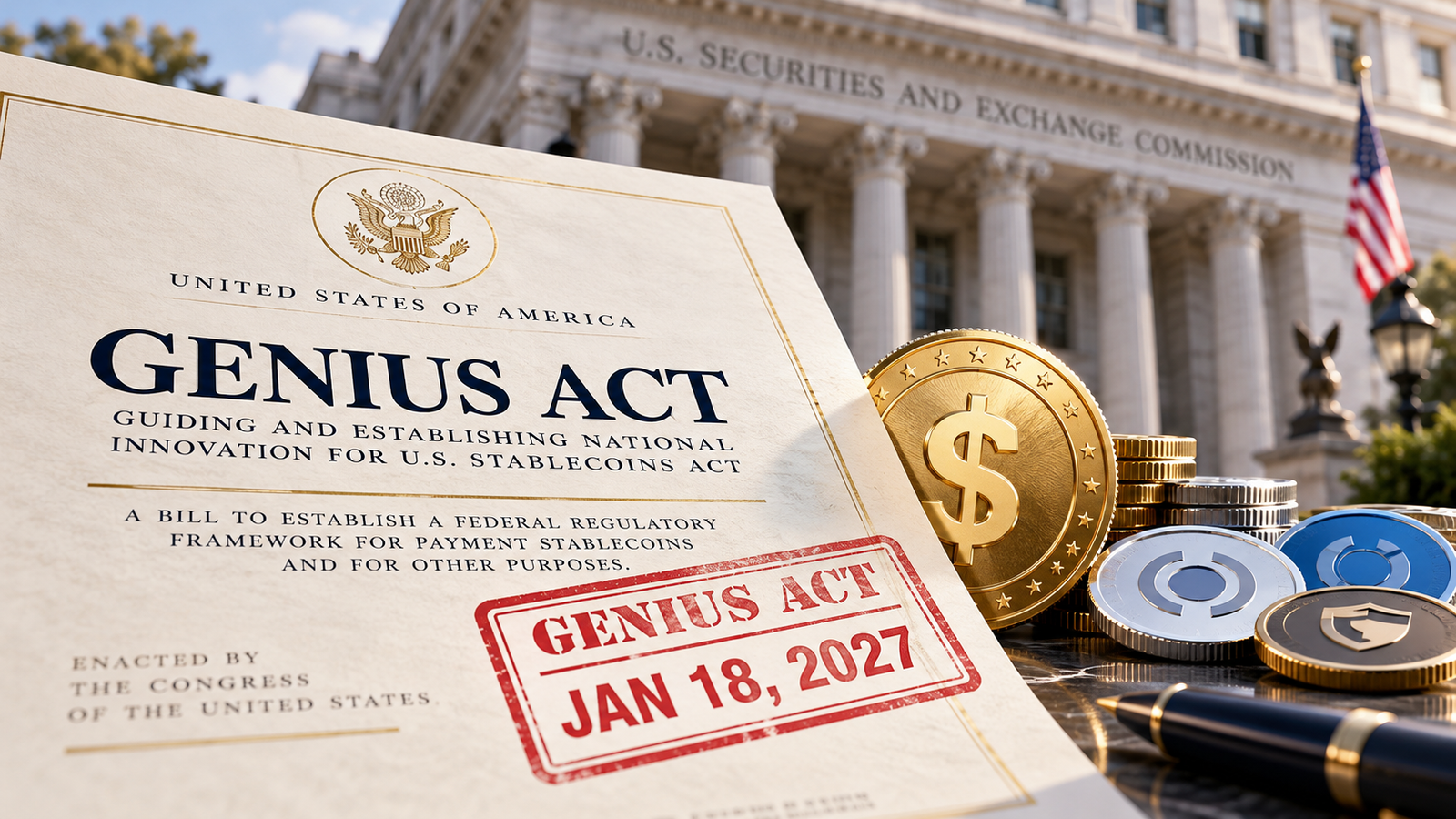
The Office of the Comptroller of the Currency (OCC) has finalized its regulatory framework for US payment stablecoins, setting January 18, 2027, as the date when new federal requirements take effect.
Announced on October 21, 2026, the final rule establishes detailed standards for reserve assets, redemption rights, issuer risk management, supervision, and custody. It also clarifies how restrictions on stablecoin interest and rewards will operate.
The decision marks a significant step in implementing the GENIUS Act, which became law in July 2025.
For stablecoin issuers, the changes extend beyond holding enough dollar-denominated assets to back outstanding tokens. Companies will need appropriate regulatory authorization, operational safeguards, reporting systems, and mechanisms for meeting redemption requests.
The rules could reshape how dollar-backed stablecoins compete with conventional payment services, particularly where issuer-funded rewards and reserve management are concerned.
What Did the OCC Finalize on October 21?
The OCC issued its final rule on October 21, 2026, following a public consultation that began earlier in the year.
The regulation implements major portions of the Guiding and Establishing National Innovation for U.S. Stablecoins Act, commonly called the GENIUS Act.
Most of the new requirements appear in 12 CFR Part 15, with related changes to banking regulations.
The framework applies to payment stablecoin issuers and certain custody activities under OCC jurisdiction, including eligible bank subsidiaries, federally approved nonbank issuers, and relevant foreign issuers.
GENIUS Act Implementation: Key Facts
| Regulatory Milestone | Date or Requirement |
|---|---|
| GENIUS Act signed into law | July 18, 2025 |
| OCC proposed implementation rule | February 25, 2026 |
| OCC final rule announced | October 21, 2026 |
| Final rule published | October 23, 2026 |
| Rules become effective | January 18, 2027 |
| Reserve backing | At least 100% with permitted assets |
| Standard redemption deadline | Generally within two business days |
| Issuer-paid interest or yield | Prohibited under specified statutory conditions |
| Separate AML and sanctions regulations | Additional rulemaking required |
The final rule covers most of the OCC’s implementation responsibilities, but it does not complete every aspect of stablecoin regulation.
Bank Secrecy Act, anti-money laundering, and sanctions-related provisions will be addressed through separate rulemaking coordinated with the Treasury Department.
GENIUS Act vs OCC Final Rule: What’s the Difference?
The GENIUS Act is federal legislation passed by Congress and signed into law.
It establishes the legal framework for issuing and regulating payment stablecoins in the United States.
The OCC final rule translates the statutory requirements into operational standards for entities subject to the agency’s jurisdiction.
This distinction matters because the OCC is not creating an entirely new law. It is defining how existing statutory obligations will be implemented, supervised, and enforced.
| Area | GENIUS Act | OCC Final Rule |
|---|---|---|
| Issuer authorization | Establishes eligible issuer categories | Specifies licensing and registration procedures |
| Reserves | Requires qualifying 1:1 backing | Details reserve management and risk controls |
| Redemption | Establishes redemption obligations | Defines operational deadlines and procedures |
| Holder rewards | Restricts issuer-paid interest and yield | Clarifies application and anti-evasion treatment |
| Supervision | Assigns regulatory responsibilities | Establishes examination and reporting standards |
| Enforcement | Creates statutory obligations | Provides OCC supervisory implementation |
Not every US stablecoin issuer will be directly supervised by the OCC.
The broader framework also includes state regulatory arrangements and responsibilities assigned to other federal authorities.
Stablecoin Reserve Requirements: What Changes?
Reserve backing is a central feature of the new regulatory framework.
Permitted payment stablecoin issuers must maintain identifiable reserve assets equal to at least the outstanding value of their payment stablecoins.
Eligible reserves are limited to specified high-quality, liquid assets, including qualifying cash balances, short-term US Treasury instruments, and other instruments permitted under the law.
The purpose is to support redemptions without requiring issuers to rely on volatile cryptocurrency holdings or speculative investments.
The OCC rule also establishes requirements addressing reserve liquidity, diversification, custody, recordkeeping, and risk management.
Issuers must demonstrate that they can access and convert reserve assets into funds when redemption demand increases.
Example: Reserve Backing for $1 Billion in Stablecoins
Consider an issuer with 1 billion outstanding dollar-pegged stablecoins, each carrying a $1 redemption value.
| Metric | Illustrative Amount |
|---|---|
| Outstanding stablecoins | 1 billion tokens |
| Redemption value per token | $1 |
| Total outstanding issuance value | $1 billion |
| Minimum required reserve value | $1 billion |
| Example reserve portfolio | $1.02 billion |
| Reserve coverage ratio | 102% |
The minimum backing requirement is 100%.
A 102% reserve coverage ratio would provide an additional $20 million in assets above the minimum, assuming all assets qualify and are measured according to applicable rules.
That surplus does not eliminate liquidity risk.
A portfolio can satisfy its nominal backing requirement while still facing operational difficulties if reserve assets cannot be accessed or monetized quickly enough.
The final rule therefore emphasizes liquidity management rather than reserve size alone.
Stablecoin Redemption Rules: Two-Business-Day Standard
The OCC final rule establishes a clearer operational standard for stablecoin redemption.
Permitted issuers must generally process redemption requests within two business days.
The rule defines redemption timing by reference to when the issuer completes the necessary processing and initiates the transfer of monetary value, or credits the customer’s account when applicable.
This distinction is important.
Initiating an outgoing bank transfer is not necessarily the same as the customer’s bank receiving and making the funds available.
Issuers must also disclose their redemption policies and applicable conditions.
Restrictions on redemption are subject to regulatory requirements rather than unrestricted issuer discretion.
Redemption Example
Suppose a customer submits a valid redemption request for 100,000 payment stablecoins on a Monday, with no intervening public holidays or other applicable exceptions.
Under the ordinary two-business-day standard, the issuer would generally need to complete the required redemption processing and initiate payment by Wednesday.
This example assumes the request satisfies the issuer’s valid redemption procedures.
Exceptional circumstances may involve regulatory intervention or permitted adjustments.
The standard should not be interpreted as a guarantee that every secondary-market token holder can instantly exchange stablecoins for dollars through any trading platform.
Will Stablecoin Issuers Be Allowed to Pay Interest?
The treatment of stablecoin rewards is among the most commercially important parts of the GENIUS Act implementation.
The law prohibits permitted payment stablecoin issuers from paying interest or yield to holders solely in connection with holding, using, or retaining payment stablecoins.
The prohibition applies regardless of whether the compensation is denominated in cash, tokens, or another form of consideration.
It also applies to institutional and retail holders.
However, the OCC made an important change between its proposed and final rules.
OCC Removes Proposed Third-Party Rewards Presumption
The earlier proposal included a rebuttable presumption concerning certain arrangements where affiliates or related third parties distributed rewards linked to an issuer.
The final rule removes that presumption.
This does not mean every third-party stablecoin rewards program is automatically permitted.
The OCC retains authority to investigate arrangements designed to evade the statutory prohibition.
It also declined to create a general safe harbor for existing rewards programs.
How Different Stablecoin Rewards May Be Treated
| Reward Arrangement | Regulatory Consideration |
|---|---|
| Issuer pays interest for holding its stablecoin | Prohibited under the statutory yield restriction |
| Issuer pays yield solely for stablecoin use or retention | Subject to the prohibition |
| Independent third-party rewards | Require examination of funding and arrangements |
| Merchant discount or transaction rebate | Depends on economic substance and structure |
| Separate lending or investment activity | Requires analysis under applicable laws |
| Rewards funded indirectly by issuer arrangements | Potential anti-evasion concerns |
The practical question is not simply who sends the reward.
Regulators may examine the economic substance of the arrangement, contractual relationships, and whether payments effectively circumvent the law.
For stablecoin businesses, this could influence the design of loyalty programs, payment incentives, and distribution partnerships.
New Supervision, Reporting and Capital Requirements
The OCC final rule expands the operational expectations placed on regulated payment stablecoin issuers.
Companies must maintain risk-management systems appropriate to their business model, financial condition, and operational complexity.
This includes controls relating to reserve assets, liquidity, custody, governance, and financial reporting.
The rule also establishes requirements for audits, regulatory examinations, and capital and operational backstops.
Rather than applying a single uniform business model to every stablecoin issuer, the OCC uses a supervisory framework that accounts for different types of institutions and risk profiles.
Main Compliance Areas
| Requirement | Purpose |
|---|---|
| Reserve reporting | Verify backing and reserve composition |
| Risk management | Address operational and financial vulnerabilities |
| Independent audits | Assess financial information and controls |
| Custody safeguards | Protect qualifying reserve and customer assets |
| Capital backstop | Support issuer resilience |
| Regulatory examinations | Monitor continuing compliance |
| Foreign issuer oversight | Apply relevant standards to overseas issuers |
These requirements could increase compliance costs, particularly for smaller nonbank issuers.
At the same time, a more defined federal framework may reduce legal uncertainty for institutions considering payment stablecoin products.
What Happens on January 18, 2027?
The GENIUS Act and OCC implementing rule become effective on January 18, 2027.
From that date, issuing payment stablecoins in the United States generally requires appropriate authorization under the statutory framework.
Operating without the required approval can carry criminal penalties.
The OCC has also issued guidance for existing issuers that may need additional time to complete their applications.
Certain eligible applicants with substantially complete applications pending by the effective date may request temporary waivers.
Those waivers are not automatic and can extend for no more than 12 months from January 18, 2027, under the applicable statutory provisions.
The OCC will separately announce its application and waiver submission procedures.
Implementation Timeline
| Date | Development |
|---|---|
| July 18, 2025 | GENIUS Act enacted |
| February 25, 2026 | OCC proposed rule announced |
| October 21, 2026 | OCC final rule announced |
| October 23, 2026 | Rule published in Federal Register |
| January 18, 2027 | Statute and OCC rule effective |
| Up to January 18, 2028 | Maximum duration of qualifying temporary waivers |
A potential waiver does not provide blanket permission for every existing stablecoin issuer to operate without authorization.
Eligibility and approval remain subject to regulatory conditions.
What the GENIUS Act Rules Mean for USDC, USDT and Other Stablecoins
The new framework may influence the operating structures of major dollar-backed stablecoins, including USDC and USDT.
However, the consequences will depend on each issuer’s legal structure, licensing arrangements, reserve management, and US distribution model.
US-based issuers may need to demonstrate compliance with applicable federal or state requirements.
Foreign issuers face additional regulatory conditions when offering qualifying payment stablecoins to US users.
The rules may also affect relationships between stablecoin issuers, crypto exchanges, custodians, and payment providers.
For users, the most relevant changes involve clearer reserve standards, redemption procedures, issuer disclosures, and supervisory accountability.
But regulatory compliance should not be confused with an unconditional government guarantee.
Payment stablecoins remain exposed to operational failures, market-price deviations, custody arrangements, and other risks.
The framework does not automatically turn stablecoin balances into federally insured bank deposits.
Could the OCC Stablecoin Rules Affect Crypto Markets?
The regulation could have several longer-term effects.
More standardized reserve requirements may increase demand for eligible short-term dollar assets as regulated stablecoin issuance expands.
Clearer licensing procedures may encourage additional financial institutions to enter the payment stablecoin market.
Meanwhile, restrictions on issuer-funded yield could change the competitive economics of stablecoin products.
Compliance expenses may also influence which businesses can operate profitably under the framework.
None of these outcomes is guaranteed.
The market impact will depend on adoption, enforcement, issuer decisions, interest rates, and how the remaining federal and state regulations develop.
For investors, the immediate significance is greater regulatory clarity rather than a direct price signal for Bitcoin, Ethereum, or individual stablecoins.
Frequently Asked Questions
When do the GENIUS Act stablecoin rules take effect?
The GENIUS Act and OCC final implementing rule take effect on January 18, 2027.
What did the OCC finalize in October 2026?
The OCC finalized standards covering payment stablecoin reserves, redemptions, risk management, custody, issuer supervision, licensing, and related regulatory requirements.
Do stablecoins need 100% reserve backing under the GENIUS Act?
Permitted payment stablecoin issuers generally must maintain qualifying reserves equal to at least the outstanding value of their payment stablecoins.
Can stablecoin issuers pay holders interest in 2027?
The GENIUS Act prohibits issuer-paid interest or yield solely related to holding, using, or retaining payment stablecoins. Third-party arrangements require separate analysis and are not automatically prohibited or permitted.
How quickly must stablecoin issuers process redemptions?
The OCC rule generally requires valid redemption requests to be processed within two business days, subject to applicable requirements and exceptions.
Does the GENIUS Act make USDC and USDT risk-free?
No. Regulatory standards may reduce certain risks, but they do not eliminate issuer, custody, liquidity, operational, or market risks.
Are existing stablecoin issuers automatically exempt?
No. Certain qualifying applicants may request temporary waivers, but eligibility depends on statutory conditions and regulatory approval.
Is the OCC final rule the entire GENIUS Act framework?
No. It implements major requirements for entities under OCC jurisdiction. Other regulators have separate responsibilities, and additional AML and sanctions-related rulemaking remains necessary.